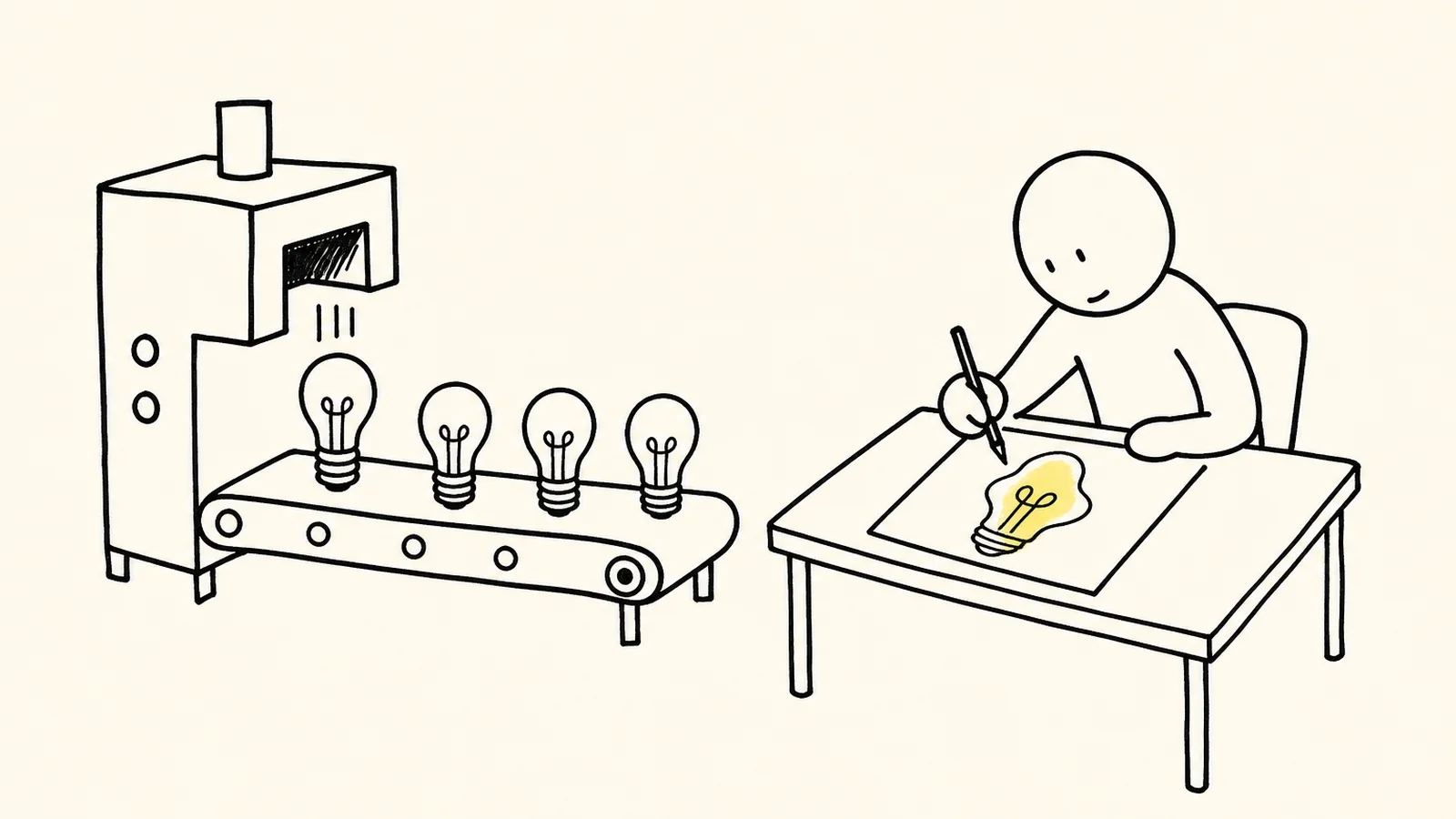
AI and creativity are linked in two opposite ways. Controlled studies since 2024 find that AI ideas make individual work more creative, especially for people starting from a lower baseline, while making different people's ideas more alike. In a 2024 story-writing experiment, writers with access to AI ideas scored 8.1% higher for novelty, but their stories were more similar to one another. A 2025 meta-analysis of 28 studies found a modest gain in performance alongside a large drop in idea diversity. A 2025 brainstorming study found that 94% of AI-assisted toy ideas overlapped, and a 2025 experiment with 1,100 people found the sameness persisted after the AI was removed, even when it had offered strategies rather than ideas. The practical answer is order: generate your own options first, use AI to widen and critique them, and make the final choice yourself. Creativity has two halves, generating and choosing, and AI is safest in the second.
On this page+
AI and creativity are linked in two opposite ways at once. Studies since 2024 find that AI ideas make a single piece of work better, most of all for people who score lower on creativity tests, while making everyone's ideas more alike. Which effect you get depends mostly on when you bring the tool in.
Most writing on the subject ends in the same place: treat AI as a collaborator, not a replacement. That is easy to agree with and hard to act on, because it never says at which stage of the work the collaborator should show up. The research is more specific than the advice. Creativity has two halves, coming up with options and choosing between them, and AI affects each half differently.
This piece walks through what the studies found, why ideas made with AI drift toward each other, what happens after you stop using it, and a sequence for creative work that keeps the first idea yours.
How does AI affect creativity?
AI makes individual work more creative on average and makes the work of different people more similar. Both effects show up in the same experiments, which is why the debate about AI and creativity so often talks past itself.
The clearest example is a 2024 study by Anil Doshi of UCL and Oliver Hauser of the University of Exeter1. They asked 300 people to write an eight-sentence story for young adults. One group wrote alone, one could get a single starting idea from an AI, and one could choose from up to five. Six hundred readers then judged the stories. Writers with the most AI access scored 8.1% higher for novelty and 9% higher for usefulness.
The gains landed unevenly. Writers who had scored lowest on a creativity test beforehand improved most, with stories rated up to 26.6% better written and 15.2% less boring, enough to bring them level with the most creative writers. The most creative writers gained nothing measurable. And stories built on a single AI idea were 10.7% more similar to one another than stories written alone.
A 2025 meta-analysis by Niklas Holzner and colleagues pooled 28 studies with 8,214 participants and found the same shape at a larger scale2. People working with AI outperformed people working alone by a modest margin (an effect size of 0.27), while the diversity of their ideas fell by a large one (an effect size of -0.86).
Level
What tends to go up with AI
What tends to go down with AI
One piece of work
Novelty and usefulness ratings, polish
Little, for people who were already strong
One person over time
Output while the tool is open
Unaided performance afterwards
A group of people
Average quality
Idea diversity: the range of what gets made
So the AI impact on human creativity depends on what you measure. Judge one story and AI looks like a clear gain. Judge the whole pile and you notice the pile is narrower.
Can AI be creative on its own?
On standard creativity tests, yes, in a measurable sense: AI beats the average person and does not beat the best people.
In a 2023 study in Scientific Reports, Mika Koivisto and Simone Grassini compared 256 people with three AI chatbots on the alternate uses task, the most common test of divergent thinking, in which you list unusual uses for an everyday object3. On average the chatbots scored higher, partly because people produce weak ideas alongside good ones, while the chatbots' answers were more consistently creative. But the best human ideas matched or beat the best machine ones. The Holzner meta-analysis found no significant difference between AI working alone and people working alone.
Whether that counts as creativity is an open argument. One side says novel, useful output is all creativity has ever meant. The other says it needs intention, a reason to make this thing rather than another, and a model has no reason of its own. We do not think it is settled, and for you it may not matter much: can artificial intelligence be creative enough to change your work? Clearly. The question worth asking about AI and creativity is what happens to yours, and creating something new sits at the top of most models of higher order reasoning skills.
Why do ideas made with AI start to look the same?
Because the AI tends to offer its most likely idea first, and whatever idea you see first becomes the one you build on.
Lennart Meincke, Gideon Nave and Christian Terwiesch at Wharton ran five brainstorming experiments, published in Nature Human Behaviour in 20254. In one, participants invented a toy using a brick and a fan. Among people brainstorming with a chatbot, 94% of the ideas shared overlapping concepts, and nine people independently named their toy "Build-a-Breeze Castle". The ideas from people working without it were all different from each other. Across the five experiments, 37 of 45 comparisons showed a significant drop in idea diversity.
Two forces add up here. A language model is built to produce likely continuations, so when a thousand people ask it for a toy made from a brick and a fan, it hands them neighboring answers. Then anchoring does the rest: once a decent idea is on the screen, most people edit it instead of replacing it. Editing feels like contributing, and it is, but inside a space someone else picked.
The pattern we see in sessions points the same way. When someone writes down what they are trying to make before anything is suggested, the first ideas on the page tend to be specific and a little strange. Those are the ideas that get edited away when a suggestion arrives first.
Does using AI make you less creative later?
There is early evidence that it can, at least in the short run, and that the sameness lingers after the tool is gone.
Harsh Kumar, Ashton Anderson and colleagues ran two pre-registered experiments with 1,100 participants, presented at CHI 20255. People worked through several rounds of either a divergent task (new uses for a tire, a shoe, a bottle) or a convergent one (find the word that links three others). Some got AI ideas or answers, some got AI strategies in the style of a coach, and some got nothing. Then everyone did a final round alone.
During the assisted rounds, AI helped. In the unaided rounds, the people who had never had it tended to do best, though not every gap was statistically significant. Two results stand out. On the word-linking task, people who had been given AI guidance scored 10.6 percentage points lower unaided than people who had worked alone. And people given AI strategies for the uses task kept producing more similar ideas after the AI was taken away.
That second result matters, because coach-style AI is the usual fix people propose. In this experiment, a method supplied by the model still steered where people looked. It fits a wider pattern about skills that go unpracticed, which we covered in what GenAI does to the skills you skip. These were short experiments, and nobody yet knows how the effect behaves over years.
What AI shapes most is whatever you see first.
How do you use AI for creative work and keep the ideas yours?
Generate first, alone. Bring AI in to widen and test your list. Make the final choice yourself.
The research on AI and creativity points to that order because creativity has two halves. Divergent thinking produces options; convergent thinking picks one and makes it work. The evidence above says AI is riskiest in the first half, because what it shows you narrows what you go on to think of. It is much safer in the second half, where your options already exist and the job is to put pressure on them.
Write your own list before opening anything. Ten ideas, four minutes, no tool. Quantity over quality; the strange ones count.
Ask AI what your list is missing, not for its own list. "Here are my ten. What kinds of idea have I not tried?" keeps your ideas as the reference point.
Ask it to attack your favorites. Which would fail first, and why? This is the checker role from our guide to the best ways to use AI: you attempt, it critiques.
Choose without it. The pick depends on what you are trying to make and for whom, and only you know that. Decide what would settle the choice before you start comparing, or choosing turns into overanalyzing.
Most people find the overlap larger than they expected, and their uncircled ideas rougher but more interesting. That is AI and human creativity in miniature: the machine supplies the likely ideas, quickly, and the unlikely ones were already yours.
We built Inwitt AI to stay out of the first half entirely. It is an AI thinking partner app that never suggests the idea. It asks one question at a time (what are you trying to make, who is it for, what would make it wrong) and draws your answers on a thinking board, so your own options sit in front of you. To be plain about the evidence: we found no controlled study yet of an AI that only asks questions during creative work. The studies above show what happens when it supplies ideas or methods. Questions are our bet on keeping the first idea where it started.
Common mistakes when using AI for creative work
Most mistakes with AI and creativity come from using AI in the generating half when it belongs in the choosing half.
Opening the tool before the blank page. The first idea you see becomes the anchor. Make it one of yours.
Asking for ideas when you want feedback. "Give me twenty slogans" and "What is weak about these five slogans?" are different jobs, and only the second keeps you as the author. As with AI and critical thinking, whoever asks the questions ends up doing the thinking.
Mistaking polish for novelty. In the story study, AI help made writing better written and less boring. Clean sentences around a familiar idea still leave a familiar idea.
Judging the piece instead of the set. Your draft can improve while your range shrinks. Look back over a month of work, not one result.
Treating a strategy list as neutral. A framework the model hands you is still the model's framing. In the Kumar experiment, it narrowed ideas even after the AI was gone.
Questions people ask about AI and creativity
Will AI replace human creativity?
Not on the evidence so far. AI matches the average person on creativity tests but not the best, and its biggest effect is on range: it pulls ideas toward the middle. Work that depends on an unusual angle, a specific taste or a reason to make one thing rather than another is the part least likely to be replaced, because it is exactly what the likely ideas lack.
Does AI help less creative people more?
In the Doshi and Hauser story experiment, yes. Writers who scored lowest on a creativity test gained the most from AI ideas and ended level with the strongest writers, who gained nothing measurable. The cost was that their stories also became more like each other.
Is it bad to brainstorm with AI?
It is risky as a first step and useful as a second. Brainstorming with AI from a blank page tends to give you the ideas everyone else gets. Brainstorming alone first and then asking AI what your list is missing keeps your range and still adds options.
What is the future of AI and creativity?
Nobody knows, and confident forecasts in either direction outrun the evidence. The studies so far are short, mostly about writing and brainstorming, and run on current models. What they show is consistent across them: AI raises the average and narrows the spread, and the order you use it in changes how much of each you get.
The blind first ten is a small version of what a session does: a question first, your answer on the page, and a look at what you wrote before anything else gets a vote. If you want that for a creative problem that will not resolve, with questions asked one at a time and your ideas drawn as they form, join the Inwitt waitlist.
Footnotes
Anil R. Doshi and Oliver P. Hauser, "Generative AI enhances individual creativity but reduces the collective diversity of novel content", Science Advances 10(28), eadn5290, July 2024. 300 writers, 600 evaluators. Figures as reported by the University of Exeter, 15 July 2024. University of Exeter summary↩
Niklas Holzner, Sebastian Maier and Stefan Feuerriegel, "Generative AI and Creativity: A Systematic Literature Review and Meta-Analysis", arXiv:2505.17241, 22 May 2025. 28 studies, 8,214 participants; effect sizes are Hedges' g (humans with AI vs alone 0.27; idea diversity -0.86; AI alone vs humans -0.05, not significant). Preprint. arXiv record↩
Mika Koivisto and Simone Grassini, "Best humans still outperform artificial intelligence in a creative divergent thinking task", Scientific Reports 13, 14 September 2023. 256 participants, three chatbots, alternate uses task. Scientific Reports article↩
Lennart Meincke, Gideon Nave and Christian Terwiesch, paper on how a chatbot changes the diversity of ideas in brainstorming, Nature Human Behaviour, 2025. Five experiments. Figures as reported by Knowledge at Wharton (1 July 2025) and the Wharton Mack Institute (14 May 2025). Knowledge at Wharton summary↩
Harsh Kumar, Jonathan Vincentius, Ewan Jordan and Ashton Anderson, "Human Creativity in the Age of LLMs: Randomized Experiments on Divergent and Convergent Thinking", CHI 2025; arXiv:2410.03703, revised 15 February 2025. Two pre-registered experiments, 1,100 participants. arXiv record↩