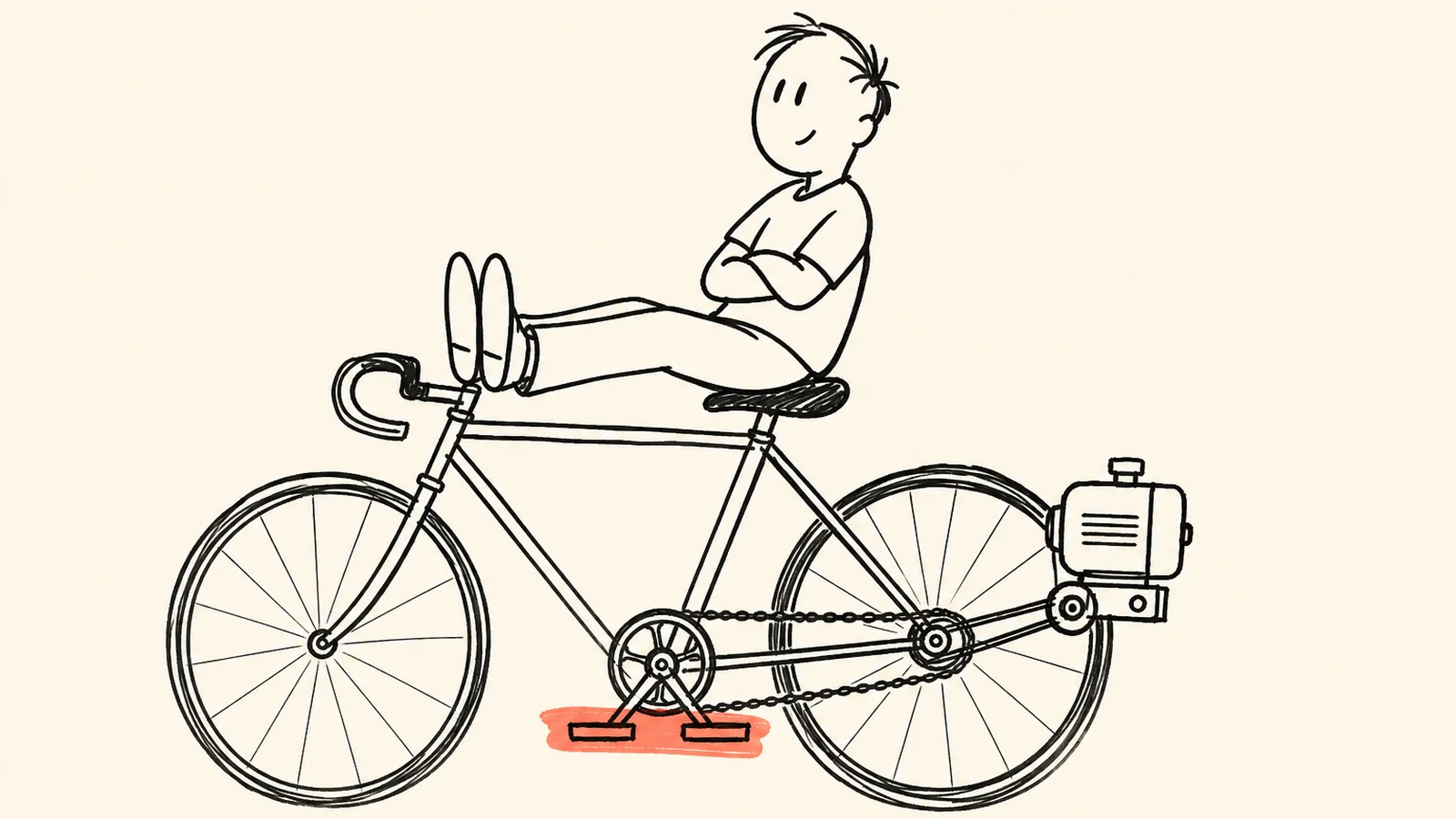
GenAI is making us dumber only in a narrow sense: it weakens the specific skills we stop practicing while it does them for us, not intelligence itself. In three randomized experiments with 1,222 people in 2026, about ten minutes of AI help left participants solving fewer problems on their own and giving up more often once the tool was removed. The split mattered: people who asked the AI for direct answers fell behind, while people who asked only for hints did as well as those with no AI. The same pattern appears in experienced endoscopists, whose unaided detection rate fell from 28.4% to 22.4% after AI arrived, and in drivers who rely on GPS. Falling IQ scores began decades before generative AI. The practical test is simple: for each task you hand to AI, ask whether you need to do it without a tool. For those, attempt it first, then ask for a hint, then for the answer.
On this page+
GenAI is making us dumber only in a narrow, measurable sense: it weakens the particular skills we stop practicing while it does them for us. Randomized trials published in 2026 found the drop after about ten minutes of taking its answers. What falls is practice and persistence, not intelligence.
You have probably seen the headlines, and maybe noticed something in yourself too: the reflex to open a chat window before you have tried the problem, or a paragraph you "wrote" that you could not quite explain an hour later. The worry is fair. The word "dumber" is not, and the difference matters, because it tells you what to protect and what you can hand over without a second thought. This piece sorts the evidence into what has been measured and what has not, then gives you a two-minute check to run on your own week.
When GenAI is making us dumber, and when it is not
The clearest test so far is a set of three randomized experiments with 1,222 people, posted in April 2026 by researchers at Carnegie Mellon, Oxford, MIT and UCLA1. Participants spent 10 to 15 minutes on fraction problems or reading comprehension questions, some with an AI assistant in a sidebar and some without. Then the assistant was taken away.
In the first experiment, people who had used it solved 57% of the unassisted problems, against 73% for the group that never had it, and they skipped nearly twice as many (20% against 11%). In the reading experiment the gap was 76% against 89%, and skips rose from 1% to 8%. The most useful result came from the second experiment, where the researchers looked at how people had used the assistant. Those who asked it for direct answers fell behind. Those who used it for hints did about as well as people who never had AI at all.
How people used the AI (second experiment)
Solved without AI afterwards
Skipped
Asked it for direct answers (61% of AI users)
65%
13%
Asked it only for hints (27% of AI users)
76%
5%
Control group, no AI
77%
7%
The 12% who had the assistant and never touched it did best of all (89%), though they chose not to use it, so they may simply have found the problems easier. So GenAI is making us dumber in the specific way this trial shows: when it produces the answer, you practice less, and you get quicker to quit once the answer is not on tap. When it only nudges, the effect mostly disappears. A school trial with nearly 1,000 students found the same split, which we covered in what AI help does on exam day.
Is AI bad for your brain, or only for your skills?
The evidence so far points at skills, not at the brain's overall capacity. Nothing published shows AI cognitive decline in the sense of a lower IQ or a damaged brain. What it shows is less practice at particular tasks, and weaker performance on those tasks when the tool is gone. That is a real loss, but a narrower and more fixable one.
The study most often quoted as proof of the AI effect on brain activity came from the MIT Media Lab in June 2025. Nataliya Kosmyna and colleagues recorded EEG from 54 people writing essays with an AI assistant, with a search engine, or with nothing2. Brain connectivity scaled down with the amount of outside help: strongest with no tools, intermediate with search, weakest with the AI. The AI group also struggled to quote essays they had written minutes earlier, and felt less ownership of them.
That is a picture of less engagement during a task. It is not a picture of damage, and the authors say so: their FAQ asks readers not to describe the work with words like "stupid", "dumb" or "brain rot". The paper was a preprint, not yet peer reviewed, and it measured engagement, not whether GenAI is making us dumber over time.
The IQ story is older than the tools. Norwegian conscription records show scores rising for men born up to 1975 and falling for those born after, and a 2018 analysis by Bernt Bratsberg and Ole Rogeberg found the reversal inside families, between brothers, which points to environmental causes3. Those men sat their tests in the 1990s and 2000s, long before generative AI. Whatever is happening to measured intelligence, it did not start in 2022.
Skills are a different matter. Abilities like analysis, evaluation and creation are built by doing them, and they thin out when something else does them for you. That is the loss worth watching.
What does cognitive atrophy look like in real work?
It looks like an expert getting worse at the exact thing the tool does for them, within months, without noticing. The sharpest example comes from medicine. In four Polish endoscopy centres, 19 experienced doctors, each with more than 2,000 colonoscopies behind them, began using an AI system that flags possible precancerous growths. Budzyń and colleagues, writing in 2025, compared the colonoscopies these doctors did without the AI in the months before and after it arrived4. The rate at which they found adenomas unaided fell from 28.4% to 22.4%.
These were specialists, not students cutting corners, and their attention had started to lean on a highlighter that was sometimes switched off. The study was observational, so other changes may have played a part, and the authors say as much.
GPS showed the same pattern years earlier. In 2020, Louisa Dahmani and Véronique Bohbot tested 50 drivers and found that more lifetime GPS use went with worse spatial memory when they had to find their own way5. Thirteen came back about three years later, and the ones who had leaned on GPS more in between had declined more. Heavy users did not start out with a worse sense of direction, which argues against the idea that poor navigators simply use GPS more. The follow-up group was small.
Cognitive atrophy, then, is specific. The endoscopists did not get worse at medicine; they got worse at spotting growths on their own. The drivers did not get worse at thinking; they got worse at building a map in their heads. In each case the skill that faded was the one the tool had been performing.
Why do answers wear a skill down when hints do not?
Because a hint leaves the hard step with you, and the hard step is where the practice happens. Cognitive offloading, handing a mental task to something outside your head, is old and mostly sensible: a shopping list is cognitive offloading. What is new about a generative tool is how much it will take. It will take the very step you were meant to be practicing, and do it well enough that you stop noticing it was ever yours.
If GenAI is making us dumber anywhere, it is at that step. The authors of the 2026 trial offer two mechanisms1. First, the reference point for effort shifts: once a task routinely takes seconds, ten minutes of struggle starts to feel like something has gone wrong, so you quit sooner. Second, self-knowledge fades: struggling is how you find out what you do not understand, and without it you lose track of where your gaps are. Both fit the skip rates.
None of this says AI can only hurt. In experiments by Benjamin Lira, Angela Duckworth and colleagues, first posted in 2025, people who practiced professional writing with an AI tool wrote better cover letters later with no AI, and so did people who only studied an AI-revised example6. They were still doing the learning; the AI supplied models to learn from. That is a hint in another form.
We read all of this as one variable: who produces the thinking. We made the same case about who asks the questions when AI meets critical thinking, and we see a version of it in sessions. Once someone writes their own first answer, even a weak one, they start arguing with it. Handed a polished answer, most people skim it and move on.
The skill that fades is the one the tool performed. Keep performing the ones you need.
Which skills are you handing over?
The ones worth worrying about are the skills you will still need when the tool is not there, and only you can say which those are. Nobody needs to protect every skill. Handing arithmetic to a calculator, or directions in a strange city to a phone, is a fair trade for most people. The trouble starts when you hand over a skill your work or your life depends on: one you will need in an exam, in a meeting, or in a conversation where you cannot pause to ask. Those are worth practicing even when a tool could do them faster.
How you use the AI
What you still practice
What fades
Ask for the finished answer
Judging whether it looks right
Producing it yourself, and staying with it when it is hard
Try first, then ask for a hint
The hard step, with a nudge
Very little
Write your attempt, then compare
Producing, then checking
Very little
Ask it to question you
Explaining your own reasoning
Nothing you meant to keep
We built our product around that last row. Inwitt AI is an AI thinking partner app that asks one question at a time instead of answering, and when you ask it for facts, the findings sit behind a guess-first research reveal: you commit to your own guess before you see what came back. It is the "attempt, then hint" order built into the tool. For the practice itself, done on a decision you actually face, see how to improve critical thinking.
Common mistakes when you worry AI makes you dumb
The first is quitting AI entirely. The evidence does not ask for that. Hint users in the 2026 trial held level with people who had no AI at all, and the writing studies found gains. Dropping the tool costs you the uses that help.
The second is mistaking an explanation you followed for a skill you have. Reading a clear worked answer feels like learning. The people who got direct answers in the fraction trial saw every step worked out, and still solved fewer problems on their own afterwards.
The third is assuming expertise protects you. The endoscopists had thousands of procedures behind them. Experience is exactly what a tool leans on, and it can thin.
The fourth is treating one small study as settled, in either direction. The EEG study had 54 people and was a preprint; the GPS follow-up had 13. Weigh each claim by what was measured, as we tried to do with the cons of AI in education. The honest summary is that GenAI is making us dumber at specific tasks under specific conditions, and nobody has yet measured what years of it do.
Questions people ask about AI and your brain
Will AI make us dumb over years, not minutes?
Nobody knows yet. The trials measure minutes, the endoscopy study a few months, and the only multi-year result comes from GPS and 13 people. The direction is consistent, which is a reason to choose deliberately, not a reason to panic.
Is AI making us dumber than search engines did?
In the MIT EEG study, engagement dropped with search and dropped further with the AI assistant, so it looks like a bigger step on the same path. Search still left you to read, select and write. A generative tool can do all three.
Are IQ scores falling because of AI?
No evidence says so, and IQ is the wrong measure for asking whether GenAI is making us dumber. The best-known decline, in Norway, began with men born after 1975 and was measured years before generative AI existed. Its causes look environmental and are still unidentified.
Can AI make you smarter?
It can help you learn when you keep doing the work. People who used it for hints, or who studied AI-improved examples and then wrote their own, held their ground or improved in the studies above.
The exercise above is a small version of a session: you answer first, and the tool asks instead of telling. Every session leaves your reasoning on a thinking board and a receipt in your own words, so the thinking stays yours and so does the skill. If that is the kind of AI you want to use, join the Inwitt waitlist.
Footnotes
Grace Liu, Brian Christian, Tsvetomira Dumbalska, Michiel A. Bakker and Rachit Dubey, "AI Assistance Reduces Persistence and Hurts Independent Performance", arXiv:2604.04721, 6 April 2026. Three randomized experiments, 1,222 participants, about 10 to 15 minutes of AI assistance. Preprint. arXiv record↩↩2
Nataliya Kosmyna, Pattie Maes and colleagues, MIT Media Lab, preprint on the accumulation of cognitive debt when using an AI assistant for essay writing, arXiv:2506.08872, 10 June 2025. 54 participants in sessions 1 to 3, 18 in session 4. The vocabulary request is in the authors' FAQ on the Media Lab project page. arXiv record↩
Bernt Bratsberg and Ole Rogeberg, "Flynn effect and its reversal are both environmentally caused", Proceedings of the National Academy of Sciences 115(26), 6674 to 6678, 2018. Norwegian male birth cohorts 1962 to 1991. Journal record↩
K. Budzyń, M. Romańczyk, D. Kitala and colleagues, "Endoscopist deskilling after exposure to artificial intelligence in colonoscopy: a multicenter observational study", The Lancet Gastroenterology and Hepatology 10(10), 896 to 903, 2025. Four centres in Poland, 19 endoscopists, colonoscopies from September 2021 to March 2022. Repository record↩
Louisa Dahmani and Véronique D. Bohbot, "Habitual use of GPS negatively impacts spatial memory during self-guided navigation", Scientific Reports 10, 6310, 2020. 50 drivers; 13 followed up after about three years. Journal record↩
Benjamin Lira, Todd Rogers, Daniel G. Goldstein, Lyle Ungar and Angela L. Duckworth, "Coach not crutch: AI assistance can enhance rather than hinder skill development", arXiv:2502.02880, first posted 2025. Preprint. arXiv record↩