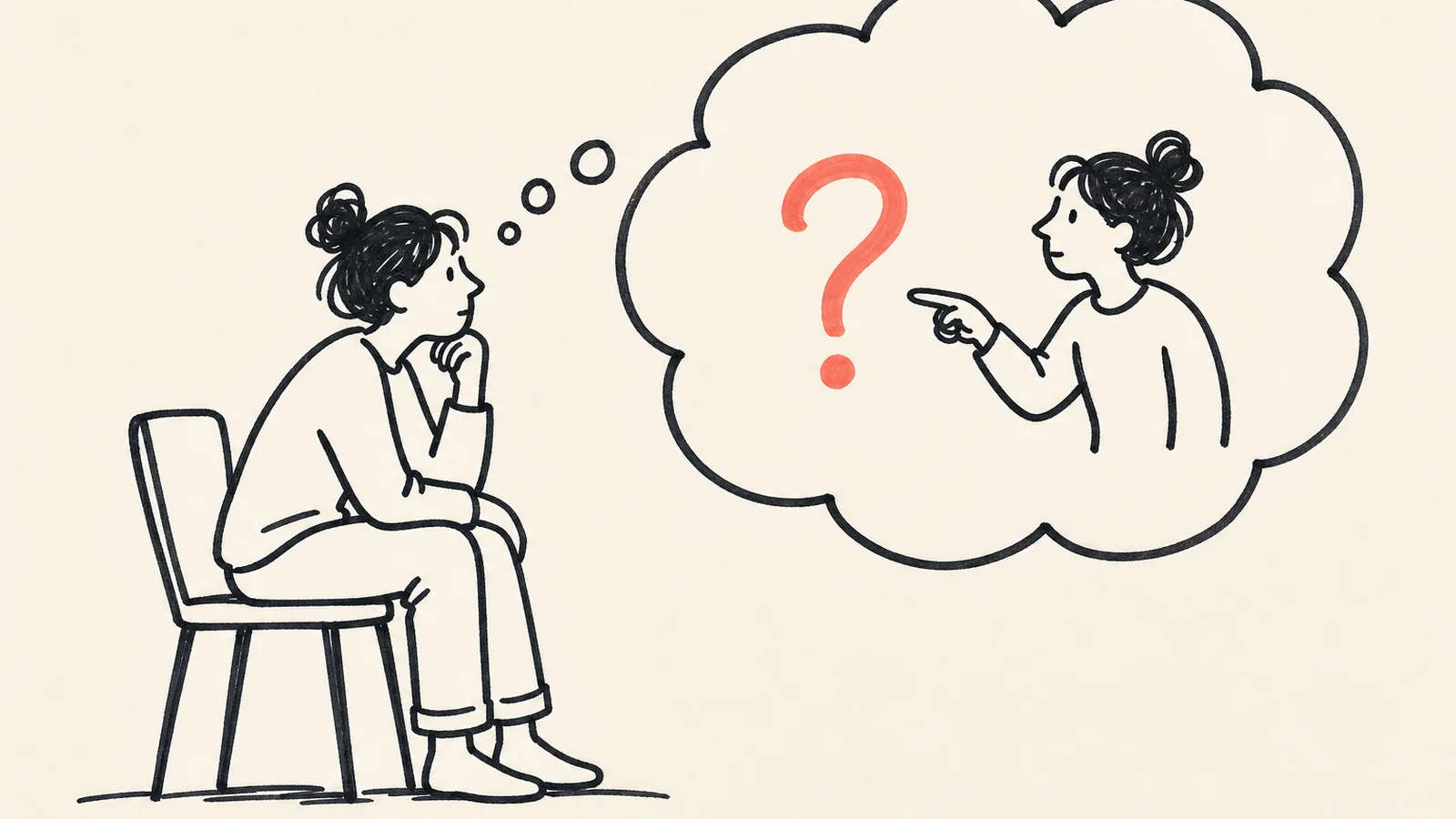
How to improve critical thinking: not by reading about it but by practising it on real decisions. Cognitive scientist Daniel Willingham argues critical thinking is not a general skill; it depends on knowledge of the subject and practice inside it. A 2015 meta-analysis of 341 effect sizes found the conditions that measurably improve it are dialogue, authentic problems and mentoring. Together those give a ten-minute daily practice: write one real decision as a single sentence, name the assumption under it, argue the other side, decide what would change your mind, and review the page later. A 2025 study of 319 knowledge workers adds a warning about AI: confidence in the tool predicts less critical thinking, confidence in yourself predicts more. Use AI to ask you questions, not to decide for you.
On this page+
Most advice on how to improve critical thinking is a list of habits: ask questions, consider other views, check your sources. The research says something narrower and more useful. Critical thinking improves when you work through a real problem, in your own words, with someone asking you questions you would not ask yourself. That is a practice, not a reading list, and it takes about ten minutes a day.
You have probably read the lists already. They are not wrong. They are just not the kind of thing that changes what you do on a Tuesday evening when a decision is sitting in front of you and you can feel yourself reaching for the first answer that sounds fine. This piece is about that gap: why critical thinking skills are hard to build, what the evidence says actually builds them, and one exercise that fits inside a normal day.
Why is critical thinking so hard to improve?
Critical thinking is hard to improve because it is not a single skill you can sharpen in the abstract. The cognitive scientist Daniel Willingham has argued for years that critical thinking "is not a skill" in the way that touch typing is a skill. It depends on knowing the subject you are thinking about and on having practised thinking in that subject, so it does not transfer cleanly from one area of life to another1.
That explains a pattern we see constantly in sessions. A person who is sharp at work, who can pick apart a spreadsheet or a contract, will reason about their own career move with the same shortcuts as everyone else. Nothing is wrong with their brain. They have ten years of practice in one domain and almost none in the domain of their own decisions.
The second problem is that most of what feels like reasoning is rationalisation. You arrive at a conclusion quickly, then build the argument for it afterwards, and the argument feels like thinking because it happened in words. Willingham calls the fix metacognition: rules you apply to your own thinking on purpose, like "state the assumption" or "name what would change my mind"1.
Those rules only help if you run them, and you only run them if something in the moment prompts you to.
So the honest summary is this. You cannot improve critical thinking by understanding it better. You improve it by practising it on real problems, with prompts that catch you before the rationalisation starts.
What actually improves critical thinking?
The largest review of the question is a 2015 meta-analysis by Philip Abrami and colleagues, covering 341 effect sizes from experimental studies that used standardised critical thinking measures. Teaching critical thinking worked, with a mean effect of 0.30, and three conditions stood out: "the opportunity for dialogue, the exposure of students to authentic or situated problems and examples, and mentoring"2.
Read those three again with your own life in mind rather than a classroom.
Dialogue means someone else is in the conversation, asking. Not lecturing, asking. The value is that another person does not share your blind spots, so their questions land where yours would not.
Authentic problems means the thing you are reasoning about is real and yours. A logic puzzle trains you for logic puzzles. Deciding whether to take the job trains you for the next decision that matters.
Mentoring means the questioner has no stake in your answer and is not trying to win. A friend who wants you to stay in the city is a debater. A good mentor asks "what are you assuming?" and then waits.
Critical thinking is not something you have. It is something you do, out loud or on paper, about a problem that is actually yours.
Put those together and you get a fairly precise recipe. Take a real decision. Put it into words. Have someone ask you questions about it who does not care which way you go. Then look at what you said. Every strategy that follows is a way of getting those four steps into an ordinary week.
How to improve critical thinking day to day
The practical answer to how to improve critical thinking is to turn one real decision a day into a short written argument with yourself. Five practices do most of the work, and together they are how you develop critical thinking in the one domain where it pays.
Write the claim in one sentence. "I should leave this job" or "we should hire the second candidate." Until it is one sentence you cannot inspect it, and most of the fog people describe as overthinking is a claim that was never written down.
Name the assumption under it. Every claim rests on something you have not checked. "I should leave" usually rests on "the next place will be different." Say it out loud. Half the time it sounds less certain in the open than it did in your head.
Argue the other side for two minutes. Not as a formality. Write the best case a smart person who disagreed with you would make, in their voice. If you cannot do it, you do not understand the decision yet.
Decide what would change your mind. This is the metacognitive rule Willingham describes, and it is the one people skip1. If nothing could change your mind, you are not reasoning, you are defending.
Review the decision later. Come back in a week or a month and read what you wrote. The review is where the learning happens, because you can see which assumption was wrong and which question you did not ask.
These five are how you practice critical thinking rather than read about it, and they map directly onto the three conditions from the research. The written claim makes the problem authentic. The other-side argument and the "what would change my mind" question supply the dialogue. The review is the mentoring you give your past self.
If you want the dialogue part without a person available at 11pm, this is what a thinking session is built for. Inwitt is an AI thinking partner app that asks one question at a time instead of answering, and it has a Critical mode whose whole job is steps two through four above. The board it draws from your answers is the written version of the argument, and the receipt at the end is what you review in step five.
Does using AI improve critical thinking or weaken it?
It depends entirely on which of you is doing the thinking. A 2025 study at CHI, the main human-computer interaction conference, surveyed 319 knowledge workers about 936 real uses of generative AI at work. The finding was clean: "higher confidence in GenAI is associated with less critical thinking, while higher self-confidence is associated with more critical thinking"3.
When people trusted the tool, they stopped checking. When they trusted themselves, they used the tool and still checked.
The same study found that AI did not remove critical thinking so much as move it, toward verifying answers and stitching them together3. That is real work, but it is not the work of forming your own judgement.
So the question is not whether to use AI. It is what role you give it. A chatbot that hands you a conclusion is doing the exact thing the research says weakens you: it supplies the answer before you have supplied the reasoning. An AI that only asks, and refuses to answer, does the opposite. It plays the dialogue role from the Abrami review, at any hour, with no stake in what you decide.
That distinction is the reason Inwitt AI was built to ask and not to tell. We have watched people in sessions arrive certain, get asked three questions, and discover the decision they were about to make was answering a different problem than the one they had.
Use AI for facts, drafts and options if you like. Do not let it own the judgement.
What only feels like it helps
Some habits feel like critical thinking practice and are not. The test is simple: is there a real problem, your words, and a question you did not want to hear?
Feels like practice
Is practice
Reading a list of cognitive biases
Naming the bias in a decision you made last week
Doing logic puzzles
Arguing the other side of a choice you are facing
Consuming more content on the topic
Writing one page about one decision
Asking a chatbot to decide for you
Asking anything, or anyone, to question you
Agreeing with yourself in your head
Reading your reasoning back a week later
The left column is comfortable because nothing in it can be wrong. The right column is uncomfortable because all of it can. That discomfort is the signal you are doing the real thing.
The other common mistake is trying to improve critical thinking everywhere at once. Pick the domain where your decisions cost you the most, usually work or money or one relationship, and practise there. Willingham's point about domain knowledge cuts both ways: the domain you know best is where your reasoning can get sharpest fastest1.
How long does it take to improve critical thinking?
There is no clean number for how long it takes to improve critical thinking, and anyone giving you one is guessing. What we can say from watching people do this: the habit of writing the claim down takes about two weeks to stick if you do it daily. Noticing your own assumptions before someone else points them out takes longer, usually a couple of months of reviews. Judgement, the thing you actually want, improves at the speed of your decisions, because each reviewed decision is one data point.
Measure it by decisions, not by days. After a month, look at the pages. If the assumptions you wrote in week one now look obvious, you have improved. If the "what would change my mind" line is getting easier to write, you have improved a lot.
Questions people ask about critical thinking
Can critical thinking be taught?
Yes, and the same evidence answers how to improve critical thinking as an adult on your own. The 2015 meta-analysis found instruction improved critical thinking at every educational level, with dialogue, real problems and mentoring as the conditions that helped most2. What cannot be taught is critical thinking in general, separate from a subject. It is learned inside the problems you actually face.
What are examples of critical thinking in everyday life?
Checking what a headline is assuming before sharing it. Asking a salesperson what would make their product the wrong choice. Writing down why you want to move house and finding the reason is about a person, not the house. Any moment where you catch your first answer and ask what it rests on is critical thinking in everyday life, and each one is a chance to become a critical thinker rather than to read about one.
What are the five steps of critical thinking?
Versions vary, but they reduce to the same sequence: state the question, gather what you know, name the assumptions, weigh the alternatives, decide and record why. The five practices above are that sequence pointed at one real decision.
Is critical thinking the same as being critical?
No. Being critical is finding fault with other people's ideas. Critical thinking is finding the weak point in your own, before it costs you something. The second is harder and worth far more.
If you want to try the exercise with a partner who only asks, join the Inwitt waitlist. Bring one real decision. Your first session will do steps one through four with you, and the thinking board will hand you the page to review.
Abrami, P. C., Bernard, R. M., Borokhovski, E., Waddington, D. I., Wade, C. A., and Persson, T. (2015). Strategies for Teaching Students to Think Critically: A Meta-Analysis. Review of Educational Research, 85(2). https://eric.ed.gov/?id=EJ1061695↩↩2