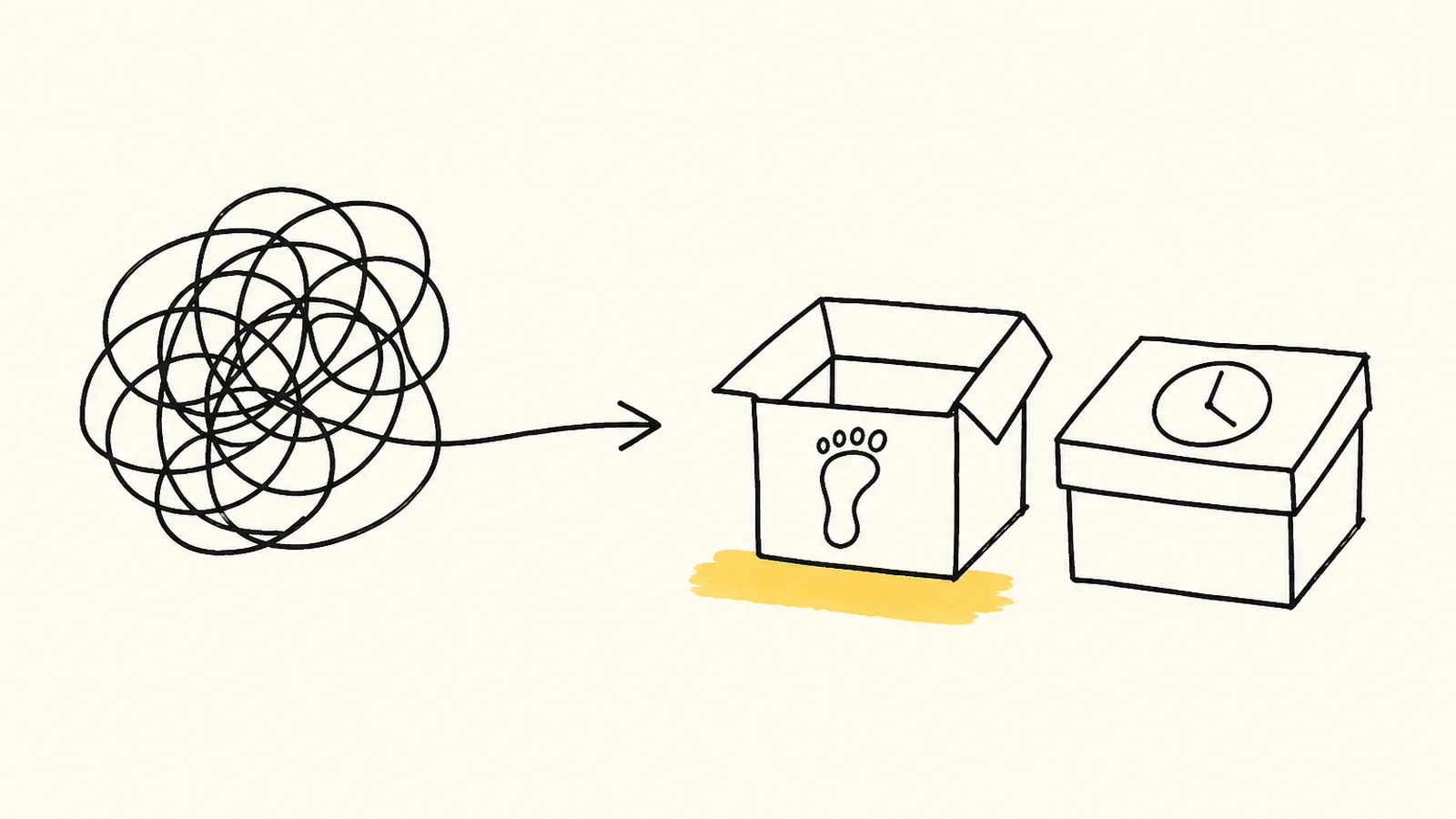
How to stop worrying starts with making the worry concrete: one sentence that names who, what and by when. Then split it. The part you can act on this week gets a next step and a day; the part you cannot gets a date when you will know more, and nothing else until then. Stopping by willpower fails because worry feels like protection: in a 2014 study by Sandra Llera and Michelle Newman, worrying kept negative emotion raised so that upsetting film clips jolted people less, and people with generalized anxiety rated worry as helpful for coping. Worry also rarely solves anything because it stays abstract. Joachim Stöber and Tom Borkovec found in 2002 that people with generalized anxiety described their main worries less concretely than others, and that after therapy their worries were as concrete as anyone's. A concrete worry can be acted on or checked; a vague one can only be repeated.
On this page+
How to stop worrying, in order: write the worry as one concrete sentence (who, what, by when), then split it. The part you can act on this week gets a next step and a day. The part you cannot gets a date when you will know more, and nothing until then. A sorted worry has very little left to say.
Most advice on how to stop worrying about everything hands you a menu: breathe, schedule worry time, challenge the thought, separate what you can control from what you can't. The last one is the right idea, and it usually fails on the first try, because a worry in its natural form is too vague to sort. "What if it all falls apart?" is neither controllable nor uncontrollable. It is fog. In sessions, the fog tends to move only when people are asked to say exactly what they are afraid of, and by when. This piece is about that order: why stopping feels unsafe, why vague worry never resolves, and how to split a worry into parts that can each be finished.
Why can't you just stop worrying?
You can't stop worrying on command because, in the moment, worry feels like protection, and partly it is. Michelle Newman and Sandra Llera call this contrast avoidance: worry keeps you in a mildly bad state so that bad news, if it comes, is less of a jolt1. In a 2014 test, Llera and Newman asked 48 people with generalized anxiety disorder and 47 people without it to worry, relax, or think neutral thoughts, then showed them fearful and sad film clips. Worrying raised negative emotion and held it there, so the clips produced smaller jumps. Relaxing left people at ease, and then sharply upset. The people with the disorder rated worry as more helpful for coping than the other conditions; the people without it rated it less helpful.
So the feeling that dropping the worry means dropping your guard is not imagined. Worry does soften the blow. The price is that you pay for the blow in advance, every day, whether or not it ever lands. That trade is why most advice on how to stop worrying fails at the first step: you are being asked to give up something that feels like insurance. A better question is what exactly you are insuring against, and whether part of it could be dealt with instead.
Why does worrying never solve anything?
Worry rarely solves anything because it stays abstract, and abstract problems have no next step. Joachim Stöber and Tom Borkovec showed this in a small 2002 study at Penn State3. Eleven clients with generalized anxiety disorder and 23 people without it wrote short descriptions of the two things they worried about most. Raters who did not know which group anyone belonged to scored each description from 1 (abstract) to 5 (concrete). The clients' worries scored 3.39 against the controls' 3.87. After 14 weekly sessions of cognitive-behavioral therapy, the clients' worries scored 3.95, as concrete as anyone's.
Their explanation is simple. "I may fail next week's exam" can be studied for, and checked against what happens next week. "I may be a failure" can be neither. Only a concrete description of a problem leads to a concrete solution, so a worry that stays at the level of "everything is going wrong" keeps the threat open and the loop running. This explains constant worrying better than any personality label: the worry never gets specific enough to be finished or disproved.
The study was small, and the authors called their findings preliminary. The practical point survives the caveat, and it is where how to stop worrying really begins: before you sort a worry or argue with it, write it down until it names a who, a what and a when.
What is the difference between practical and hypothetical worries?
A practical worry is about a problem that exists now and that you could do something about. A hypothetical worry is a "what if" about something that may never happen and is not yours to decide. The split comes from cognitive-behavioral therapy for anxiety and sits at the center of the worry tree, a flowchart common in UK talking-therapy self-help: notice the worry, ask whether you can do anything about it, then either make a plan or let it go.
Practical worry
Hypothetical worry
Sounds like
"The rent is due on the 1st and I am short."
"What if I never get my life together?"
When
Now, or a known date
Someday, maybe
Can you act on it this week?
Yes
No, or not directly
What ends it
A plan with a first step
A date when you will know more, and living with not knowing until then
Michel Dugas and colleagues built a treatment for generalized anxiety around this split4. Its target is intolerance of uncertainty, the sense that not knowing is itself unbearable. Current problems get problem-solving training; hypothetical worries get cognitive exposure, which means facing the feared scenario on purpose instead of circling it. In their 2003 trial, 52 patients went through 14 group sessions, improved more than a waitlist on every measure, and kept improving over two years of follow-up. Practical worries end with a plan; hypothetical worries end with a date and a tolerance for the wait.
The trouble is the last row of the table. Most real worries are not one or the other.
How to stop worrying when a worry is both
To stop worrying about a mixed worry, split it in writing: separate the part you can act on from the part you cannot, and give each its own ending. Almost everything people bring to sessions is mixed. A worry about a restructure at work is partly hypothetical (the decision is not yours) and partly practical (your savings, your CV and your questions are). Left whole, it gets filed as "can't control" and nothing happens, or as "must fix" and you plan for every branch at once.
Make it concrete. Rewrite it as one sentence with a who, a what and a when. "What if I lose my job?" becomes "The team review in three weeks might cut my role."
Split it. Ask which parts of that sentence you could do something about before the date. Write those on the left. Write the rest on the right.
Give the left side next steps. One action per line, each with a day: update the CV on Saturday, ask your manager on Thursday what the review will weigh, work out how many months your savings cover.
Give the right side a date. Here, the review is the date. Until then, the right side gets nothing.
Cross out the original. The worry has been replaced by a short list and a date.
Splitting deals with both problems above at once. The concrete sentence can be acted on and checked, and every action on the left shrinks what you were bracing for, so there is less left to insure against.
The hard step is the second one, because "which part of this could you act on?" is an easy question to dodge when you are the one asking it. Inwitt AI is an AI thinking partner app built around questions like that: it asks, you answer, and your answer goes onto the thinking board in your own words. The steps you name on the left become cards on the task board your sessions feed, so the actionable half leaves the session as something you can tick off.
What do you do with the part you can't control?
Give it a date, ask what you are bracing for, and write your first move if it happens; then leave it alone until the date. This is the half where guides on how to stop worrying say "let it go" and stop. A hypothetical worry about things you can't control does not end because you accept it in principle. It ends when it has somewhere to wait.
The date comes first. If the right side of the page says "the review, in three weeks", that is when the worry gets its turn. When it comes back in between, tell it the date. If it keeps arriving every day, postponing a worry to a set time has two trials behind it and works well alongside the split.
The second move uses contrast avoidance against itself. Ask: if the feared thing happened, what would I do first? Write that one line. It turns a hypothetical into a contingency, which is concrete, so the part of you that keeps bracing has a plan to point at instead of a feeling to keep up. Dugas's treatment pairs problem-solving with exposure for a similar reason: facing the scenario clearly once does more than circling it vaguely for months.
If the worry is really about one choice you have to make, and the not knowing is the hard part, it sorts a little differently. We wrote about anxiety about a single decision separately.
Worry pre-pays the bad feeling. Splitting it means you only pay for the part that is real.
What only feels like it helps?
Most of these appear on the standard lists of how to stop worrying. Each brings an hour of relief without sorting anything.
Sorting in your head. The split shifts while you make it, and the same worry gets filed differently at 3pm and at 3am. On paper, it stays where you put it.
Running the worry tree on a vague worry. "Can I do anything about everything going wrong?" has no honest yes or no. Make it concrete first, then ask.
Solving the abstract version. "Be less of a failure" has no first step. "Pass next week's exam" has several.
Telling yourself to stop. An order not to think about something keeps you checking for it, which is why pushing a thought away backfires, especially under stress.
Reassurance on repeat. A friend saying "it'll be fine" answers the feeling, not the problem, and it wears off by morning. The practical half still has no step.
A plan for every branch. Mapping every way the restructure could go before acting on any of it is worry dressed as planning. Pick the first step on the left side and do it; analysis with no stopping rule is a loop of its own.
Questions people ask about worrying
Why do I worry so much?
Usually because worry feels like preparation, and it gets rewarded. It keeps you braced so bad news hurts less, and when the feared thing does not happen, the worry quietly takes the credit. Vague worries also can't be disproved, so they never lose an argument. Making a worry concrete is what gives it a way to lose.
How do I stop worrying about everything at once?
Write all of them down, then star the three that come back most often. Run the split on those three only, and leave the rest on the list for a week. Many worries that feel like "everything" turn out to be a few concrete problems and one large hypothetical.
Is constant worrying a mental illness?
Not by itself. Worry that is hard to control, spreads across many topics, and comes with poor sleep, tension or restlessness for months is a core feature of generalized anxiety disorder, and that deserves an assessment from a GP or a licensed therapist. Nothing here is treatment; several of the studies above tested these ideas inside full courses of therapy.
What is the 3-3-3 rule for anxiety?
It is a grounding exercise: name three things you can see and three you can hear, then move or touch three things. It can settle a spike of anxiety by pulling your attention into the room. It does not sort the worry, so expect it back once you have settled, and use the quiet to write it down.
Worry asks one question over and over: what if? The questions that end it are different: what exactly, by when, and which part is yours to act on. They are hard to ask yourself at the moment the worry is loudest, which is when having them asked for you helps most. Every session leaves a board and a session receipt with the split in your own words. If you want questions instead of answers, join the Inwitt waitlist.
Footnotes
Michelle G. Newman and Sandra J. Llera, "A novel theory of experiential avoidance in generalized anxiety disorder: a review and synthesis of research supporting a contrast avoidance model of worry", Clinical Psychology Review, 2011, 31(3), 371-382. https://pubmed.ncbi.nlm.nih.gov/21334285/↩
Sandra J. Llera and Michelle G. Newman, "Rethinking the role of worry in generalized anxiety disorder: evidence supporting a model of emotional contrast avoidance", Behavior Therapy, 2014, 45(3), 283-299. https://pubmed.ncbi.nlm.nih.gov/24680226/↩
Joachim Stöber and T. D. Borkovec, "Reduced concreteness of worry in generalized anxiety disorder: findings from a therapy study", Cognitive Therapy and Research, 2002, 26, 89-96. https://doi.org/10.1023/A:1013845821848↩
Michel J. Dugas, Robert Ladouceur, Eliane Léger, Mark H. Freeston, Frédéric Langlois, Martin D. Provencher and Jean-Marie Boisvert, "Group cognitive-behavioral therapy for generalized anxiety disorder: treatment outcome and long-term follow-up", Journal of Consulting and Clinical Psychology, 2003, 71(4), 821-825. https://pubmed.ncbi.nlm.nih.gov/12924687/↩