Consumer decision fatigue is the tired, put-it-off feeling that builds when buying things keeps asking you to choose. The number of options is a weaker cause than most advice suggests: a 2010 meta-analysis of 50 experiments found almost no average effect of larger assortments. A better-supported cause is purchases that stay open. In a 2008 study, mall shoppers who had done more active deciding that day did worse on later arithmetic, though the broader self-control theory behind it failed a 36-lab test in 2021. People also pay to keep options open even when they care little about them, and choices that can still be reversed, such as purchases inside a return window, tend to satisfy less. The practical fix is to close purchases on purpose: write what the item is for and what would count as done before comparing, then buy it, drop it or give it a date. Pay for convenience only on choices you have already made once.
On this page+
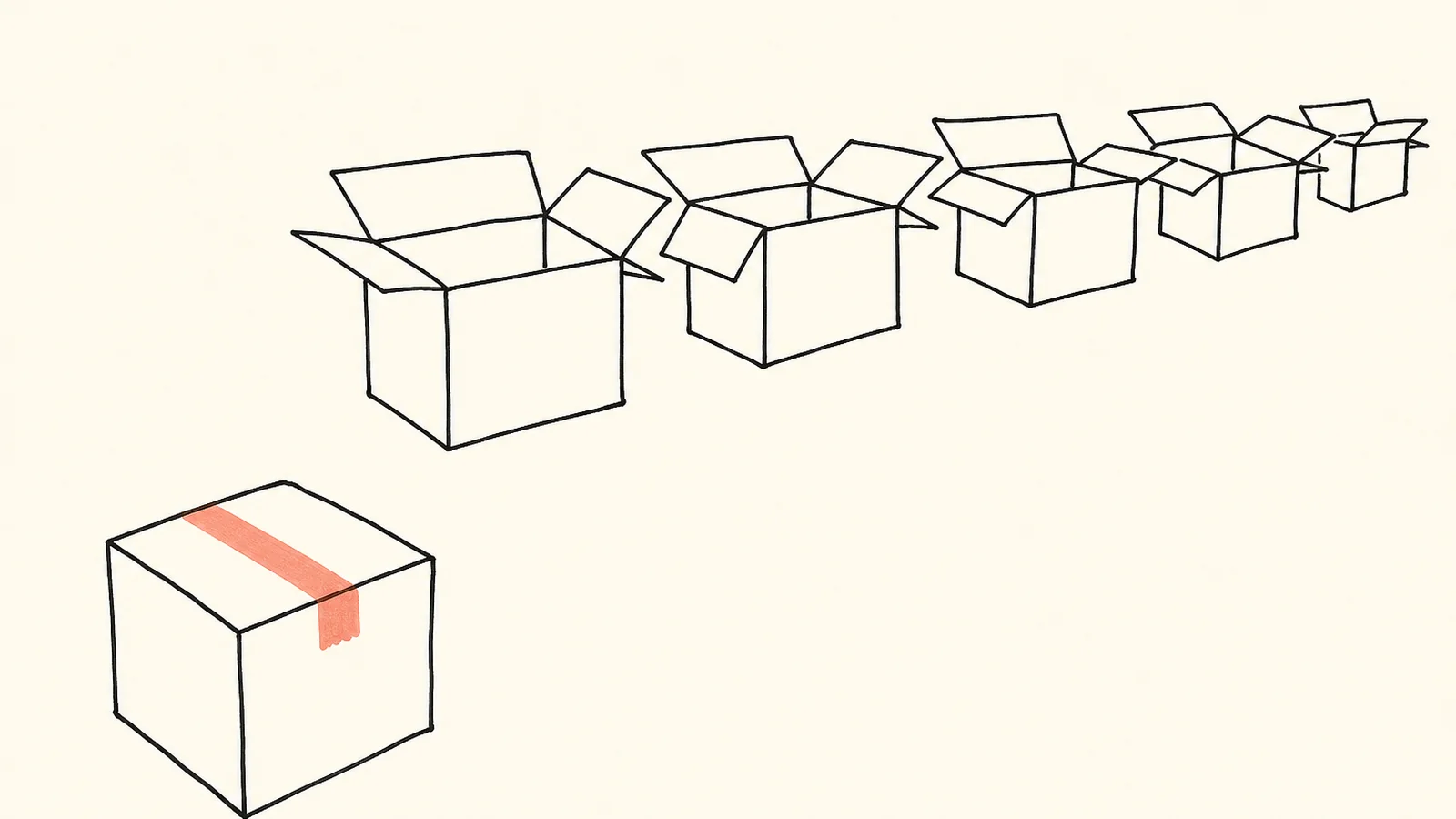
Consumer decision fatigue is the worn-out, put-it-off feeling that builds when buying things keeps asking you to choose. It tends to come less from the number of options than from purchases that never close: the open tabs, the saved cart, the return window still running. Closing them on purpose is the part you control.
You probably know the shape of it. A new kettle has been nearly bought for two weeks. Four tabs are open, each with a slightly different model, and a fifth has reviews of the second one. You are not short of information, and a kettle is not a big expense. You are just tired of it.
Most of what is written about this is for the people selling to you: how a store can cut options, shorten checkout and suggest a default so you buy before you tire. This piece is for the other side of the counter: what the research supports about why shopping wears you down, and one habit that helps more than trimming the list.
What is consumer decision fatigue, and is it real?
It is real as an experience, and the evidence for the mechanism is weaker than most pages admit. The term comes from research on self-control. In 2008, Kathleen Vohs, Roy Baumeister and colleagues published a set of studies in which people who made choices among consumer goods or college courses showed less self-control afterward than people who only thought about the same options: they gave up sooner, put things off more, and did worse on arithmetic. The study people quote most was run at a shopping mall. Shoppers reported how much active deciding they had done that day, then solved simple math problems. The more they had decided, the worse they did, even after the researchers accounted for how long they had been shopping.
The caveat matters. The broader idea behind those studies, that self-control draws on a supply that runs down, did poorly when tested at scale: a preregistered 2021 project across 36 labs and 3,531 participants found an effect close to zero3. We went through what survives of the idea in the psychology of decision fatigue. The practical reading is modest. Choosing feels like effort, the effort piles up within a day, and nobody yet knows how much of the slump is a used-up resource and how much is that you have stopped caring about kettles.
Why does online shopping feel so tiring?
Not mainly because of the number of options. When Benjamin Scheibehenne, Rainer Greifeneder and Peter Todd pooled 50 experiments with 5,036 participants in 2010, the average effect of a larger assortment was virtually zero4. Choice overload does appear under some conditions, chiefly when you do not yet know what you want, which we covered in being overwhelmed by choices. A 2025 meta-analysis of 62 studies on consumer confusion sorts its causes into the information, the product and the consumer, so the shopper is part of the cause, not only the shelf5.
What changed online is that very little ever closes. A store shuts at nine; a browser tab does not. The saved cart, the wish list, save for later, price-drop alerts and the return window all let a purchase stay half-decided. Each one is convenient. Each one is also a decision you have agreed to keep making, a little, every time you see it.
People will pay to keep options open, even options they care little about. In four experiments published in 2004, Jiwoong Shin and Dan Ariely found that doors which threatened to disappear in a simple game drew more effort and money to keep them available, even when they held little of interest and the cost was obvious6. The motive looked like a dislike of losing something, not a real wish for flexibility.
When people bring a stuck purchase to a session, this is the pattern we see most. The item is cheap compared with the time spent on it, and the comparison has run so long that nobody can say what it was for. Consumer decision fatigue rarely comes from one hard choice. It comes from carrying small ones around for weeks, which is how most everyday decision fatigue builds up.
Do free returns make shopping decisions harder to settle?
They can, because a choice you can still undo is one you keep judging. In 2002, Daniel Gilbert and Jane Ebert ran a photography course in which students printed two of their favorite pictures and kept one. Some were told they could swap it within a few days; others were told the choice was final. The students who could swap liked their photo less than the students who could not, and people did not see this coming: asked in advance, most preferred the version where they could change their minds7.
Shopping now runs on that option: thirty days to return, two sizes ordered and one sent back, free returns as a selling point. The safety net is worth having for things that may not fit or work. The cost is less obvious. While the return window is open, the purchase is not finished in your head, so you check the price elsewhere, read another review, notice the other color. We looked at which parts of a choice can truly be undone in reversible vs irreversible decisions.
A purchase you can still undo is a purchase you are still making.
How do you stop consumer decision fatigue?
Close purchases on purpose. Before you compare anything, write what the purchase is for and what would count as done, then end it one of three ways: buy it, drop it, or set the date it closes by. Fewer options help a little. A purchase with an end helps more.
An open purchase
A closed purchase
Where it lives
Tabs, carts, wish lists, your head
A receipt, or a deleted tab
What it asks of you
A small decision each time you see it
Nothing
What ends it
A sale, a new review, a mood
A line you wrote before comparing
After you pay
Still checking prices and alternatives
A return only if it fails that line
The line about what it is for does most of the work. A kettle for one person who drinks tea twice a day is a different purchase from a kettle meant to look good in a kitchen you are proud of. Once that line is written, most tabs fail it, and the rest can be compared on the two or three things that purpose cares about.
The line about what counts as done is the stopping rule: say, the first one under $40 that boils fast and has a lid that opens wide. When something meets it, buy it and stop looking. If the return window is open, use it only if the item fails the line, not because something newer turned up.
That exercise is a small version of what a session in Inwitt AI does: a question first, your own answer written where you can see it, and a look at what you wrote before anything else gets a vote. On the thinking board, the purpose sits next to the options, so comparisons it does not care about stand out.
Is paying for convenience worth it to avoid deciding?
Sometimes, and the test is whether you would make the same choice every time. Much of what is sold as convenience is sold as relief from consumer decision fatigue: subscriptions, bundles, pre-selected options, one-click reorders. For a choice that comes out the same way each time, the same detergent or the usual coffee, a standing rule is exactly right. You decided once, and there is nothing left to reopen.
The trouble starts when the default was never decided at all. A free trial that rolls into a monthly charge, an add-on ticked at checkout, a subscription you meant to review in spring: these feel like convenience, but they are choices someone else set up and you never closed. Not deciding is still a decision, made by a deadline or a default, as we argued in what happens when you do not make a decision.
So pay for convenience on repeat purchases you have already thought through once, and note when each gets reviewed. On purchases you never actually decided, it is not convenience. It is postponing the choice and paying monthly for the delay.
Does wanting the best make shopping more tiring?
Yes, and it shows up after the purchase as much as before it. Barry Schwartz and colleagues measured a trait they called maximizing: the habit of looking for the best option rather than one that is good enough. Across seven samples, published in 2002, people who scored high on it were less satisfied with their consumer decisions, compared themselves with others more, and reported more regret, along with lower happiness and life satisfaction8.
So the search does not end when the box arrives. A maximizer keeps checking whether something better existed: the same open loop as the return window, held open by habit instead of store policy. The alternative is not carelessness. It is deciding, before you look, what good enough means for this purpose, and treating a match as the end. If the fear underneath is picking wrong, anticipated regret splits it into the part luck decides and the part you can shrink.
What only feels like it helps
Some habits feel like progress and keep the purchase open.
Reading one more batch of reviews. Past the first few, reviews mostly tell you that people differ. If nothing a review could say would change your pick, you are waiting, not researching.
Adding columns to the comparison. Every new attribute is a new reason to reopen.
Saving it for later. A saved item is a decision on hold. It asks again every time you open the app.
Buying two and returning one. Sometimes the only way to judge fit. As a habit, it moves the comparison into your home for weeks.
Waiting for a sale with no price in mind. Without a number, every price drop restarts the question. With one, the alert becomes a stopping rule.
Questions people ask about consumer decision fatigue
Is consumer decision fatigue the same as choice overload?
No, though they overlap. Choice overload is about one moment: too many options at once. Decision fatigue is the running total, choosing again and again until the next choice gets worse or gets avoided. The fix for both starts with knowing what the purchase is for.
Is decision fatigue shopping online worse than in a store?
We know of no clean study comparing the two directly, so treat any confident answer with care. What differs is structure. A store visit has an end, while tabs, carts and return windows can keep a purchase open for weeks, and an open purchase keeps asking to be decided.
Why do I feel drained after shopping even when I bought nothing?
Because choosing takes effort whether or not you check out, and an unfinished purchase stays on your mind. In the 2008 mall study, the slump tracked how much active deciding shoppers reported, allowing for time spent shopping. Ending a trip with a written "not yet, revisit on this date" gives the search an end even without a purchase.
Do stores design around consumer decision fatigue?
Openly. Marketing and e-commerce guides treat it as something to reduce: fewer options per page, recommended picks, shorter checkouts, pre-selected extras. Some of that helps you. Watch the default: decide whether you want the add-on or the subscription before you reach the page that has already ticked it.
The two lines from the exercise, what this is for and what would count as done, are the same moves a thinking session makes with bigger decisions: one question at a time, your answer written down, nothing decided for you. Inwitt is an AI thinking partner app built around that; it asks, and the thinking stays yours. If something heavier than a kettle has sat half-decided for weeks, start thinking free.
Footnotes
Vohs, Baumeister, Schmeichel, Twenge, Nelson and Tice, "Making choices impairs subsequent self-control: a limited-resource account of decision making, self-regulation, and active initiative", Journal of Personality and Social Psychology 94(5), 883-898 (2008). Journal record↩
American Psychological Association news release on the same studies, reprinted by ScienceDaily (April 2008). Article↩
Vohs, Schmeichel and colleagues, "A multisite preregistered paradigmatic test of the ego-depletion effect", Psychological Science 32(10), 1566-1581 (2021). Journal record↩
Scheibehenne, Greifeneder and Todd, "Can there ever be too many options? A meta-analytic review of choice overload", Journal of Consumer Research 37(3), 409-425 (2010). Journal record↩
Shahid, Maseeh, Jebarajakirthy, Sharma, Saha and Gupta, "Consumer confusion: a meta-analytic review", Journal of Business Research 192, 115294 (2025), summarized by Toronto Metropolitan University. Research summary↩
Shin and Ariely, "Keeping doors open: the effect of unavailability on incentives to keep options viable", Management Science 50(5), 575-586 (2004). Journal record↩
Gilbert and Ebert, "Decisions and revisions: the affective forecasting of changeable outcomes", Journal of Personality and Social Psychology 82(4), 503-514 (2002). Journal record↩
Schwartz, Ward and colleagues, "Maximizing versus satisficing: happiness is a matter of choice", Journal of Personality and Social Psychology 83(5), 1178-1197 (2002). Abstract↩