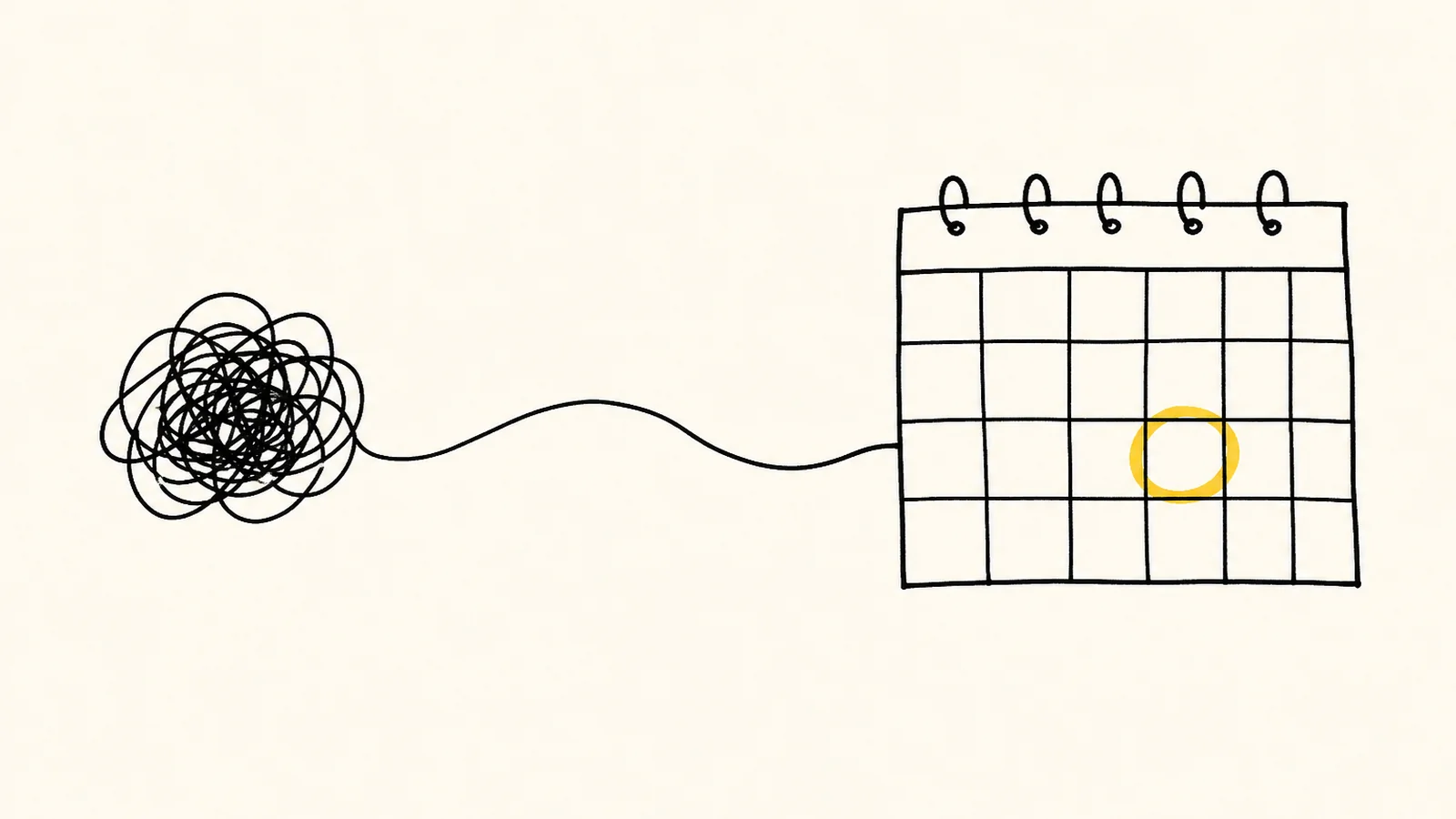
How to stop overthinking comes down to two moves in order: postpone the loop to a fixed appointment, then check it as a written prediction. The appointment is a daily 20 to 30 minute worry period at one time and place; in a 2013 trial by McGowan and Behar, two weeks of it reduced worry, anxiety and insomnia more than a control condition, and a 2024 trial found postponement works by showing that worry can wait. At the appointment, write each worry as a prediction with a date, then record what happened. When Lucas LaFreniere and Michelle Newman had people with generalized anxiety do this in a 2020 study, 91.4% of their worry predictions did not come true, against an emotional estimate of about 62%. Reassurance borrows someone else's confidence. A record of your own predictions is evidence, and it does not wear off by morning.
On this page+
How to stop overthinking comes down to two moves, made in order. First, postpone the loop to a fixed time and place each day, so the thought learns it can wait. Second, when that time comes, write each worry as a prediction with a date, and check it when the date arrives. Most will not have happened, and that record is what quiets the next one.
Notice the loop and name its topic in two or three words.
Tell it when it gets its turn: a set 20 to 30 minutes later today.
At that time, write each worry as "I predict that..., and I will know by...".
When the date comes, write what actually happened next to the prediction.
You have probably been told to breathe, to meditate, to distract yourself, to challenge your thoughts. The lists of how to stop overthinking everything run to fifteen tips, and each one helps for a while. Then the same thought comes back at 2am with the same confidence. We see this in sessions all the time: people arrive having argued with a worry for weeks and lost every round, because the worry was never asked to commit to anything that could be checked. This piece is about the two moves that make it commit, and the research behind each.
Why can't you just stop overthinking?
You can't stop overthinking by deciding to, because the loop believes it is doing a job. Worry presents itself as preparation: if you keep turning the problem over, you might spot the danger before it lands, and stopping feels like dropping your guard. So an instruction to stop sounds, to the loop, like an instruction to stop paying attention. Pushing the thought away fares no better, as anyone who has tried not to think about something at 2am can confirm. Most advice on how to stop overthinking starts by asking you to stop, and that is the one step the loop will not take.
What the loop lacks is not willpower on your part. It lacks two things: a time when it is allowed to run, and a way to find out whether it was right. Without the first, it runs all day, attaching itself to every quiet moment. Without the second, it never learns anything, so tomorrow's worry arrives with exactly the confidence of today's, no matter how many of yesterday's came to nothing.
What is the loop actually doing?
Most overthinking is one of three things, and each ends with a different question. Worry is about the future: a prediction that something bad will happen. Rumination is about the past: a verdict you keep putting back on trial. An open decision is a choice you have not made, so your mind keeps reopening the file. From the inside they feel identical, which is why tips that fix one so often fail on the others.
What it sounds like
What it is
The question that ends it
"What if the presentation goes badly?"
Worry: a prediction about the future
What exactly will happen, and by when will I know?
"Why did I say that in the meeting?"
Rumination: a verdict on the past
What, concretely, would I do differently next time?
"Should I take the job or not?"
An open decision
What would have to be true for me to say yes?
This piece deals with the first row, because it is the most common and because the evidence for what ends it is unusually clear. Rumination responds better to concrete questions than to postponement, which we covered in the paper door out of your head. An open decision needs a finish line more than a worry period, and setting a stopping rule is the fix there. If the loop is about a partner, the doubts sort differently again: see overthinking about someone you love.
How do you postpone a worry?
You postpone a worry by giving it an appointment: a fixed 20 to 30 minutes, at the same time and in the same place each day, and nowhere else. When the thought arrives at 11am, write two or three words on a list ("presentation, Thursday") and tell it that it gets its turn at 6pm. Then go back to what you were doing. At 6pm, sit in the chosen spot and worry on purpose, with the list in front of you. When the time is up, stop, even mid-thought.
Clinicians call this stimulus control, or a worry period, and of all the advice on how to stop overthinking it has the most testing behind it. In a 2013 trial, McGowan and Behar randomly assigned 53 people with high levels of worry to two weeks of either a daily 30-minute worry period restricted to one time and place, or a control condition that told them simply not to avoid worry when it came. The worry period group improved more on worry, anxiety, negative mood and insomnia1.
A 2024 trial led by Krzikalla adds a clue about why it works. People with generalized anxiety who postponed their worry for six days, with the explicit aim of testing the belief that worry cannot be controlled, worried significantly less than a waitlist group, and the effect held four weeks later2. So worry time is not a trick to get the thought out of the way. Each time the thought waits and nothing collapses, you collect proof that you, not the worry, decide when it gets attention.
What do you do when worry time comes?
At worry time, turn each item on the list into a prediction you could be wrong about. "Thursday's presentation" becomes "I predict my manager will say it was not good enough, and I will know by Friday." Write that sentence for each worry, each with its own date. Next to it, write two numbers: how likely it feels, and how likely it seems if you judge only on what has happened before. Then close the notebook, and when each date arrives, write what happened beside the prediction.
This is close to a method called the Worry Outcome Journal, studied by Lucas LaFreniere and Michelle Newman and published in 20203. Twenty-nine students with generalized anxiety disorder logged their worries when prompted four times a day for ten days, reviewed them each night, and recorded what actually happened over the following weeks. Of all the predictions they wrote, 91.4% did not come true. For seven of the participants, none did. Of the small share that did happen, about 30% turned out better than the person had expected.
The study was small, had no control group, and its participants had a diagnosis, so treat the exact figure as a demonstration rather than a law. The part that transfers is the mechanism. A written prediction with a date is something reality can answer, and a vague dread is not.
The hard part of that exercise is the question, not the pen: what exactly do you expect, and how would you know? That is the kind of question Inwitt AI asks. It is an AI thinking partner app, so it does not reassure you or rate your worry; it asks the next question and writes your answer onto the thinking board. The session receipt keeps the prediction in your own words, so on the check date you are reading what you actually said, not what you remember saying.
Why does checking work when reassurance doesn't?
Checking works because it gives you evidence from your own life, while reassurance borrows someone else's confidence, and that wears off by morning. The same 2020 study found a gap that explains why worry feels so convincing. Participants rated the emotional likelihood of their worries at about 62% and the logical likelihood at about 42%, while the real rate was under 9%3. Even their careful, considered estimate was nearly five times too high.
A friend saying "it'll be fine" answers the 62% with a feeling of their own. A record of your predictions answers it with a number you collected yourself. In the study, the people whose worries more often proved untrue also showed bigger drops in anxiety symptoms by the end of treatment, which is what you would expect if the checking itself is doing work. We see a small version of this in sessions: once a worry is written as a prediction, people often say it sounds less likely on the page than it did in their head.
A worry is a prediction that never gets checked. Give it a date and it finally has to answer to something.
How to stop overthinking at night
To stop overthinking at night, hold the worry appointment earlier in the evening and keep the list by the bed. Night is when worry is loudest because nothing competes with it, and lying still in the dark is exactly the time and place a worry period should never be held. The worry period in McGowan and Behar's trial reduced insomnia as well as worry1, and the restriction to one time and one place is part of why: the bed stops being where worrying happens.
When racing thoughts start after lights out, write the three-word tag on the notepad and tell the thought that tomorrow's appointment has room for it. If it is a decision rather than a worry, write down the decision and the date you will make it, because an open decision is what keeps the mind returning; we went into that in why open choices drain you all day. Then stop writing. Turning the light on to solve it at 2am is the opposite of postponing.
What only feels like it helps?
Most lists of how to stop overthinking include at least one of these. Each relieves the feeling for a while without ever testing the worry.
Arguing with the worry in your head. Disputing a thought you have not written down is a debate where the other side can change its claim every round. On paper, it has to hold still long enough to be checked.
Reassurance on repeat. Asking the same person, or searching the same question, settles the feeling for an hour and teaches the loop that relief comes from outside. A record you keep yourself does not wear off the same way.
Worry time with no list. An appointment kept without writing anything down turns into a second, longer worry session. The list and the dates are what turn it into a test.
Vague predictions. "Something will go wrong" can never be checked, so it can never be wrong. Push it until it names a thing, a person and a date.
Distraction as the whole plan. A walk or a podcast is fine for twenty minutes. Used alone, it postpones the worry without ever checking it, so it returns at full strength.
Waiting for the decision to make itself. If the loop is really an unmade choice, no amount of worry time will close it. What happens when you do not make a decision is that a deadline or someone else makes it for you.
Questions people ask about overthinking
Why do I overthink so much?
Usually because the loop is doing something it believes is useful: rehearsing a threat so you are not caught off guard. It runs longer when the stakes feel high, when the outcome is uncertain, and when you are tired or alone with it. It also feeds itself, because every worry that does not come true gets quietly credited to the worrying rather than to the odds. Writing predictions down is what breaks that credit.
Is overthinking a sign of anxiety?
It can be. Worry that is hard to control, spreads across many topics, and comes with poor sleep, tension or restlessness for months is a core feature of generalized anxiety disorder, and that deserves a professional assessment. The line between overthinking and anxiety is mostly about how long it lasts and how much it takes over. Ordinary overthinking attaches to one thing and fades once that thing is settled.
How long does it take to stop overthinking?
In the trials above, people reported less worry after two weeks of a daily worry period, and after six days of postponement12. That is not a promise, but it points to days or weeks rather than years. The prediction record also builds quickly, because many worries reach their check date within a few days.
What is the 5-minute rule for overthinking?
It is a time limit: give the thought five minutes, then either act on it or let it go. It works well for small, practical loops. For a worry that keeps coming back, five minutes is often too short to write it as a prediction, and letting it go without checking means it returns; a worry period with a list does the same job and leaves you a record.
Most of how to stop overthinking is one question asked at the right moment: not "is this rational?" but "what exactly do you predict, and when will you know?" It is hard to ask yourself that at the moment the worry is loudest, which is why having it asked for you helps more than it ought to. Every session leaves a board and a receipt, so the worry you came in with leaves as a written prediction with a date. If you want questions instead of answers, join the Inwitt waitlist.
Footnotes
McGowan SK, Behar E. "A preliminary investigation of stimulus control training for worry: effects on anxiety and insomnia", Behavior Modification, 2013. https://pubmed.ncbi.nlm.nih.gov/22977265/↩↩2↩3
Krzikalla C, Buhlmann U, Schug J, Kopei I, Gerlach AL, Doebler P, Morina N, Andor T. "Worry postponement from the metacognitive perspective: a randomized waitlist-controlled trial", Clinical Psychology in Europe, 2024. https://pubmed.ncbi.nlm.nih.gov/39119056/↩↩2
Lucas S. LaFreniere and Michelle G. Newman, "Exposing worry's deceit: percentage of untrue worries in generalized anxiety disorder treatment", Behavior Therapy, 2020, 51(3), 413-423. https://pmc.ncbi.nlm.nih.gov/articles/PMC7233480/↩↩2