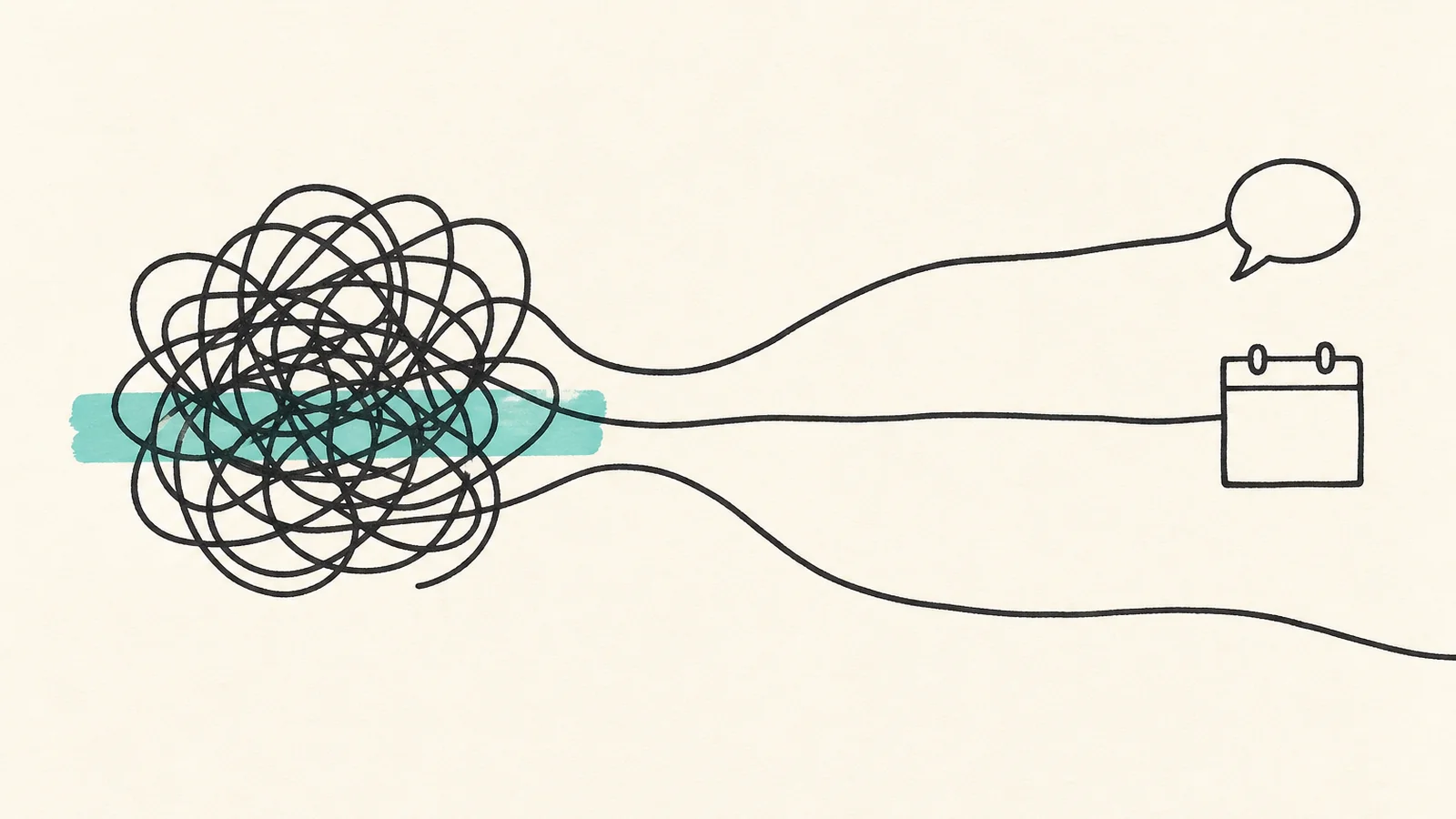
There is no trick for how to stop overthinking in a relationship. The move is to sort the doubt before you try to answer it, by asking who could actually settle the question. Three names cover nearly everything. Askable doubts sit with your partner and close with one plain question, asked once. Observable doubts close on evidence gathered over a set number of weeks, not tonight. Unknowable doubts, like whether someone will still want this in five years, have no answer anywhere, and handing them to a partner turns them into reassurance seeking. That distinction matters because reassurance has a shelf life. In a 2022 fourteen-day diary study of 110 couples, women high in attachment anxiety who sought reassurance reported lower trust the next day. Research on rumination points the same way: ruminators generate perfectly good solutions and then decline to act on them. The loop is not short of answers. It is short of a close.
On this page+
Most advice on how to stop overthinking in a relationship tries to quiet the thought. The faster move is to sort it. Ask who could actually answer the question you keep circling: your partner, your own attention over the next few weeks, or nobody alive. Each of those needs a different ending.
It is eleven at night and the reply took four hours. You have read it eight times. Somewhere around the fifth read you started scrolling back through the week looking for the message where the tone changed, and you are still not sure whether you found it or made it.
By now the thinking has stopped being about them. It is about whether you are allowed to stop. The loop is not waiting for an answer. It is waiting for a reason to close.
Why does overthinking in a relationship feel like work?
Because it is work, and it has no finish line. Worry was defined in 1983 by Borkovec and colleagues, in a definition still quoted across the rumination literature, as a chain of thoughts about an outcome that is uncertain and might be bad: an attempt at mental problem solving. The attempt is genuine. The problem solving is the part that fails.
Rumination feels productive because it runs on the machinery of productive thinking. What it does not produce is a decision. In the 2008 review Rethinking Rumination, Susan Nolen-Hoeksema and colleagues gathered the evidence that rumination makes thinking more pessimistic and fatalistic and gets in the way of solving anything.
One finding inside that review is stranger than the headline. In a study by Lyubomirsky and colleagues in 1999, people who ruminated came up with perfectly good solutions to their problems and were then less likely to actually carry them out. In related work by Ward and colleagues in 2003, ruminators were less confident in the solution they had generated and asked for more time before committing to it. They had the answer. They would not sign it. That is the shape of overthinking in a relationship: not a shortage of conclusions, but a refusal to let any of them be the last one.
That research was done on depression rather than romance, so read it as a description of a mechanism, not of your relationship. The mechanism still explains the eleven o'clock hour. Analysis that never agreed on what would settle it becomes a loop with no stopping rule, and it ends in exhaustion instead of a decision.
We have watched this from the outside often enough to be sure of one thing: the loop rarely stalls for want of an answer. People usually have the answer by minute four. What they do not have is permission to stop, so they go round again hoping the next lap produces one that feels safe to keep.
What are the three kinds of relationship doubt?
Sort by who holds the answer, not by how the doubt feels. Three names cover nearly everything.
Askable. Your partner holds the answer and could hand it over in a sentence. Did you mean it the way it sounded? Are we telling people we are together? Is your ex still texting you? These are facts about another person's life and mind, and only they have them. They close when you ask once, plainly, and then treat what comes back as information rather than as a mood reading.
Observable. Nobody can tell you yet, including them, because the answer has not happened. Do they show up when it costs them something? Does the same argument return in a different outfit every six weeks? These close on evidence collected over a named stretch of time. Not tonight.
Unknowable. The question is real and there is no answer anywhere. Will they still want this in five years? Would someone else have suited you better? Nobody holds these, and no conversation will produce them. They do not close. They get carried, and carrying is a different skill from solving.
The doubt
Who holds the answer
What closes it
What happens if you send it elsewhere
Askable
Your partner
One plain question, asked once
Asked as a mood rather than a question, it returns weekly
Observable
You, over a set number of weeks
Written evidence read against the date you chose
Answered tonight from memory, which returns whatever you are feeling
Unknowable
Nobody
Nothing closes it. It gets carried
Handed to your partner, where it becomes reassurance seeking
Relationship doubts never arrive sorted. They arrive as one heavy feeling with four questions inside it, two of which your partner could settle before the kettle boils. The work is not to answer the pile. It is to split it, which is why the mode built for deciding opens by asking what would settle the question rather than by answering it.
Why doesn't reassurance from your partner settle it?
Because you handed an unknowable question to someone who cannot answer it, and they answered anyway. The relief is real. It is also dated.
Reassurance seeking is the behaviour most often attached to anxious attachment, and it has been measured inside real couples. In 2022, Evraire, Dozois and Wilde followed 110 couples in Canada through a fourteen-day daily diary alongside questionnaires on attachment and trust2. People higher in attachment anxiety sought more reassurance day to day, and lower trust predicted more reassurance seeking, both for the person doing the asking and for their partner. The finding that matters here is what came next. Among women high in attachment anxiety, seeking reassurance on one day predicted lower trust the following day. The answer did not survive the night.
Those were 110 mostly white, mostly college-educated heterosexual couples in one Canadian city, tracked by self-report, and the pattern ran differently for men and for people high in avoidance. It is a pattern, not a law. It does rhyme with something older: in the same 2008 review, bereaved adults who ruminated reached out for support more often than other people and reported more friction and less emotional support in return1. Asking more and receiving less is what people describe when they say their partner sounds tired of the question.
There is a second reason it fails. When you ask whether they still want to be here, you are not collecting information. You already know what they will say, and so do they. You are asking them to hold a feeling on your behalf, and feelings handed to other people have to be handed over again tomorrow.
Reassurance is an answer with a shelf life, and the loop knows exactly when it expires.
Is it relationship anxiety or a real signal?
You cannot tell from how it feels, because relationship anxiety feels exactly like knowing. Test it in writing instead, on two things: whether it names something that happened, and whether it survives a night.
The standard advice is to notice the difference in your body, on the theory that intuition is quiet and anxiety is loud. That works for people who can already tell them apart. For everyone else it hands the judgement back to the feeling being judged.
Specificity is the first test. Write the doubt as a sentence a stranger could check. "Something is off" fails. "He changed the subject twice when I asked about the weekend" passes. A real signal points at an event. Anxiety points at everything and refuses to be pinned to anything.
Survival is the second. Write it down with the date, then read it back after a night's sleep without editing it. A signal is usually still standing, in close to the same words. Anxiety has usually moved to a different worry in the same emotional voice, which tells you what was driving it.
Written records argue back, which is why they earn their keep even when nothing is wrong. In a 2020 study, LaFreniere and Newman had 29 adults with generalized anxiety disorder log their worries for ten days and track what happened across thirty3. Of the predictions logged, 91.4% did not come true, and the most common individual result was that none of them did. Twenty-nine people with a clinical diagnosis is a small sample and says nothing about your odds. What it does establish is that the record and the memory disagree, and only one of them is written down.
A note you wrote before you knew the outcome is the only thing that can contradict you later, which is why any real piece of thinking should end in a written record of what you concluded. Set the date when you write it, and let something come back to ask what happened. The reading back is the step almost everyone skips.
How to stop overthinking in a relationship in one sitting
Twenty minutes, a pen, one page. Write the loop as a single question, name who holds the answer, write the one move that name allows, and date the page.
Write it as one question. Not a paragraph. One line ending in a question mark. Most loops shrink visibly here, because half of what you were carrying turns out to be three separate questions wearing one coat.
Name who holds the answer. Your partner, you in three weeks, or nobody. Write the name beside the question. Guessing is fine. You will find out if you guessed wrong, and that is also information.
Write the move that name allows. Partner: the exact sentence you will say, once, and when. You in three weeks: what you will watch for, and the date you will read your notes. Nobody: the words "carry it", which is an instruction rather than a defeat.
Date the page and close it. The date is the close. Without one, the sort is just more thinking in better handwriting.
Doing this out loud with something that asks rather than answers is the whole job of an AI thinking partner app, which is what Inwitt AI is. It puts one question in front of you at a time and draws your reasoning where you can see it, so the three piles stop being a metaphor and become a page you can point at.
If the spiral is too loud to write through, ground yourself first and sort afterwards. Grounding will get you out of the loop for an evening. The sort is what stops it reopening at the same hour tomorrow.
What only feels like it helps?
Anything that produces relief without producing a close. Most pages on how to stop overthinking in a relationship hand you six tactics and leave you to guess which of them ends anything. These five reliably do not.
Asking the same question in new words. The third version of "are we okay" is not information gathering. It is the same request in a fresh coat, and it teaches you that the answer needs replacing.
Searching your own memory for evidence. Memory is not a neutral archive. It returns what matches the mood you are searching in, so a bad evening will always find you a bad month.
The long conversation that resets the clock. Two hours of talking can feel like resolution and leave nothing written down, so there is nothing to read back and no date to check against.
Reading reply times as data. Speed of reply measures somebody's phone, their meetings and their battery. Relationship rumination will happily build a case out of it anyway.
Deciding at one in the morning. Tiredness does not make you wrong. It makes every option look equally heavy, which is the condition under which nothing gets signed.
Questions people ask about overthinking in a relationship
Is overthinking a sign the relationship is wrong?
Not by itself. Overthinking tracks uncertainty and how much the outcome matters to you, so it shows up most in the relationships people most want to keep. It becomes a signal about the relationship only when one specific doubt keeps surviving the night and the evidence you collect keeps confirming it.
How do I stop overthinking a slow reply?
Decide which kind of doubt it is before you do anything else. "Are they annoyed with me" is askable and costs one sentence. "Are they losing interest" is observable and costs a few weeks of noticing. Treating the second as though it were the first is what turns a four-hour reply into a two-hour investigation.
Should I tell my partner I am overthinking?
Telling them is not the same as asking them to fix it. "I have been in my head about Saturday and I want to ask you one thing" gives them a question they can actually answer. "Do you still love me" gives them a job that has to be redone tomorrow night.
When is this worth taking to a therapist?
When it is not only this relationship: the same loop has run through several of them, or it is costing you sleep, work and appetite, or the doubts arrive with intrusive images you cannot put down. Sorting doubts is a thinking tool. It does not treat anxiety, and someone trained to do that should.
The honest answer to how to stop overthinking in a relationship is that you do not stop the thinking. You give it somewhere to end, by replacing a question you cannot answer with one you can: who could end this. If you want that done out loud, with something asking the questions and keeping the page for you, you can join the Inwitt waitlist.
Evraire, L. E., Dozois, D. J. A., & Wilde, J. L. (2022). The contribution of attachment styles and reassurance seeking to trust in romantic couples. Europe's Journal of Psychology, 18(1), 19-39. https://pmc.ncbi.nlm.nih.gov/articles/PMC8895702/↩