To get out of your head, move the loop somewhere you can see it: write the exact sentence that keeps repeating, sort it into what it is, and ask it one concrete question. Being stuck in your head is thinking that never lands, and Watkins's 2008 review shows why: repetitive thought at the abstract level (why, what it means) prolongs low mood, while concrete processing (what exactly, what next) recovers faster. There are two exits. The body door (name the feeling, ground the senses, move) works in minutes and holds for about as long as the activity. The paper door works on the thought itself. Most loops are one of four things: an unmade decision, an unasked question, an unnamed feeling, or something nobody can know yet. Masicampo and Baumeister found in 2011 that an unfinished goal stops intruding once a specific plan for it exists, which is why a next step or a check-back date quiets a loop that suppression only feeds.
On this page+
You get out of your head by moving the loop somewhere you can see it, not by arguing with it or drowning it out. Write down the exact sentence that keeps repeating, sort it into what it is (a decision, a question, a feeling, or something nobody can know yet), and ask it one concrete question. A thought stops coming back once it has somewhere to go.
You know the state. A conversation from Tuesday is still running on Thursday. A choice has been made and unmade eleven times, in the shower, at the traffic light, at 2 a.m. You are in the room but not really in it, because the loop is louder than the room. The advice you find says to breathe, go for a run, name five things you can see. Some of that works, for about as long as the run lasts.
This post is about the difference between the exit that works for a minute and the exit that works for the thought. We have watched a lot of people work through this in sessions, and the pattern is consistent: the loop almost always turns out to be a piece of thinking that was never finished, and it stops the moment it is finished, or at least parked with a date.
Why can't you think your way out of your head?
Because the loop runs at a level where nothing can be settled, and trying to switch it off makes it louder. Being stuck in your head is not too much thinking. It is thinking that never lands anywhere: "why am I like this", "what if it goes wrong", "what did she mean by that". Those questions have no answer that closes them, so the mind keeps re-asking. That is why you cannot get out of your head by thinking harder in the same direction.
Edward Watkins's 2008 review in Psychological Bulletin gathered the evidence on repetitive thought and found that its effect depends on the level it runs at. Abstract, evaluative processing (why, what it means about me) prolongs low mood and worsens problem-solving; concrete processing (what exactly happened, what specifically comes next) recovers faster and solves more.1 The loop is abstract by nature. You cannot out-think it at its own altitude.
The other instinct, to stop the thought, has been tested since 1987. Daniel Wegner asked people not to think of a white bear for five minutes; they could not, and when they were then allowed to think about it, they thought about it more than people who had never been told to stop.2 Suppression is not an exit. It is a rehearsal.
What are the two ways to get out of your head?
There are two doors: through the body, or onto paper. The first is fast and temporary; the second is slower and holds. Most guides on how to get out of your head only give you the first door.
The body door is a set of moves that pull attention out of the loop and into the present moment:
Name it. Say, or write, the word for what you feel: "dread", "embarrassment", "boredom". In a 2007 brain-imaging study, Matthew Lieberman and colleagues found that putting a feeling into a word reduced the amygdala's response to negative images compared with other ways of looking at them.3
Ground it. The 5-4-3-2-1 routine (five things you can see, four you can touch, down to one you can taste) works because attention has a fixed width and the senses can fill it.
Move. A brisk walk changes the body's state, and the loop is partly a body state.
These work. They are how you get out of your head and into your body when you need to be present for the next ten minutes: a meeting, a child, a drive. What they cannot do is answer the thought, so a thought with a real question inside it walks straight back in when the walk ends.
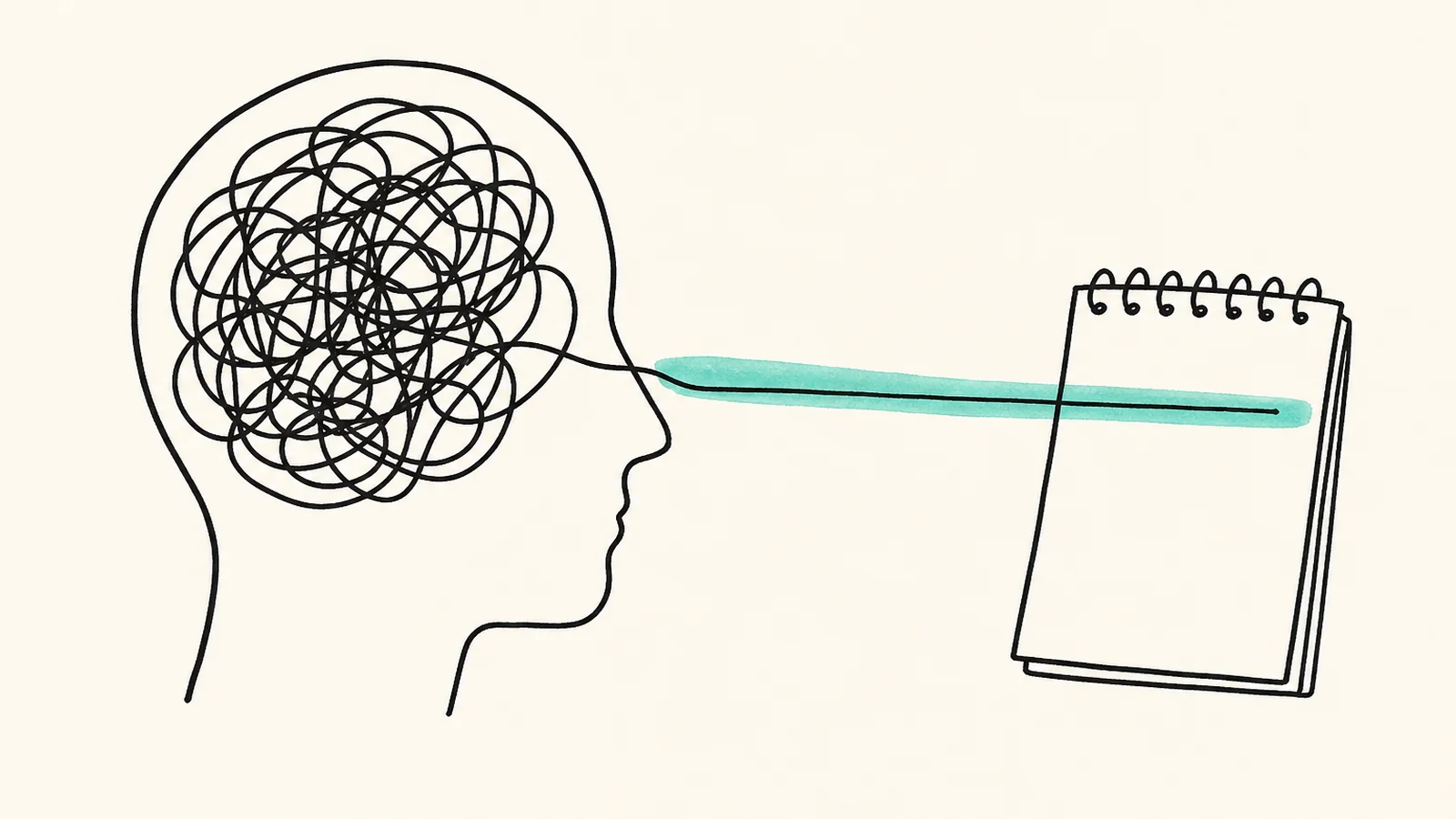
The paper door is the other way: take the loop out of your head and put it where you can see it. Then it stops being a mood and becomes a sentence, and a sentence can be worked on.
The body door
The paper door
How fast
Seconds to minutes
Five to twenty minutes
Best for
A feeling, a spike, the next ten minutes
A decision, a question, a plan
What it changes
Your state
The thought itself
What it cannot do
Answer anything
Settle you in the middle of a meeting
Sign you chose wrong
The same thought is back within the hour
You are writing pages while your heart is still racing
What is the loop actually made of?
Usually one of four things: a decision you have not made, a question you have not asked, a feeling you have not named, or something nobody can know yet. Overthinking feels like one condition from the inside. Written down, it separates into kinds, and each kind has a different exit.
In sessions the kind we see most is the first one. Someone arrives saying they cannot stop thinking about work, and within three questions it turns out they have been deciding whether to leave the job, every day, for two months, without once writing the two options side by side. That is not rumination in the clinical sense. It is a decision being made and unmade in a place with no memory, on assumptions never said out loud, so each morning it starts from zero.
The second kind is an unasked question. "Does he think I handled that badly?" cannot be answered by you, which is why it loops; it can be answered by him in one sentence. The third kind is a feeling wearing a question as a disguise: "what if I fail" is often "I am scared", and Lieberman's finding is that the name does most of the work. The fourth kind is genuinely open, such as whether the offer will come through, and the only honest move is a date on which you will look again.
A thought that keeps coming back is not a thought you failed to stop. It is a question you have not finished answering.
How do you get a thought out of your head and onto paper?
Four moves: write the sentence exactly, take it from why to what, ask it one question, and give it a next step or a stopping rule. It takes a pen and about five minutes, and it works because each move takes the loop one level more concrete, which is the direction Watkins's evidence points. It is the same reason one real decision on paper teaches more than a list of habits.
Write the sentence exactly. Not a summary, the actual words as they sound in your head: "I should have said something in that meeting." Seeing it written is already different from hearing it: it is shorter than it felt, and it is now outside you.
Take it from why to what. "Why do I always freeze" cannot be answered. "What did I want to say, and what stopped me" can. Swap every why for a what or a which, and the loop turns into a list.
Ask it one question. Only one. For a decision: what would have to be true for option A to be right? For an unasked question: who can answer this, and when will I ask? For a feeling: what is its name? For an unknowable: what is the date I will check again?
Give it a next step or a stopping rule. This is the move that quiets the loop, and there is good evidence for why. E. J. Masicampo and Roy Baumeister showed in 2011 that an unfinished goal keeps intruding on unrelated tasks, and that writing a specific plan for it ended the intrusions even though the goal itself was still unfinished.4 The mind was not waiting for the goal to be done. It was waiting for a plan.
That exercise is a session in miniature. Inwitt AI is an AI thinking partner app built around the same move: it asks one question at a time and writes your answers onto a thinking board where you can see them, so the loop becomes a diagram instead of a sound. It does not answer for you. At the end you get a receipt with what you decided and the next step, in your words, and that step lands on a task board rather than back in your head.
Why does the same thought keep coming back?
Because it is unfinished, not because you failed to get out of your head properly. Racing thoughts at night are usually the day's open loops arriving at the one moment nothing else is competing for attention. The Zeigarnik effect, the old finding that incomplete tasks stay more available in memory than complete ones, is the mechanism Masicampo and Baumeister were testing; their contribution was to show that a plan counts as complete enough.
There is a difference between a loop that is parked and one that is dismissed. Dismissed means you told it to go away, which Wegner's white bear says it will not. Parked means it has a place and a time: the question is written, the person who can answer it is named, the check-back date is in the calendar. In our experience the habit of overthinking fades as the number of open loops drops, because there is less for it to feed on.
What only feels like it helps?
Five things get mistaken for an exit, and each one feeds the loop instead.
Pushing the thought away. Wegner's 1987 white bear result still holds: suppression rebounds. If you want to stop thinking about something, give it a page, not a wall.
Asking for reassurance. "Do you think it will be fine?" buys twenty minutes. The question comes back because someone else's confidence is not your evidence. Ask the person who actually knows, or write down what you would need to see to believe it yourself.
One more search. Reading a twelfth article on how to stop overthinking is overthinking with better sources. Research helps when it changes an input to a decision; it feeds the loop when it is a way of not deciding.
Distraction as the only tool. The body door is real and we recommend it. Used as the only way to get out of your head, it turns every loop into a feeling to be managed rather than a question to be answered, and the questions pile up behind it.
Treating every loop as anxiety. Some loops are anxiety and belong with a professional. Many are unfinished decisions dressed as anxiety, and the tell is that they resolve the moment the decision is made. Sort first, then treat.
Questions people ask about getting out of your head
What does it mean to be stuck in your head?
It means your attention is on a replay or a rehearsal rather than on what is in front of you: a conversation from yesterday, a decision for next week, a version of yourself you are judging. The tell is that the thinking is repetitive and does not conclude. Thinking that moves toward a decision is not being stuck; it is deciding.
Is being in your head a sign of anxiety?
It can be, and often it is not. Anxiety tends to loop on threat ("what if") and comes with a body state: tight chest, poor sleep, a startle at small things. An unfinished decision loops on options ("should I") and lifts the moment the decision is made. If the loop has run for months, disturbs sleep most nights, or includes thoughts that frighten you, talk to a clinician; that is a different problem from the one this post solves.
How do I get out of my head and into my body fast?
Name the feeling in one word, then do 5-4-3-2-1 with your senses, then move for ten minutes if you can. Expect it to hold for the length of the activity. If the thought returns afterward, it has a question in it and needs the paper door.
How long does it take to stop living in your head?
The first loop takes about five minutes to sort on paper. The habit of living in your head takes longer to change, because it is fed by a backlog of unfinished decisions, and each one has to be closed or parked before you get out of your head for more than an evening. In sessions we see the shift in weeks rather than days: the person stops opening with "I keep thinking about" and starts opening with "I need to decide".
Can you quiet your mind without meditation?
Yes. Meditation trains you to watch thoughts without following them, which is useful, but a mind goes quiet when its open loops are closed or parked, and you can do that with a pen. Paper suits the loops that are questions; breath suits the ones that are only noise.
To get out of your head, then, is not one skill but two: leaving the loop for the moment, and finishing the loop for good. The second is the one that changes how many loops you have. A session with a thinking partner runs the four moves in order, one question at a time, and leaves you a board you can look at when the thought tries to come back; your first session shows what that looks like. If you would rather start with a pen tonight, the exercise above is enough. If you want the questions asked for you, join the Inwitt waitlist.
Wegner, D. M., Schneider, D. J., Carter, S. R. and White, T. L. (1987). Paradoxical effects of thought suppression. Journal of Personality and Social Psychology, 53(1), 5-13. https://pubmed.ncbi.nlm.nih.gov/3612492/↩
Lieberman, M. D., Eisenberger, N. I., Crockett, M. J., Tom, S. M., Pfeifer, J. H. and Way, B. M. (2007). Putting feelings into words: affect labeling disrupts amygdala activity in response to affective stimuli. Psychological Science, 18(5), 421-428. https://pubmed.ncbi.nlm.nih.gov/17576282/↩
Masicampo, E. J. and Baumeister, R. F. (2011). Consider it done! Plan making can eliminate the cognitive effects of unfulfilled goals. Journal of Personality and Social Psychology, 101(4), 667-683. https://pubmed.ncbi.nlm.nih.gov/21688924/↩