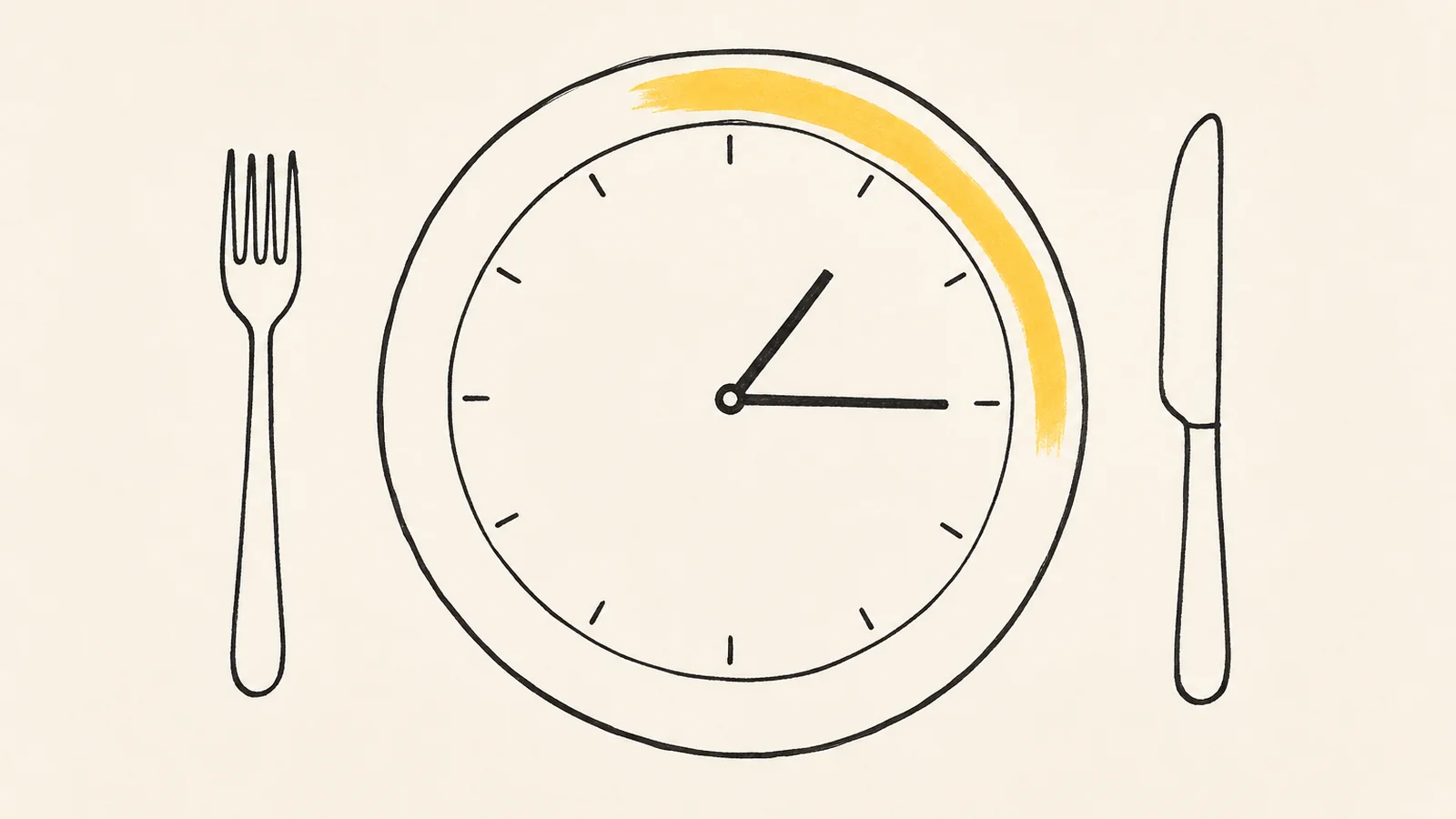
Food decision fatigue is the worn-down feeling around choosing what to eat, and it is strongest at dinner. The popular claim that people make 200 food decisions a day comes from a 2007 study that summed estimates for each part of a meal; a 2025 critique traces the gap between 14 guessed decisions and 227 calculated ones to a measurement effect called subadditivity. A December 2025 review also found little direct evidence linking decision fatigue to food choices. What wears people out is more specific: dinner is re-decided every evening, often while hungry, and often by a household where turning an idea down costs nothing and suggesting one costs effort. In one observational study, grocery orders placed further ahead of delivery held more vegetables and less spending. The practical fix is to settle dinner earlier: decide when it gets decided, write a standing rule instead of a menu, name an owner, and keep a fallback for nights the plan breaks.
On this page+
Food decision fatigue is the worn-down, can't-be-bothered feeling around choosing what to eat, and it peaks at dinner. It comes less from the number of food choices you make than from one decision, what's for dinner, that gets reopened every evening while you are hungry and tired. Deciding it earlier is the part you control.
You probably know the scene. It is past six, someone asks what's for dinner, and you open the fridge, close it, open a delivery app, scroll, and close that too. You made bigger decisions at work today in less time. This piece looks at what the evidence on food decision fatigue actually supports, why dinner is the one that wears you out, and how to settle it before the evening gets a vote.
What is food decision fatigue?
Food decision fatigue is the tired, put-it-off feeling that builds around deciding what to eat, and it usually shows up as takeaway by default, the same three meals on repeat, or a long stare into the fridge. It describes an experience, not a diagnosis, and the research behind it is thinner than most articles let on. A December 2025 review in Nutrients by Natasha Brasington and colleagues worked through 84 articles and concluded that "there is currently a paucity of evidence specifically connecting decision fatigue with food choices."1 Most of what gets cited comes from general self-control experiments, not from people choosing meals, and the authors call the proposed mechanisms "largely speculative".
That does not make food decision fatigue imaginary. It means the popular explanation, a daily tank of willpower drained by every snack, is the weakest part of the story. (We cover the wider debate in what psychology means by decision fatigue.) A more useful question is which food decisions are doing the draining. For most people it is one of them.
Do we really make 200 food decisions a day?
Probably not, at least not in any sense that matters for how tired you feel. The figure comes from a 2007 study by Brian Wansink and Jeffery Sobal. They asked 154 people how many decisions about food and drink they made each day, and the average guess was 14.4. Then the same people broke a typical meal into parts (when, what, how much, where and with whom), and those answers were multiplied across every meal, snack and drink and added up. That produced 226.7. The gap of 212.3 was presented as "mindless" decisions we make without noticing.2
In 2025, Claassen, Mata and Hertwig at the Max Planck Institute for Human Development argued that the gap is a measurement artifact. It matches a well-known pattern called the subadditivity effect: people give higher frequency estimates when asked about several specific parts of something than when asked about the whole. Split any question finely enough and the total grows. As Ralph Hertwig put it, "Magic numbers such as the alleged 200 food decisions do not tell us much about the psychology of eating decisions." (Wansink later had 18 papers retracted; this one was not, and the 2025 critique is about method, not misconduct.)
So advice that tells you to cut 200 daily food choices is aiming at a number that may not exist. Choice count was a weak explanation even before this; when we looked at feeling overwhelmed by choices, the bigger factor was not knowing what you wanted first.
Why is dinner decision fatigue worse than lunch or breakfast?
Dinner decision fatigue is worse because dinner is the one food decision that combines three bad conditions: it is reopened daily, it is made once the workday is over, and it is often made by more than one person. Breakfast mostly runs on habit, and most people eat the same few things without deliberating. Lunch is shaped by where you happen to be. Dinner stays open.
Breakfast
Dinner
How often it is re-decided
Rarely: it runs on habit
Every evening
When it is decided
Before the day has asked much of you
After work, often already hungry
Who decides
Usually you alone
Often a household, with vetoes
What a poor pick costs
Not much
Cooking time, money, someone's mood
What closes it
The habit
Usually the clock, then a default
When people bring a small recurring decision into a thinking session, the options are rarely what is stuck. The pattern we see most is that nobody ever decided how the decision gets made, so it is made from scratch each time, under the worst conditions available. Dinner is the cleanest example. Choosing between pasta and a stir-fry is easy. Making that same choice again at 6:40 p.m., hungry, with two people saying "I don't mind", is not.
Dinner is rarely a hard decision. It is an easy one you agreed to make again every night.
Why can't I decide what to eat when I'm hungry?
You can't decide what to eat when you're hungry partly because hunger changes the question. Asked in the morning, dinner is a question about the week: what is in the fridge, what is cheap, what you would like to be eating. Asked at 6:30 p.m., it becomes a question about the next twenty minutes, and nothing in the fridge answers that as well as a delivery app does.
There is some real-world evidence that the timing of a food decision shifts what gets chosen. Katherine Milkman, Todd Rogers and Max Bazerman studied a year of orders (2005) from an online grocer in a North American city and compared them by how far ahead of delivery they were placed. As reported by Knowledge at Wharton in 2010, the further ahead people ordered, the less they spent, and the share of "should" items like vegetables rose while the share of "want" items like ice cream fell.3 It is an observational study, and the authors did not test why it happens. It still fits a simple rule: a food decision made before you are hungry is a different decision from the same one made after.
That is also why telling yourself to just decide fails at 6:30 p.m. The decision is not hard. It has been left until the hour when you are least able to make it the way you would want to. It is the structure we describe in managing decision fatigue by closing open decisions: the drain comes from a choice that keeps coming back open.
Why do couples argue about what's for dinner?
Couples argue about what's for dinner because the usual way of deciding makes saying no free and suggesting something costly. One person asks, the other says "I don't mind", the first suggests something, and the second turns it down. Each veto takes a second. Each proposal takes thought, and carries a small risk of being the person who picked the bad meal. Run that loop a few times while both people are hungry and the argument is no longer about food.
One fix is a proposal rule: you can turn an option down only if you offer one in its place. That changes the cost of each turn, because a no now takes as much thought as a yes. A second fix is to decide who decides. One person owns the first half of the week and the other owns the second, and the owner's pick stands unless someone else offers to cook.
Who ends up holding the dinner question matters as well. In many families it lands on one person, which we covered in the decision fatigue moms describe. Between partners, the noticing and follow-up around each pick are part of the load too, a point we come back to in decision fatigue in relationships.
How do you stop food decision fatigue?
You stop food decision fatigue by settling the recurring decision once, ahead of time, instead of re-deciding it every night. More recipes or a better app will not do that on their own; a rule made in advance will. Four moves cover most of it:
Decide when dinner gets decided. Pick a time that is not the evening: Sunday afternoon for the week, or mid-morning for tonight. A choice made outside the hungry hour is more likely to be one you still agree with at 7 p.m.
Write a standing rule, not a menu. "Weeknights are one of these six meals" is easier to keep than a plan for each day, because it closes the question without fixing the answer.
Name an owner. One person decides each night, and the proposal rule applies to everyone else.
Give it an exit. Name the fallback for nights the plan breaks (eggs on toast, the frozen thing, one set takeaway order) so a missed plan does not reopen the whole question.
Meal planning helps when it does these four things. A plan on the fridge while dinner is still decided at 6:40 p.m. has changed nothing about when or how the decision gets made.
Often what the list shows is not a shortage of ideas but a missing rule: the same few dinners keep winning, just late. That is a small version of what a session in Inwitt AI does: a question first, your own answer written where you can see it, and a pattern you notice yourself instead of one you are handed. On the thinking board, the seven nights sit side by side, so the late ones are hard to miss.
What only feels like it helps
Collecting more recipes. More options make the evening question bigger, not smaller. If you already have six meals your household will eat, a seventh helps only when it replaces one.
A meal kit with no rule around it. Kits remove the shopping decision and sometimes the recipe decision. If which box, and which night, is still settled at the last minute, the evening loop is still there.
The perfect weekly plan. A plan that needs everyone home, on time and in the mood tends to break by midweek, and a broken plan reopens everything. A loose rule with an exit lasts longer.
A random picker for everything. A coin flip is fine for two takeaway options nobody cares much about. It does not settle a disagreement about money or health, and using it there leaves the real question for tomorrow.
Blaming willpower. Ordering takeaway at 7 p.m. is usually what happens when a decision is left until nothing else fits the time left. Calling it a character flaw skips the part you could change, which is when the decision is made. When nobody decides, a default does, as we cover in what happens when you do not make a decision.
Questions people ask about food decision fatigue
Is meal decision fatigue the same as meal fatigue?
Not quite. Meal decision fatigue is being worn out by choosing what to eat, while meal fatigue usually means being bored of eating the same things. They pull in opposite directions, which is why a fixed rotation can cure one and cause the other. Keep the short list, and swap one meal out every few weeks.
Does decision fatigue make you eat less healthily?
It might, but the evidence is weaker than headlines suggest. The 2025 Nutrients review found few studies that directly tested decision fatigue against real food choices.1 Hunger, stress, sleep, time and what is already in the house all play a part, and deciding earlier happens to address several of them at once.
Does meal planning actually help?
It helps when it changes when and how the decision is made, not only what is written on the plan. A plan made on Sunday moves the decision out of the hungry hour. If the plan gets ignored most evenings, it was probably too fixed to survive the week; a short list of options plus a fallback holds up better.
When is not being able to decide what to eat a sign of something else?
If choosing food comes with fear, guilt, strict rules about what is allowed, or skipped meals, the difficulty is probably not decision fatigue. That is worth raising with a doctor or a registered dietitian, not fixing with a better meal plan.
The seven-dinner list is the same move a thinking session makes with bigger decisions: one question at a time, your answer written down, and nothing decided for you. Inwitt is an AI thinking partner app built around that; it asks, and the thinking stays yours. If something heavier than dinner keeps getting reopened every night, start thinking free.
Footnotes
Brasington, Beckett, Pristijono and Akanbi, "The Effect of Decision Fatigue on Food Choices: A Narrative Review", Nutrients 17(24), 3901 (2025). Journal record↩↩2
Max Planck Institute for Human Development, "The myth of 200 daily food decisions" (July 2025), on Claassen, Mata and Hertwig, "The (mis-)measurement of food decisions", Appetite 209, 107928 (2025). Press release. The original study is Wansink and Sobal, "Mindless eating: the 200 daily food decisions we overlook", Environment and Behavior 39(1), 106-123 (2007). Journal record↩
Milkman, Rogers and Bazerman, "I'll have the ice cream soon and the vegetables later: a study of online grocery purchases and order lead time", Marketing Letters 21(1), 17-35 (2010), as reported by Knowledge at Wharton (October 2010). Article↩