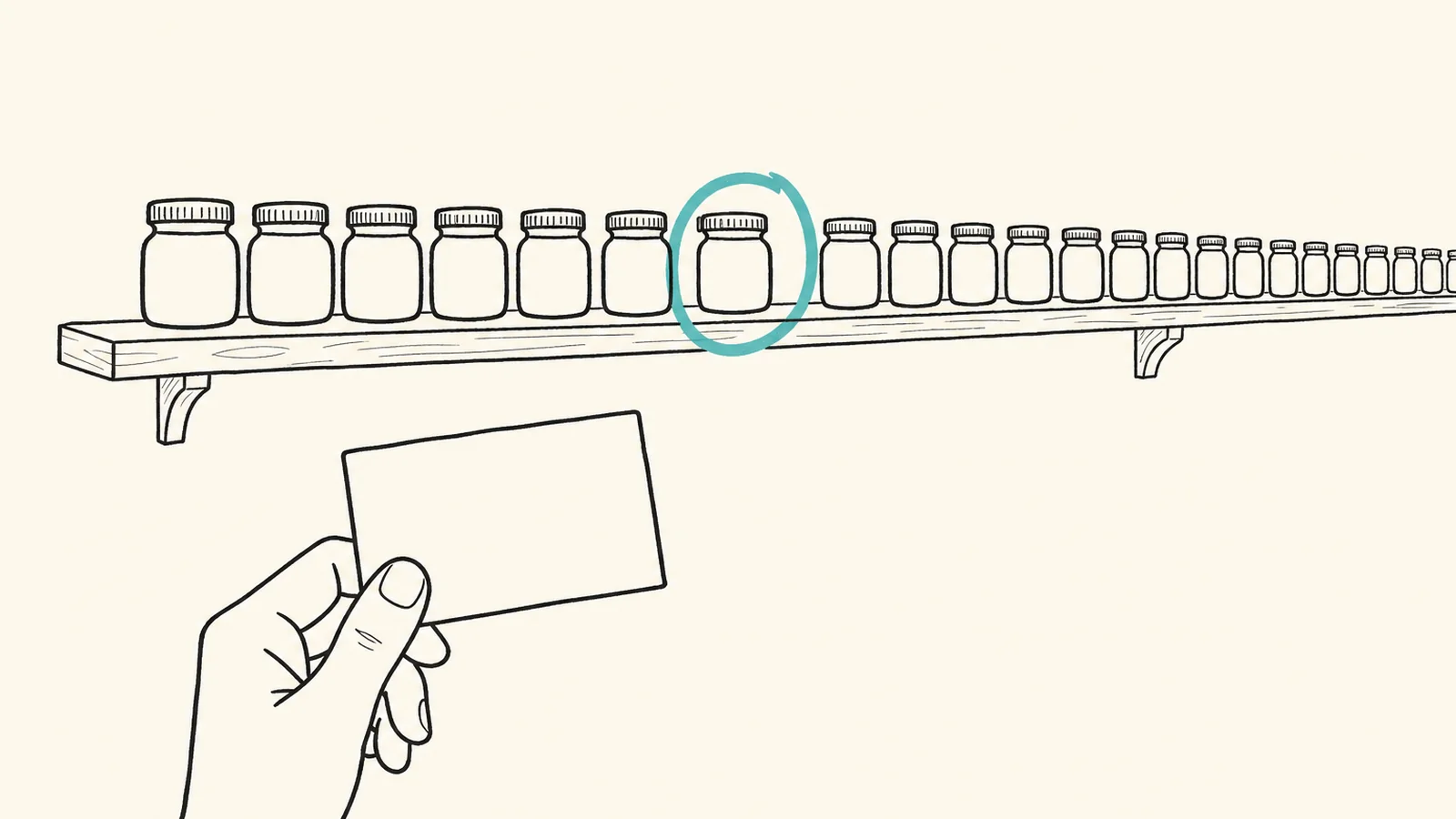
Feeling overwhelmed by choices usually means looking at a long list before you know what you want from it. Research on choice overload is mixed on average: a 2010 meta-analysis of 50 experiments found almost no overall effect, while a 2015 meta-analysis by Chernev, Böckenholt and Goodman, covering 7,202 participants, found a reliable effect under four conditions: unclear preferences, a decision that must be made now, complex options, and a hard task. The first is the one you control most. Chernev's 2003 experiments found that people with an ideal already in mind preferred large assortments and checked options against that ideal, while others compared everything with everything. So the order matters: describe what the right choice would do for you in one sentence, name one thing you would give up, decide whether you are browsing or choosing, and compare on two or three attributes. Only then shortlist, set a deadline or settle for good enough.
On this page+
Feeling overwhelmed by choices means, most of the time, that you are looking at the options before you know what you want from them. Research on choice overload finds that a long list stalls people mainly under certain conditions, and not knowing your own preference is the one you can fix. Describe the ideal first, then make the list answer to it.
You have forty tabs open. Maybe they are apartments, or laptops, or courses, or the next five years of your career laid out as a dozen paths that all look plausible. Each new option looks good for a minute and then makes the others look worse. An hour later you know more about every option and less about which one you want.
Most advice for being overwhelmed by choices cuts the list: pick three, set a timer, settle for good enough. Those moves help, but only after a step they skip. What follows is what the research says about when too many options actually overwhelm people, why one condition matters more than the rest, and a three-line exercise to do before you open the list again.
Why do too many choices feel overwhelming?
Because every option you add is another comparison to make, and without a clear standard each comparison opens a new question instead of settling one. Psychologists call the result choice overload, or overchoice: more options leading to less choosing, less confidence, or more regret.
The study that made the idea famous came from Sheena Iyengar and Mark Lepper in 20001. In an upscale grocery store, they set up a tasting table with either 24 jams or 6. The big display drew more shoppers to stop, but the people who saw six were much more likely to buy a jar. A second study used chocolates. People choosing from 30 enjoyed the choosing more than people choosing from 6, yet ended up less satisfied with the chocolate they picked, more regretful, and less likely to take chocolates rather than cash as payment afterward.
That split is the trap in one sentence: a big set is pleasant to browse and hard to commit from, which is why you keep going back to it. Barry Schwartz's 2004 book, The Paradox of Choice, gave the pattern its popular name.
In sessions, we see a version of it whenever someone arrives overwhelmed by choices. They describe their options at length and in detail, then describes what they want in one vague phrase: "something that feels right", "the best one". The options have been studied closely. The want has never been written down.
Is choice overload real?
Yes, but not in the way most articles suggest. On average, adding options barely matters; under specific conditions, it reliably makes choosing worse.
The first big review was not kind to the idea. In 2010, Benjamin Scheibehenne and colleagues pooled 50 experiments with 5,036 participants and found an average effect of virtually zero, with large differences between studies2. We looked at what that means for a single stuck decision elsewhere. In 2015, Alexander Chernev, Ulf Böckenholt and Joseph Goodman ran a second meta-analysis, covering 99 observations and 7,202 participants, and asked a different question: when does it happen3? Once four conditions were taken into account, the effect of a large assortment was significant. The more of each condition, the more overload.
Condition
What it looks like
Can you change it?
Preference uncertainty
You do not know what you want from the choice
Yes, before you look
Decision goal
You must pick now, not just browse for later
Yes, by splitting browsing from choosing
Choice-set complexity
Each option carries many details to compare
Partly, by comparing on fewer attributes
Task difficulty
Time pressure, a hard trade-off
Sometimes, by asking for more time
Kellogg Insight's 2017 summary of this work boils the first condition down to how much you already know what you want4. It also notes that complexity is not just the count: five options with many details each can be harder than many options with one detail each. And outright paralysis, never choosing at all, was the least consistent result across studies. More often you do choose. You just trust the choice less.
Why does knowing what you want change the list?
Because it changes what you do with the list. Without a standard, you compare every option against every other on every feature. With one, you check each option against the standard and move on.
Alexander Chernev showed this in 2003, across four experiments5. People who already had an ideal combination of features in mind were more likely to prefer a large assortment than people who did not. For them, a big set raised the odds that something close to the ideal was in it, and choosing from it strengthened their preference for what they picked. The way they chose differed too. People with an articulated ideal processed options selectively, checking each against what they wanted. People without one worked through the options comprehensively, attribute by attribute, comparing everything with everything.
The second way is the one that produces forty tabs. Every comparison raises a new question (is the bigger kitchen worth the longer commute?), and each answer depends on what you want, which is exactly what is missing. So the search adds a criterion with every new option, the same pattern that drives overanalyzing a decision, and the finish line keeps moving.
This is also why the same person can be decisive about one kind of choice and stuck on another. Someone who knows coffee picks from a twenty-item menu in seconds. Choice paralysis tends to show up where you have never had to say what you want: a first apartment, a career change, a field you are new to.
How to stop feeling overwhelmed by choices
Write down what you want before you look at the options again, then let the list answer to it. Most of the tips you have read are good; they just come in the wrong order.
Describe the ideal in one sentence. Not a brand or a model, but what the right choice would do for you. "A place I can walk to work from and have friends over" is a standard. "The best apartment" is not.
Name what you would give up. One trade-off you accept in advance. Without it, every option that wins on something you did not rank reopens the question.
Decide whether you are browsing or choosing. If you are not ready to pick today, say so, and treat the time as gathering. Browsing that pretends to be choosing is where much of the pressure comes from.
Compare on two or three attributes. The ones from your sentence. Everything else is a tiebreaker, not a column.
Then shortlist, and set a deadline. Now the cut has a reason behind it.
Steps one and two settle the preference before whatever happens to be on the list can bend it. Done in that order, a long list stops being a threat. It becomes a better chance that the thing you described is in there.
A long list is only overwhelming when you have nothing to hold it against.
The first line is the hard one, because it is tempting to answer with an option instead of a want. This is the kind of question Inwitt AI asks. It is an AI thinking partner app: it asks one question at a time, and when your answer is an option, it asks what you want that option to do for you. It never picks for you or ranks the options. In Decision mode, your answers go onto the thinking board as you give them, so the standard sits beside the list and you can hold each option against it.
When do shortlists, deadlines and good enough actually help?
Once you know what you want, all three help with feeling overwhelmed by choices. Before that, each one ends the search without making the choice yours.
A shortlist of three is the most common advice for too many choices, and it works when the three are the closest matches to a standard. Cut at random, or by whatever caught your eye first, and you have a smaller version of the same problem. A deadline works the same way. Without a standard it does not produce a decision; it stops the search, and whatever is in front of you when time runs out wins. That is how a default ends up deciding for you.
Satisficing, taking the first option that clears your bar instead of hunting for the best, is the strongest of the three, and it depends entirely on having a bar. "Good enough" is a standard only once you have written down what enough means. The people who find it hardest are the ones Schwartz calls maximizers: they look for the best, so every new option might be it. A written standard gives a maximizer something better to measure against than the whole list.
What only feels like it helps
More research before you know what you want. Reading every review feels responsible when you are overwhelmed by choices. Without a standard, it mostly adds features you had not thought to care about, and each one makes the comparison harder. Research the options after you have described the ideal, and only on the features it names.
Asking someone what they would choose. A recommendation borrows someone else's ideal. That is fine when you share their needs and a quiet problem when you do not, because their choice arrives with their reasons attached. Ask what they would want from it instead, and see whether your answer differs.
Letting the options write your criteria. If you only learned that a feature exists by seeing it on the third listing, it is probably not part of what you want. Novelty is not a preference.
Keeping the choice open after you have made it. Checking whether something better has appeared since you decided restarts the comparison with a new rival. If the choice met your standard, it was a good choice. Measuring it against options you never needed is how a settled decision turns into regret about a choice you made well.
Questions people ask about too many choices
What is it called when you have too many choices?
Choice overload, also called overchoice or choice paralysis. The paradox of choice is the title of Barry Schwartz's book on the same idea. The research term is choice overload, and it covers not choosing, choosing with less confidence, and regretting the choice afterward.
Is choice overload the same as decision fatigue?
No. Choice overload is about one decision with a large set of options. Decision fatigue is about the cost of many decisions across a day, and it often comes from one open decision you keep reopening rather than from the size of any single list. They can feed each other: an overwhelming choice left open makes the rest of the day heavier.
Is feeling overwhelmed by choices a sign of anxiety?
Usually not on its own. Most people get overwhelmed by choices in areas they are new to, and that points to a missing preference, not a disorder. If it happens with every choice, every day, and comes with dread, it may be decision anxiety, and if it is getting in the way of your life, a professional is the right person to talk to.
Why do small choices, like what to eat or watch, feel so hard?
Because small choices rarely get a stated preference, and they are often browsing that pretends to be choosing. Decide which one it is first. If you are choosing, one line ("something light, under an hour") turns a menu or a catalog into a few options in seconds.
Three lines on a page before you open the list is a small habit, and the first line is easier to write when something keeps asking what you want rather than which one. That is what a session does: one question at a time, your answers on a board, the decision in your own words at the end. If there is a choice you have been scrolling through for weeks, join the Inwitt waitlist and bring it to your first session.
Footnotes
Sheena S. Iyengar and Mark R. Lepper, "When choice is demotivating: can one desire too much of a good thing?", Journal of Personality and Social Psychology 79(6), 995-1006 (2000). Journal record↩
Benjamin Scheibehenne, Rainer Greifeneder and Peter M. Todd, "Can there ever be too many options? A meta-analytic review of choice overload", Journal of Consumer Research 37(3), 409-425 (2010). Journal record↩
Alexander Chernev, Ulf Böckenholt and Joseph Goodman, "When product assortment leads to choice overload: a conceptual review and meta-analysis", Journal of Consumer Psychology 25(2), 333-358 (2015). Journal record↩
Sachin Waikar, "When are consumers most likely to feel overwhelmed by their options?", Kellogg Insight, 3 October 2017. Article↩
Alexander Chernev, "When more is less and less is more: the role of ideal point availability and assortment in consumer choice", Journal of Consumer Research 30(2), 170-183 (2003). Journal record↩