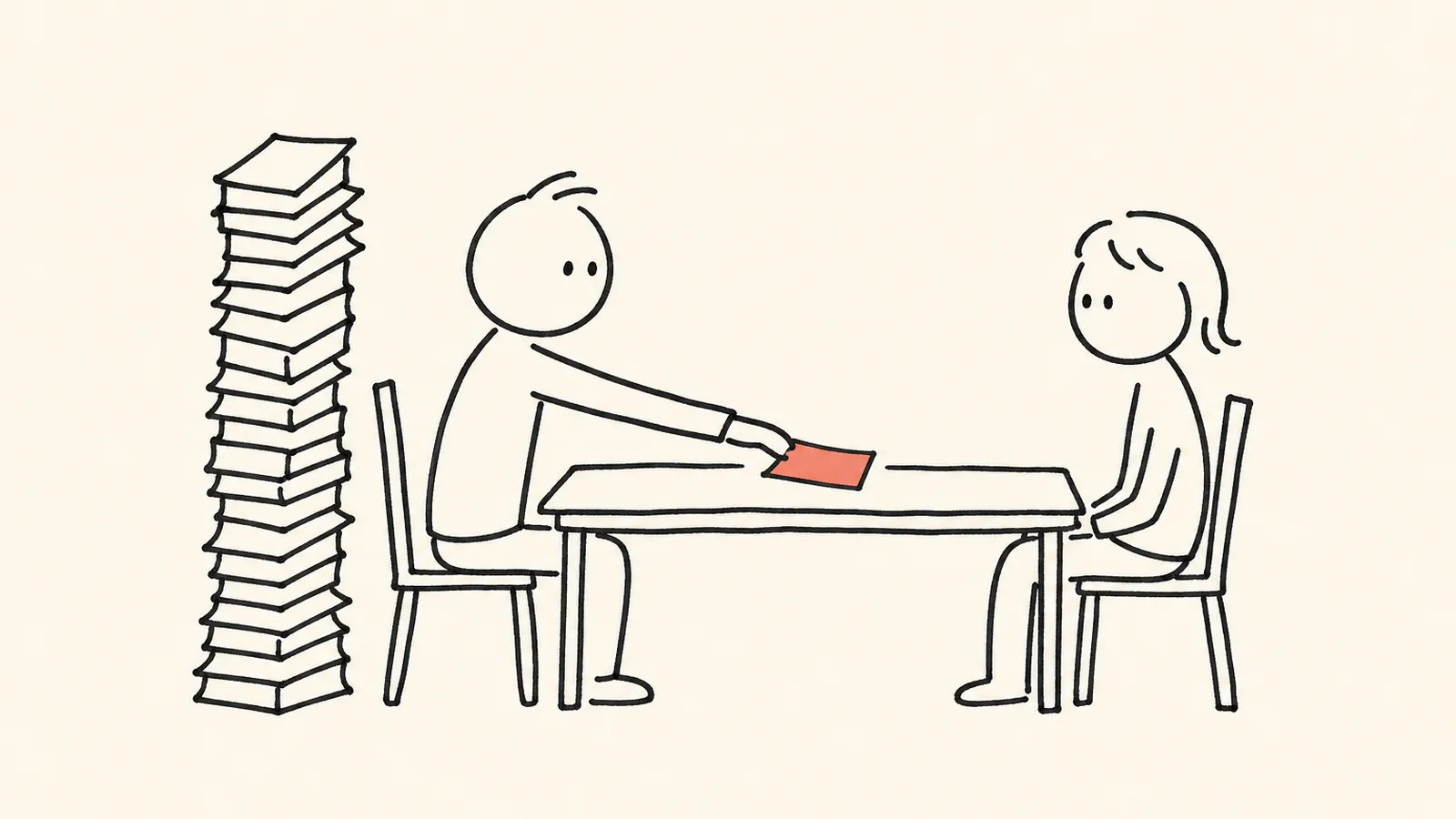
Decision fatigue in relationships is the worn-down feeling of being the partner who keeps having to decide, from dinner to weekends to the school forms. The tiredness rarely comes from the final pick. A 2019 study by sociologist Allison Daminger, based on interviews with 35 couples, split household decisions into four jobs: noticing what is needed, finding options, choosing, and following up. Choosing was shared roughly evenly; noticing and following up fell more on one partner and were often invisible to both, and a frequent source of conflict. That is why taking turns to pick, or saying you do not mind, changes little: it moves the visible step and leaves the heavy ones. What helps is handing over whole areas of life with all four jobs, agreeing in advance what each person wants a say in, and writing down what was decided so it does not reopen.
On this page+
Decision fatigue in relationships is the worn-down, snappish feeling of being the partner who keeps having to decide: dinner, weekends, gifts, the school form. The tiredness rarely comes from the final pick. It comes from the work around it: noticing a decision is needed, finding the options and following up, usually done by one person and seen by neither.
You probably searched this after a small question turned into a big evening. Someone asked what you wanted for dinner, you said you did not mind, they said they did not either, and twenty minutes later you were both irritated about something that was never about food. The usual advice is to take turns choosing. This post explains why that rarely works, and what to hand over instead.
What does decision fatigue in relationships look like?
Decision fatigue in relationships looks like one person turning into the household's switchboard. Every question routes through them: which weekend to visit family, whether the car needs a service, what to buy a niece, when the kids' forms are due. The other partner is usually willing to help and often asks, sincerely, "just tell me what you want me to do". That sentence is part of the load, because it hands back the hardest piece of the job.
The signs are familiar. You default to whatever is easiest and resent it later. You snap at a harmless question because it is the fortieth of the day. You reopen plans that were settled, or you agree to things you did not want just to make the asking stop. In decision fatigue in marriage or long partnerships, the pattern hardens into roles: one person plans, the other approves.
In sessions, we see a version of this often. When someone brings a shared decision to think through, most of what goes on the board first is not the choice itself. It is everything they noticed and looked up before their partner knew there was a decision to make.
Is it decision fatigue or the mental load?
Mostly, what people call decision fatigue in relationships is the mental load: the planning, remembering and checking that surround a decision. The popular story of decision fatigue says each choice drains a limited tank, so the person with the most choices runs dry first. That story is shakier than it sounds. A 2021 test across 36 laboratories and 3,531 participants found an effect close to zero1, and we covered what the research says about decision fatigue in more detail elsewhere. The tiredness is real. The tank is the doubtful part.
A better map comes from the sociologist Allison Daminger. In a 2019 study based on 70 in-depth interviews with members of 35 couples, she described a kind of housework she called cognitive labor. It "entails anticipating needs, identifying options for filling them, making decisions, and monitoring progress"2. That is four jobs where most couples see one.
She found the work "taxing but often invisible to both cognitive laborers and their partners", and "a frequent source of conflict for couples". In her sample, the women did more of it overall, and more of the anticipating and monitoring in particular. The deciding itself was split roughly evenly.
Here is what the four jobs look like for one ordinary decision, a weekend away:
Job
What it looks like
Does the other partner see it?
Noticing
Realizing a long weekend is coming and nothing is booked
Rarely
Finding options
Checking dates, prices, three places, who can mind the dog
Sometimes, as a list of links
Choosing
"This one or that one?"
Yes, this is the visible part
Following up
Booking, packing list, telling the dog sitter, the reminder on Thursday
Rarely, until something is missed
Only one row is the decision most people picture. The other three are the invisible labor that wears one person down. Daminger's study was qualitative and drew on one group of mostly well-off couples, so it cannot say how common each split is. What it gives is the map, and the map is what most advice is missing.
Why doesn't "you pick" help?
"You pick" hands over the one job that was already shared and keeps the three that were not. The person who asked still noticed the decision, still gathered the options, and will still be the one who checks it happened. They wanted help carrying the decision. They got a second vote on the last step.
"I don't mind" is worse, because it hands the decision back unmade. An unmade decision does not sit quietly. In 2011, the psychologists Masicampo and Baumeister found that unfinished goals kept intruding on people's thoughts until they made a specific plan for them, and that making the plan "eliminated" the interference3. A dinner question bounced between two people who both say they do not mind is an open loop running in two heads at once. Eventually a decision nobody makes still gets made, usually by whoever is hungriest or most tired, and nobody likes the result.
This is why "what do you want for dinner" causes so many fights out of proportion to its stakes. The question is rarely about the food. It is a request to share the work, and the reply either accepts that request or quietly declines it.
Handing someone the final pick is not sharing the decision. It is sharing the easy part of it.
Rotating a "decider of the week", a popular fix for decision fatigue in relationships, helps only when the week includes noticing and following up. If one partner still spots every decision and passes it to the decider, the rotation has moved the visible step and nothing else.
How do you share decisions so they stay shared?
You share decisions by handing over whole decisions, all four jobs, by area of life, and writing down what was agreed. Splitting choices one at a time keeps the noticing with whoever spots them. Couples decision making gets lighter when the question of who owns each area is settled once, not renegotiated every time something comes up.
List last week's shared decisions. Not chores: decisions. What to eat, what to do on Saturday, what to say to a relative, whether to replace the kettle. Ten is plenty.
Put initials against each job. For every decision, mark who noticed it, who found the options, who chose and who followed up. This takes five minutes, and it turns a vague complaint into something you can both point at.
Hand over whole areas, not single picks. "You own meals Monday to Thursday" means noticing the fridge is empty, choosing what to cook and buying it. "You own birthdays on your side of the family" means remembering them too. Ownership is what moves the mental load; help with one step does not.
Agree the veto line before, not after. Say what each of you wants a say in ("anything over a certain amount", "anything involving my parents") and leave the rest to the owner. Second-guessing a choice after it is made teaches the owner to hand it back.
Write down what was decided. A note on the fridge or in a shared list, with what would reopen it. Shared decisions that live only in memory get reopened, and reopening is how one person drifts back into owning everything.
The same idea shows up at work: a decision with no clear owner keeps routing back to one desk, which is the same ownership problem in a business. At home the stakes are smaller and the resentment is larger, because nobody is paid to carry it.
That exercise is also how a session in Inwitt AI, an AI thinking partner app, tends to run. In the Decision thinking mode it asks one question at a time (what did you notice first, what would make this settled, who else is part of it) and draws your answers on the thinking board, so the work you did before the choice becomes visible. It does not pick for you or tell you who should own what. The decision you reach and the next steps land in a session receipt, in your words, which doubles as the written record from step five.
What only feels like it helps
Several common fixes for decision fatigue in relationships feel fair and leave the load exactly where it was.
Taking turns picking. It shares the step that was already shared. Unless the turn includes noticing and following up, the person who spots every decision still does.
"Just tell me what to do." It sounds generous. It makes the other person the manager of your help, which is one more job on their list.
A shared calendar with no owner. Putting events in one place helps both people see them. It does not decide who books, reminds and checks, so the calendar quietly becomes one person's tool.
Deciding everything together. Talking through small choices as a pair feels like closeness and doubles the time each one takes. Save joint decisions for the ones that are hard to undo; give the rest an owner.
Keeping score in your head. A silent tally of who did more builds resentment without changing anything. The four-column sheet turns the tally into something you can both look at and argue with.
The polite "I don't mind". Often it is meant kindly. If you genuinely do not mind, say what you would pick anyway, so there is something on the table. It helps to say what you want before you look at options, even for dinner.
None of this fixes a relationship where one person refuses to carry anything. The sheet makes the split visible; what you do with it is a conversation, and sometimes a hard one.
Decision fatigue in relationships: common questions
Is decision fatigue a sign something is wrong with the relationship?
Usually not. Decision fatigue in relationships is a sign the work of deciding has drifted to one person, which happens in caring, functional couples all the time. If what keeps coming back is a question about the relationship itself, that is a different loop, and sorting out doubts about the relationship itself comes first.
How do I explain it to my partner?
Use one specific decision, not a general complaint. Walk through the four jobs for last weekend's plans and ask who did each. Often the other partner has simply not seen the noticing and following up; in Daminger's interviews, that work was frequently invisible to both people.
What if my partner always says they don't mind?
Ask for a first choice anyway, even a weak one, and agree that a weak first choice counts. If that keeps failing, hand them a whole area to own rather than more single picks. People who never mind about dinner often have strong views once the whole meal is theirs.
Can decision fatigue cause arguments?
It can make them more likely. Daminger's couples described this kind of invisible work as a frequent source of conflict, and the fights tend to land on trivial questions because those are where the tiredness spills over. The argument about the restaurant is rarely about the restaurant.
The sheet above makes one week of shared decisions visible. A session does the same thing at the speed of a conversation: one question at a time, your answers on the board, and a receipt with what you decided and who owns it, written in your words. If you want somewhere to work that out before you raise it at home, join the Inwitt waitlist.
Footnotes
Vohs, Schmeichel and colleagues, "A multisite preregistered paradigmatic test of the ego-depletion effect", Psychological Science 32(10), 1566-1581 (2021). Journal record↩
Allison Daminger, "The cognitive dimension of household labor", American Sociological Review 84(4), 609-633 (2019). Journal record↩
Masicampo and Baumeister, "Consider it done! Plan making can eliminate the cognitive effects of unfulfilled goals", Journal of Personality and Social Psychology 101(4), 667-683 (2011). Author PDF↩