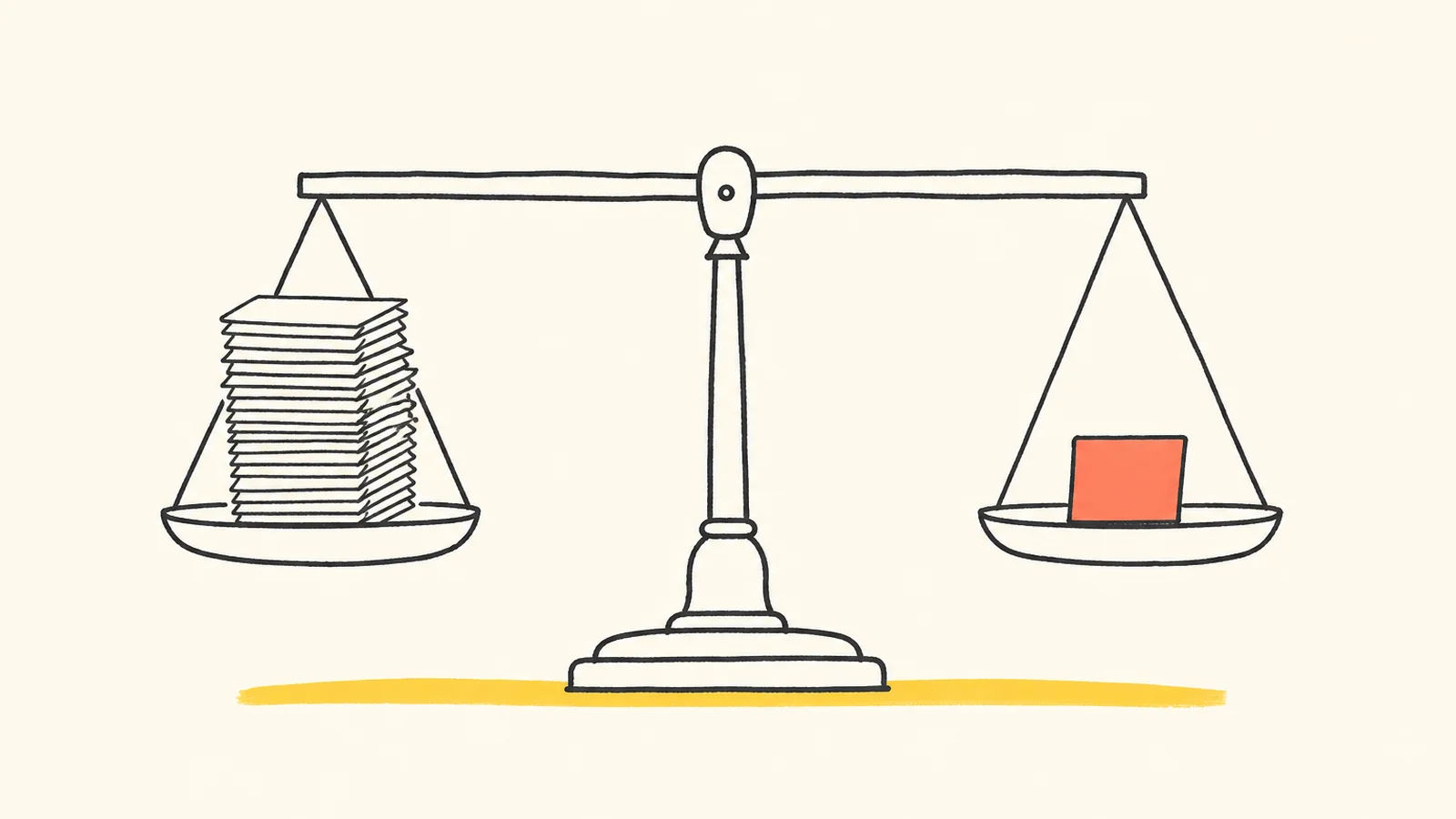
The decision fatigue moms describe is the worn-out feeling of being the household's default decider, and it comes from two piles. The first is repeating decisions such as dinner and snacks, which never close. A 2024 survey of 3,000 US parents by Weeks and Ruppanner found mothers said they mostly handled 79% of daily household thinking and fathers 37%, while repairs and finances were closer to even. Routines and written rules work well on this pile, and so does handing whole areas to a partner or to children. The second pile is loaded decisions such as screens, sleep and school, which feel like a verdict on you as a mother. Surveys link beliefs about ideal mothering, guilt and comparison with strain, though none measured decisions directly. Routines do not reach this pile. Questions do: what would this say about me, who told me that, and what would actually happen?
On this page+
The decision fatigue moms are describing is the worn-out feeling of being the household's default decider, and it comes from two different piles. One is choices that repeat every day and never close. The other is choices that feel like a verdict on you as a mother. Routines only clear the first.
You probably searched this after a small question landed badly. Someone asked what was for dinner, and what you felt was out of all proportion to dinner. So you tried the usual advice: plan the meals, lay out the clothes, batch the choices. Some of it helped, and you still feel it. This piece sorts the two piles behind the decision fatigue moms talk about, because each one has its own exit.
Why do so many decisions land on moms?
Many decisions land on moms because the ones that split most unevenly are the daily ones, and those never stop arriving. In 2024, Ana Catalano Weeks and Leah Ruppanner asked 3,000 US parents who mostly handles 21 pieces of household thinking, the cognitive labor behind running a home1. The answers fell into two groups.
Daily tasks, which they call "regular, essential, and daily", cover food, childcare, scheduling, cleaning and social life. Mothers said they mostly handled 79% of these, fathers 37%. Episodic tasks, "infrequent, easily delayed", cover repairs and finances. There the numbers were closer and reversed: fathers 65%, mothers 53%. The three items that used the word "deciding" show the same pattern:
Who says "mostly me"
Mothers
Fathers
Deciding what meals to cook
75%
39%
Deciding on a child care provider
62%
28%
Deciding how to allocate money
52%
57%
Mothers are not doing all of the deciding. Money is close to even. What they carry more of is the kind that cannot wait until Saturday, which is how one person quietly becomes the default parent. That is the part of the mental load this data can see.
Two limits. These are individual self-reports, not couples checked against each other, so the shares add up to more than 100%. And the study measured who handles what, not the decision fatigue moms report. Whether choosing itself wears you down is a separate and shakier claim, and we went through what the research says about decision fatigue in its own post. The tiredness is not in question. The tank theory is.
What makes the decision fatigue moms feel so hard to shake?
The decision fatigue moms feel is hard to shake because two different problems share one name. The first pile is repeating decisions: dinner, snacks, what goes in the bag, which activity this term. Each is small, and none of them closes, because the same question is back tomorrow. The second pile is loaded decisions: screens, sleep, going back to work, which school, whether to step in with a teacher. These come up less often and weigh far more, because the choice seems to say something about what kind of mother you are.
Most advice treats both as a matter of volume and prescribes fewer choices. That works on the first pile. It misses the second, where one choice can take up an entire week of thought. You can have a fully planned month of dinners and still lie awake over a single message to a teacher.
Repeating decisions
Loaded decisions
Example
What's for dinner
How much screen time is fine
What makes it heavy
It never closes
It seems to be about you
What a routine does
Settles it
Adds one more standard to fail
What helps
A rule, made once
Questions about the standard
Each pile also behaves differently when it goes unsettled. A repeating decision costs a little, many times. A loaded one tends to stay open in your head, which makes it one open decision you keep reopening long after the kids are asleep.
A meal plan can settle dinner. It cannot settle whether you are a good mother, and that is what some decisions are really asking.
Why don't routines reach the loaded decisions?
Routines don't reach loaded decisions because the weight is not in the logistics. It is in the standard you are measuring yourself against. Research on parenting decisions rarely tests this directly, but three sets of surveys point the same way.
In surveys of 181 mothers of children aged five and under, published in 2013, Kathryn Rizzo, Holly Schiffrin and Miriam Liss found that believing women are the essential parent was linked to lower life satisfaction, even after accounting for family support2. The same team found that guilt and shame tracked the gap between the mother you are and the mother you think you should be, along with fear of being judged3. That is the research version of mom guilt. And in a 2017 study of 721 mothers, those who compared themselves more on social media reported more role overload and lower parental competence4.
None of these studies measured decisions, and all of them are correlational. Feeling insecure may drive the comparing as much as the other way round. The link to your Tuesday afternoon is our reading of them, not their finding.
It fits what we see in sessions. When someone brings a small-looking parenting decision, the first thing on the board is rarely the options. It is what the choice would mean about them if it went badly. Once that is written down, the decision can shrink to its actual size. Sometimes it does not, and that is useful to know as well: some decisions are hard because they are hard.
So a loaded decision gets questions rather than a system. What would this say about me if it went badly? Who told me that? What would actually happen, and how soon could I change course? The last one matters most, because many of these choices can be revisited next month, and the regret you are bracing for is often bigger than the one you would get.
How do you clear the decisions that keep coming back?
You clear repeating decisions by turning each one into a rule you make once, then moving it off your desk entirely where you can. This is where the standard advice earns its place: most of what is written for the decision fatigue moms live with is aimed at this pile. Reducing decision fatigue as a mom really does start here, as long as you know where the pile ends.
Write the rule down, with its exception. "School nights are one of these four dinners, unless someone offers to cook." A rule in your head still has to be remembered, which keeps it on your list.
Hand over the whole thing, not the last step. If you still notice the problem and collect the options, you have kept most of it. We covered the four jobs behind each household decision separately, with a way to share them.
Give some of it to the kids. This is the exit most advice skips. A child who packs their own snack from an agreed shelf has taken a decision off your day, and older children can own a whole area.
That last one is not lowering the bar. Reviewing the research in 2008, Mireille Joussemet and colleagues listed "offering choices and encouraging initiative" as part of supporting a child's autonomy, and said this "should not be confused with permissiveness"5. You set the limits; the child decides inside them. That work looks at how children develop, and we found nothing testing whether it lightens the parent's load, so treat that part as a reasonable bet.
That exercise is close to how a session in Inwitt AI, an AI thinking partner app, tends to run. In the Decision thinking mode it asks one question at a time and draws your answers on the thinking board, so the standard you were measuring yourself against can be seen and argued with. It does not tell you what to do about screens or school. What you decide lands in a session receipt, in your words.
What only feels like it helps
Several common fixes for the decision fatigue moms feel look responsible and leave the weight where it was.
A routine for a loaded decision. A rule about screens can be useful, but if the rule is there to prove you are a good mother, every exception reopens the whole question. Ask about the standard first.
Researching until you are sure. Reading one more thread feels like diligence. On loaded decisions it often turns up facts that would not change your choice, and more verdicts to measure yourself against.
Polling the group chat. Asking other parents can be practical on the question of which dentist. On the question of what kind of parent to be, you get a survey of what other people defend. It helps to say what you want before you look.
Quoting the 35,000 decisions a day. It appears on many pages about parents, and it makes the tiredness feel scientific. One citation trace ended at a book that contains no such count6. You do not need the number. Your day is evidence enough that something is heavy.
A day off. Rest is good, and you should take it. The repeating pile will be waiting when you come back, and the loaded one often comes along with you.
Questions moms ask about decision fatigue
Is mom decision fatigue the same as burnout?
Not quite. Mom decision fatigue is an everyday description of being worn down by deciding, not a diagnosis, while burnout usually means a wider exhaustion with the role itself. If low mood, dread or being unable to decide anything lasts for weeks, particularly after a birth, that is worth raising with a doctor. A better meal plan is not the right tool for that.
What can single moms do with no one to hand things to?
The partner advice does not apply, and the data shows why it matters. Among the 460 single parents in the Weeks and Ruppanner study, the two groups of tasks collapsed into one, and single mothers said they mostly handled 90% of daily tasks. For single moms, rules and kids carry more of the weight, along with anyone outside the house who can own one specific thing, such as the same friend doing one school run. Asking for one named job is easier to say yes to than asking for help.
What if my partner thinks it is already shared?
Go through it item by item instead of arguing about the whole. In the same study, fathers' overall estimate of their share ran 16 points above their item-by-item count, and mothers' ran 7. Both see more of their own work when they estimate in general, and a list of specific tasks gives you something to compare.
Where should I start?
Start with the one repeating decision that arrives at the worst moment of your day, and write one rule for it. Leave everything else alone for a week. Being the default decider took years to build, and it does not need a whole new system by Sunday.
The sheet above gets one R and one L out of your head and onto paper. A session does the same at the speed of a conversation: one question at a time, your answers on the board, and a receipt in your own words of what you decided. If you want somewhere to take the decision you keep coming back to, join the Inwitt waitlist.
Footnotes
Ana Catalano Weeks and Leah Ruppanner, "A typology of US parents' mental loads: Core and episodic cognitive labor", Journal of Marriage and Family (published online 2024). Journal record↩
Rizzo, Schiffrin and Liss, "Insight into the parenthood paradox: Mental health outcomes of intensive mothering", Journal of Child and Family Studies 22 (2013). Journal record↩
Liss, Schiffrin and Rizzo, "Maternal guilt and shame: The role of self-discrepancy and fear of negative evaluation", Journal of Child and Family Studies (2013). Journal record↩
Coyne, McDaniel and Stockdale, "Do you dare to compare? Associations between maternal social comparisons on social networking sites and parenting, mental health, and romantic relationship outcomes", Computers in Human Behavior 70, 335-340 (2017). Repository record↩
Joussemet, Landry and Koestner, "A self-determination theory perspective on parenting", Canadian Psychology 49(3), 194-200 (2008). Journal record↩
El Call, "Do We Really Make 35,000 Decisions a Day?", Did The Research (January 2024), a secondary citation trace. Article↩