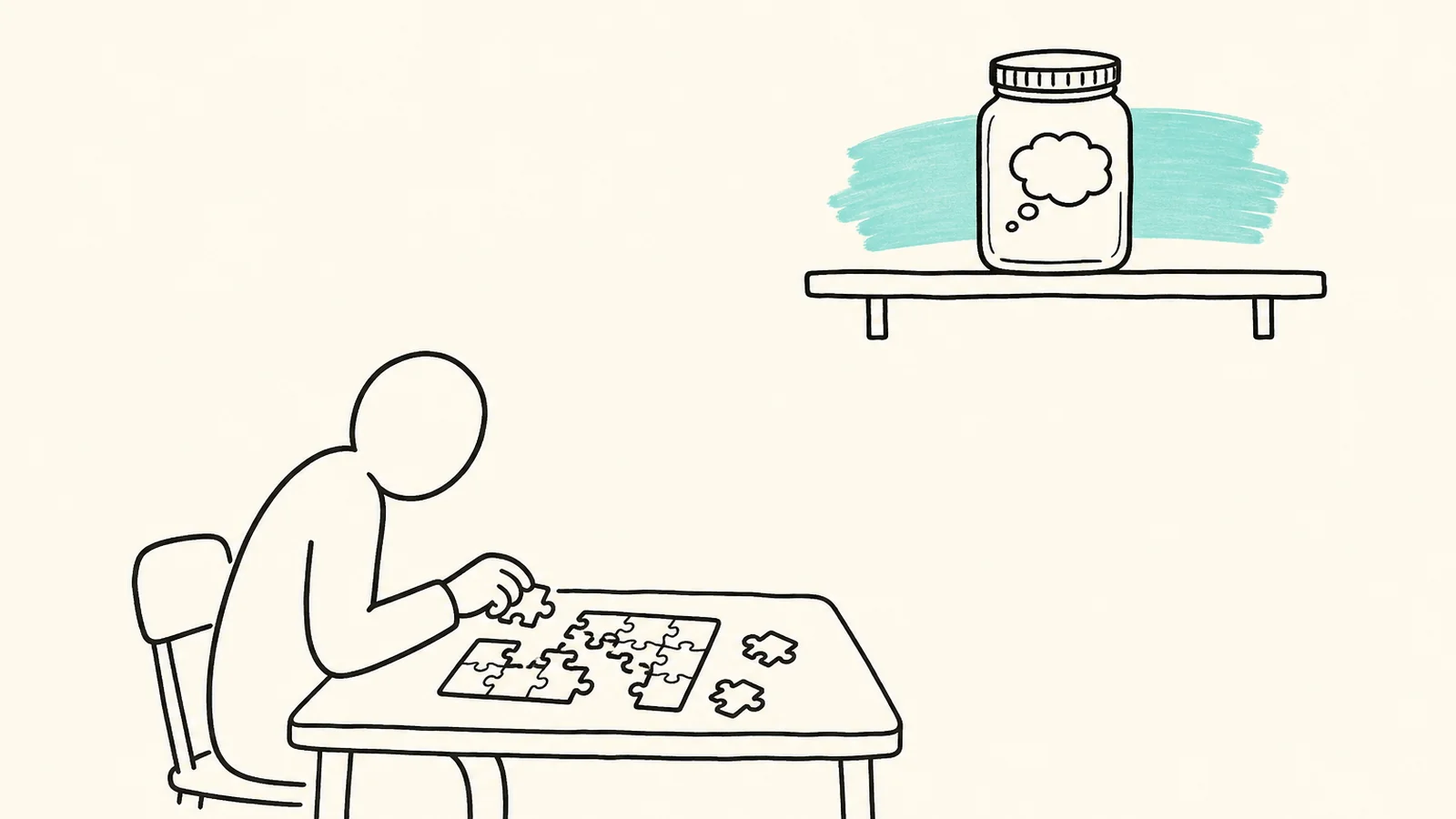
The answer to how to get your mind off something starts with sorting the thought: is it waiting on news you cannot change, or unfinished business where a move is still yours to make? For a waiting thought, distraction works when it absorbs you. In 2019, Rankin, Walsh and Sweeny found that law graduates awaiting bar results and doctoral students on the job market who spent more of the wait in flow worried less and felt better, while passive options like television or social media rarely hold attention. Choose one specific, slightly challenging activity in advance: in Wegner's 1987 thought suppression study, one planned distractor reduced the later rebound of an unwanted thought. For an unfinished thought, distraction loses until the thought has a plan. Masicampo and Baumeister showed in 2011 that writing how, when and where you will act on an unfinished task stopped it intruding on other work. Distraction becomes avoidance when it replaces a step that has a real deadline.
On this page+
The answer to how to get your mind off something is to decide first what kind of thought it is. If you are waiting on news you cannot change, pick one absorbing, slightly hard activity and give it your full attention. If the thought is unfinished business, write its next step and when you will take it. Then distraction has a chance to work.
You are probably here because one thing has taken over the evening: an interview result that has not come in, a message nobody has answered, a comment from work on repeat, a choice you have put off for a week. You have tried a film, a walk, your phone, and the thought rode along with all of them. Most advice on how to get your mind off something gives you ten tactics at equal weight. This piece starts one step earlier, with the question that decides which tactic you need. If the thought is about a person rather than a thing, that has its own approach, and loops in general have two exits of their own.
You can't stop thinking about something by deciding to, because telling your mind to avoid a thought sets it watching for that thought. In 1987, Daniel Wegner and his colleagues asked people to spend five minutes not thinking about a white bear and to ring a bell whenever they did. They rang it anyway. Afterwards, when they were allowed to think about the bear, they thought about it more than people who had been free to think about it from the start1.
The same paper holds a second finding that gets quoted far less. In the second experiment, people who were given one specific thing to think about instead, while they suppressed, were less preoccupied with the bear afterwards1. "Don't think about it" fails. "Think about this instead" does better. That is the case for distraction in two sentences, and the reason the choice of distraction matters more than the effort you put into it. There is more on why pushing a thought away brings it back in another post.
What the research does not say is that every thought can be distracted away. When you can't stop thinking about something, it is often because the thought is still owed something, and no film will pay that debt. Which brings us to the sorting step.
Is the thought waiting or unfinished?
Almost every thought you want off your mind is one of two kinds: waiting or unfinished. A waiting thought is about an outcome that is out of your hands until news arrives: the test result, the offer, the reply, someone else's verdict. There is nothing left for you to do, and the mind keeps checking anyway. An unfinished thought is about something where a move is still yours to make: the conversation you have not had, the email you have not sent, the decision you keep reopening.
The test is one question: is there a move here that is mine to make? If the honest answer is no, the thought is waiting. If yes, it is unfinished, even when the move is small or unpleasant.
Waiting thought
Unfinished thought
Sounds like
"What if they say no?"
"I really need to deal with that."
A move that is yours?
No, not until news arrives
Yes, even a small one
What distraction does
Helps, if it absorbs you
Buys an hour, then the thought returns
What ends it
The news, or time spent well
A written next step with a day attached
Many thoughts are both. Waiting for a job offer is waiting; deciding what you will say if the number comes in low is unfinished. Pulling the two apart is half of how to get your mind off something, because each half now has a tool. If a worry feels too tangled to split, making it specific first helps.
In sessions, the pattern we see most is an unfinished thought treated as a waiting one. People try to wait out a decision that is theirs to make, and the decision does not wait with them.
How to get your mind off something you are waiting on
To get your mind off something you are waiting on, choose an activity that needs all of your attention and has a small challenge in it, decide on it before the spiral starts, and stay with that one thing. Passive distraction rarely holds a worried mind for long.
The best evidence here comes from Kate Sweeny's lab, which studies the stretch between doing something and hearing how it went. In 2019, Kyla Rankin, Lisa Walsh and Sweeny followed law graduates waiting for their bar exam results and doctoral students on the academic job market. Those who spent more of the wait in flow, the state of being absorbed in a task that stretches you, reported less worry and felt better2. In a lab study, students waited for peers to rate their attractiveness while playing Tetris that got harder as they improved. That version lifted their mood more than a boring or a frustrating one did. It did not cut worry on its own, but the students who actually reached flow were the ones who worried less2.
Two details from that work matter more than the headline. The authors suspect that people waiting for news reach for passive activities, television or social media, that are not engaging enough to crowd out the worry. And many participants could not name an activity that put them in flow at all. Most advice on how to distract yourself skips this: the choosing has to happen before you need it.
What tends to make a distraction absorbing:
A clear goal you can reach soon: finish this level, this chapter, this row of stitches, this lap.
A little difficulty: hard enough that your attention is needed, easy enough that you are not frustrated.
Feedback as you go: you can see whether it is working.
Your hands or body involved where possible. Cooking a new recipe beats scrolling through recipes.
Wegner's second experiment adds one more rule: one specific thing, chosen in advance, works better than trying to stay generally busy. Write a list of three absorbing activities in advance, so that on a waiting day you choose from the list instead of from the sofa.
Distraction is a good tool for waiting and a bad one for deciding.
What if the thought is unfinished?
If the thought is unfinished, distraction alone will lose, because the mind keeps returning to open business until that business has a plan. Write the next step, when you will take it and where, and then distract yourself. The plan is what releases the thought; the activity only fills the space it leaves.
In 2011, the psychologists E. J. Masicampo and Roy Baumeister had people name important tasks they had not finished, then gave them an unrelated reading task. Their minds kept wandering back to the tasks.
People who first wrote a specific plan for each task, how, when and where they would act, did not show those extra intrusions, even though they had done none of the work yet3. The plan had to be meant: in a later study, the people who went on to carry out their plans were the ones whose intrusions disappeared3.
That is most of how to get something out of your head when it keeps coming back: give it a next step small enough to be real. "Sort out the flat situation" is not a plan. "Text the landlord on Thursday at lunch and ask whether the lease can run to March" is. If the next step is itself a decision you have been avoiding, it has its own shape: a stuck decision is usually waiting on one missing piece, and naming that piece is the step.
What makes the page work is that the answer is yours and it is visible. A session in Inwitt AI, an AI thinking partner app, works the same way: it asks one question at a time, and only what you confirm goes onto the thinking board, so you leave with your own next step in writing rather than a suggestion you have to argue with.
When is distraction the wrong move?
Distraction is the wrong move when it stands in for a move that is yours to make, when that move has a real deadline, or when the feeling underneath needs attention rather than cover. Healthy distraction gives your mind a rest from a thought it cannot act on. Unhealthy distraction keeps you away from one it should act on. Part of knowing how to get your mind off something is knowing when not to.
A quick check: imagine being distracted for a whole week. If the thing would still be there afterwards, unchanged and closer to its deadline, the distraction is avoidance. The same goes for grief, anger at someone you love, or a disappointment you have not let yourself feel. Those usually settle faster when you give them some time on purpose, a walk or a page or a conversation, than when you keep them at arm's length.
Sometimes a thought is neither waiting nor unfinished. If the same thoughts arrive every day for weeks, frighten you, or take your sleep, work or appetite, take that to a doctor or a therapist. That is a sensible step, not a failure of technique.
What only feels like a way to take your mind off things
Some of the most common answers to how to get your mind off something keep the thought running underneath. These are the ones we see most often.
Scrolling or background television. They fill the eyes and leave the mind free to wander back, which is exactly the kind of passive activity the waiting studies point to. It feels like rest; it is the thought with a soundtrack.
Checking for the news. Refreshing the inbox, the portal, the message thread. Each check restarts the wait. If you are waiting for news, decide when you will check, once or twice a day, and leave it alone in between.
Choosing a distraction in the middle of the spiral. At that point you will pick whatever is closest, which is usually the phone. Choose from the list you made on a quiet day.
Talking it over as a distraction. Talking to a friend helps when you are working something out. Rehearsing the same worry aloud for the fourth time is the loop with an audience. Ask them to talk about something else, or about what you could actually do next.
Listing your options again. For an unfinished thought, going back over the possibilities feels like progress and is the loop itself. A plan names one step, not five.
Trying to stop the thought. See the white bear. Give it a page, not a wall.
Questions people ask about how to get your mind off something
Is it healthy to distract yourself?
Yes, when the thing you are distracting yourself from is out of your hands for now. Absorbing distraction during a wait is linked to less worry and better mood. It turns unhealthy when it replaces a move that is yours to make, or when it becomes the only way you ever meet a hard feeling.
How do you get something out of your head for good?
Usually by closing what it is asking for. A waiting thought ends when the news comes; an unfinished one quiets when it has a plan you mean to keep, and ends when you keep it. You may still remember it, but it stops intruding.
Why do I keep thinking about something that already happened?
Because part of it is often still open: an apology not made, a meaning you have not settled, a lesson you have not written down. Ask what is still unfinished about it. If the honest answer is nothing, it is a memory you are visiting, and an absorbing activity will help you move on from it.
What should I do while waiting for test results?
Decide when you will check, then fill the time in between with things that need your full attention and give you a small challenge. Make the list before the bad hour arrives. If the waiting keeps you awake, there is more on what to do with thoughts that arrive at night.
One question sits at the center of how to get your mind off something, and a session keeps asking it in different forms: is there a move here that is yours? You answer it in your own words, the board keeps only what you confirmed, and the receipt at the end holds your next step and the day you chose for it. If something has been riding along with every distraction you try, join the Inwitt waitlist and bring that one sentence with you.
Footnotes
Daniel M. Wegner, David J. Schneider, Samuel R. Carter III and Teri L. White, "Paradoxical effects of thought suppression", Journal of Personality and Social Psychology 53(1), 5-13 (1987). Journal record↩↩2
Kyla Rankin, Lisa C. Walsh and Kate Sweeny, "A better distraction: Exploring the benefits of flow during uncertain waiting periods", Emotion 19, 818-828 (2019). Journal record. The authors' plain-language summary: SPSP Character & Context, October 2019. ↩↩2
E. J. Masicampo and Roy F. Baumeister, "Consider it done! Plan making can eliminate the cognitive effects of unfulfilled goals", Journal of Personality and Social Psychology 101(4), 667-683 (2011). Author PDF↩↩2