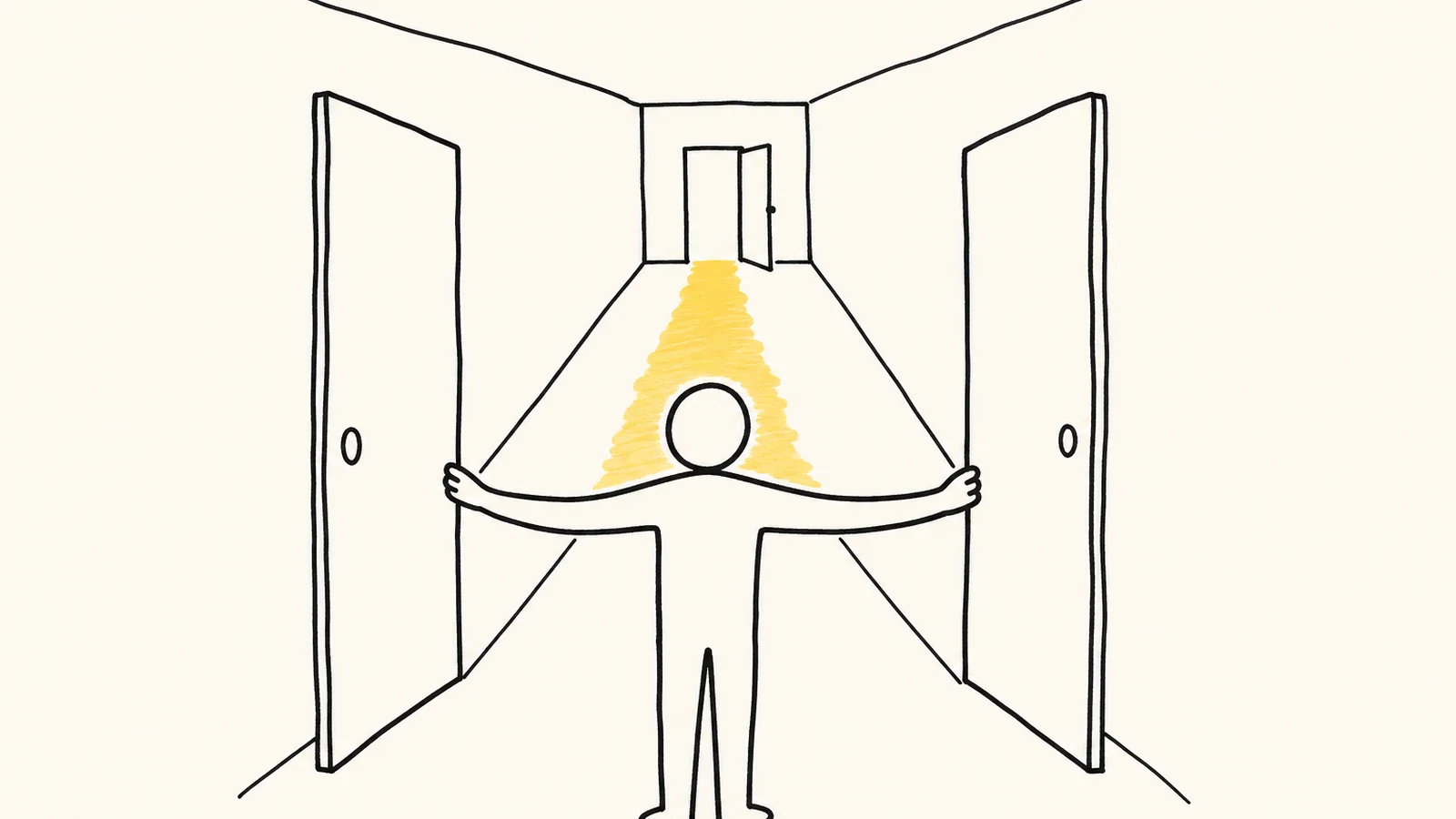
When you can't make a decision, it is usually waiting on one missing piece rather than on more thought: a fact that would change the choice, a criterion for breaking the tie, a loss you have not accepted, another person's answer, or nothing at all, because you have already chosen. The reason most advice gives first, too many options, has weak evidence. A 2010 meta-analysis of 50 experiments found an average choice-overload effect of virtually zero, and 40 replications published in 2023 cast doubt on the idea that a hard trade-off makes people put decisions off. What holds up better is that people pay to keep options open even when those options matter little to them, and that decisions they can reverse leave them less satisfied. Indecisive people also gather more information, mostly about the option they end up choosing. One test question for each missing piece, answered fast in writing, shows which one is holding the decision open.
On this page+
When you can't make a decision, the decision is usually waiting on one thing you have not named: a fact that would change it, a rule for breaking the tie, a loss you have not accepted, someone else's answer, or nothing, because you have already chosen. Find which one, and the next step is plain. More thinking in general rarely helps.
You have probably done the thinking already. You have made the list, asked three friends and slept on it twice, and the two options still sit at the same height. That is a sign your trouble making decisions is not a shortage of thought. What follows are the five things a stuck decision tends to wait on, the question that tests for each, and what the research says about the reasons most advice gives.
Why can't I make decisions?
Usually because the decision is missing a specific piece, not because something is wrong with you. The common explanations (fear of failure, perfectionism, low self-trust) describe how indecision feels. They are often true and not very useful, because knowing you are afraid of choosing wrong does not tell you what to do on Tuesday. Research on chronic indecisiveness has found it is not linked to intelligence, which researchers read as a difference in what people want from a decision rather than in ability1. Indecisive people are not slower thinkers; they want something from the decision that it cannot give them yet.
In sessions, we see the same shape again and again. Someone describes the two options at length, in careful detail, and then mentions the missing thing once, in passing, often as a joke: something like "I'd have to tell my dad, obviously." That throwaway line is usually where the decision is stuck. The options were never the problem.
Feeling unable to make decisions about everything, rather than about this one, is a different question, and the FAQ below takes it. This piece is about the single decision you have been carrying for weeks.
Is it really too many options?
Probably not, even though it is the reason almost every guide gives first. The idea that more choice freezes people became popular after a few striking experiments, and it has turned out to be fragile. In 2010, Benjamin Scheibehenne, Rainer Greifeneder and Peter Todd pooled 50 experiments with 5,036 participants and found an average choice-overload effect of virtually zero2. Some studies found strong effects, others found that more options helped, and the authors could not identify any set of conditions that reliably produces overload.
The narrower version, that two good options pulling in different directions make you put the choice off, fares no better. Amos Tversky and Eldar Shafir reported that effect in 1992. In 2023, Ioannis Evangelidis, Jonathan Levav and Itamar Simonson ran 40 well-powered replications of it and related work with 26,703 participants, and concluded that their results cast doubt on the original findings3.
None of this means a hard trade-off feels easy. It means the trade-off alone is a poor explanation for why you can't make a decision three weeks after the options stopped changing. Something else is holding it open.
What to do when you can't make a decision
Name what the decision is waiting on, then do the one thing that supplies it. Five missing pieces cover almost every stuck decision we see, and each has a question that tests for it.
It is waiting on
How it sounds
The test question
The exit
A fact
"I need to know more first"
If I learned it, would I go the other way?
Get that one fact, or drop it
A criterion
"They are both good in different ways"
Which one thing would I accept losing on?
Rank one criterion above the rest
An accepted loss
"I don't want to rule anything out"
What do I lose for good if I pick A?
Say the loss out loud, once
Someone else
"It depends how they would feel"
Whose answer is this waiting for?
Ask them, not yourself
Nothing
"I just want to be sure"
Which option do I keep collecting reasons for?
Admit the choice is made
The table works because each row asks for a different action. A missing fact needs a phone call or a search with an end. A missing criterion needs a ranking, which is uncomfortable because it means saying that salary matters more than the commute, or the reverse. A loss needs naming.
A decision that waits on someone else needs a conversation, and no amount of solo thinking will stand in for it. Sorting a thought by who could actually answer it is often the fastest way out. The last row is the most common and the least admitted. If you can't make a decision but keep reading reviews of one of the options, you are no longer deciding; you are asking for permission.
If you go through all five and none applies, the options really are close. Then the choice matters less than finishing it, and any fair way of picking will do.
Why does more research not settle it?
Because past a point, research stops being research and turns into reassurance. Studies of indecisive people using information boards, grids where each cell hides one fact about one option, have found that they take longer, open more cells, and spend a larger share of their search on the option they end up choosing1. Researchers call this tunnel vision. The extra search does not buy better choices. It buys confidence in a choice that was leaning one way from the start.
You can test this on your own search. Before you look anything else up, write down what you expect to find and which way it would push you. If every plausible answer leads to the same option, that fact is not why you can't make a decision, and the search is a way of not finishing. If one answer would genuinely flip you, that is the single fact worth getting, and it usually takes a day, not a month.
Because closing an option registers as a loss, and people pay to avoid losses even when the option is worth little. In 2004, Jiwoong Shin and Dan Ariely ran four experiments with "door games" in which options disappeared unless people spent effort on them4. Players spent effort and money to keep doors open even when what was behind them held little interest. They kept doing it when told about the outcomes, after practice, and when the cost was made obvious, and the evidence pointed to loss aversion rather than a sensible wish to stay flexible.
The cost does not end at the moment of choosing. Daniel Gilbert and Jane Ebert, in a 2002 study, had photography students choose one of two prints they had made to keep5. Students who were told they could swap later liked the print they kept less than students whose choice was final, and the students asked to forecast this predicted no difference. In a follow-up, 66.3% of 89 students still preferred the version of the study where they could change their minds, the version that left people least satisfied.
Keeping a decision reversible feels like the safe move. It also keeps the comparison running, which is the thing you wanted to stop.
An option you keep open is not free. You pay for it every day you do not close it.
This is why the "accepted loss" row matters. You are allowed to be sad about the option you do not pick. Saying "I am giving up X, and that is a real loss" out loud, once, does more than another list of pros, because the list was never what held the door open.
How do you find what your decision is waiting on?
Answer the five test questions quickly, in writing, and watch which one you hesitate on. Speed matters here: the careful answer is usually the defended one, and the first answer is usually the honest one.
Here is how it might go. Say you can't make a decision between staying in your job and taking an offer in another city. The fact question gets a quick answer: there is nothing left to find out. The criterion question comes out as "growth over money". The loss question stalls, because the offer means moving away from friends you see every week, and you have not said that to yourself in plain words.
That stalled line is the decision. Once it is written down, the choice turns into a different and more honest question: is the growth worth that loss? That one can be answered.
This is the move Inwitt AI is built around. In Decision, one of the six thinking modes, the AI thinking partner app asks one question at a time and writes your answers onto a thinking board, so the line you skipped stays visible instead of disappearing into a longer list. It does not tell you which option to pick. It keeps asking until you can see what you were waiting for.
What only feels like progress?
When you can't make a decision, several habits feel like deciding and keep it open instead.
Rewriting the pros and cons list. A second or third version of the same list adds length, not information. If the list did not settle it the first time, the missing piece is not on it.
Polling friends. Asking five people helps when you need a fact they have. More often it is a search for someone to make the call, and the answers cancel out. If the decision really is waiting on one person, ask that one person.
Waiting until you feel sure. Certainty tends to arrive after a choice, not before it. Waiting for it means a default or a deadline decides for you, and not deciding is a choice of its own.
Setting a deadline without naming what it is for. A deadline helps when you know what you will do before it. Without that, it moves the same stuck week to a later date.
Flipping a coin when the options are not close. A coin is fine for the last case, when the options really are equal. Used earlier, it hides the missing piece instead of finding it.
Questions people ask about indecision
Why am I so indecisive about everything?
When the trouble shows up in every decision, it often travels with perfectionism and with maximizing, the wish to find the best option rather than a good one1. One heavy decision left open can also spill into the rest of the day, because one open decision makes the small ones feel heavier. Start with the biggest stuck decision, not the small ones.
Is indecisiveness a sign of anxiety or depression?
It can be part of both. Difficulty making decisions that is new, shows up everywhere, and comes with changes in mood, sleep or energy is worth taking to a doctor or a therapist. The exercise above is for one stuck decision, not a treatment for either.
Does a deadline help when you are paralyzed by indecision?
Only when it is attached to the missing piece. "I will call the recruiter by Friday and decide on Monday" works. "I will decide by Friday" tends to produce a stressful Thursday and no decision.
Is it bad to change your mind after deciding?
Not if something new has come up. If nothing has, reopening it is usually the comparison starting again, and the Gilbert and Ebert study suggests that costs you satisfaction with whatever you chose. Judge a past choice by how it was made, not only by how it turned out.
The next time you can't make a decision, the five questions take two minutes on paper, and they work better when something keeps asking after the first easy answer. That is what a session does: it asks, you answer, and the decision ends up on a session receipt in your own words. If there is one you have been carrying for weeks, join the Inwitt waitlist and bring it with you.
Footnotes
Patalano and LeClair, "The influence of group decision making on indecisiveness-related decisional confidence", Judgment and Decision Making 6(2), 163-175 (2011), reviewing Ferrari and Dovidio (1997, 2000, 2001) and Rassin and colleagues (2008). Open-access paper↩↩2↩3
Scheibehenne, Greifeneder and Todd, "Can there ever be too many options? A meta-analytic review of choice overload", Journal of Consumer Research 37(3), 409-425 (2010). Journal record↩
Evangelidis, Levav and Simonson, "A reexamination of the impact of decision conflict on choice deferral", Management Science 69(5) (2023). Journal record↩
Shin and Ariely, "Keeping doors open: The effect of unavailability on incentives to keep options viable", Management Science 50(5), 575-586 (2004). Journal record↩
Gilbert and Ebert, "Decisions and revisions: The affective forecasting of changeable outcomes", Journal of Personality and Social Psychology 82(4), 503-514 (2002). Journal record↩