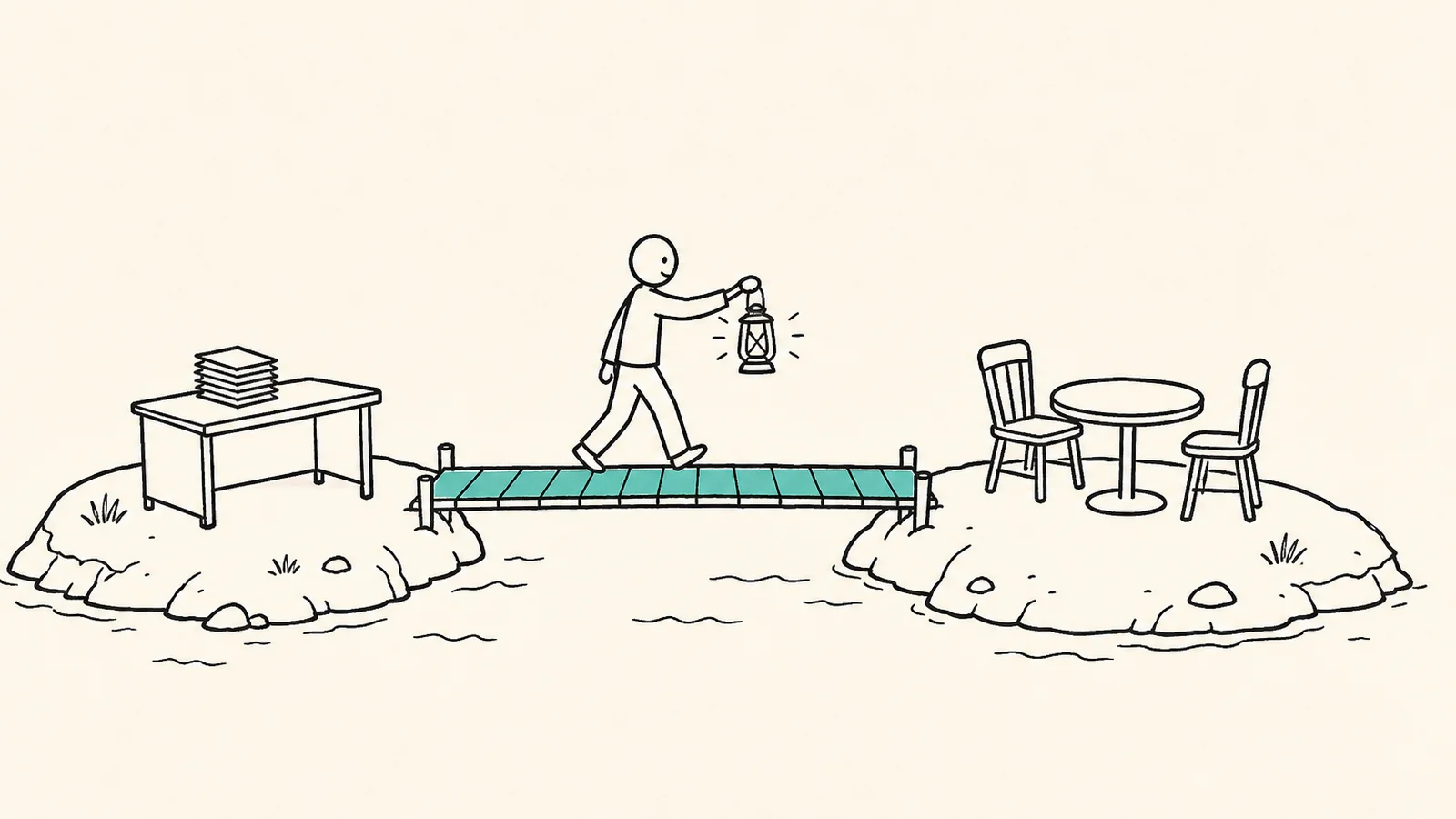
Thinking skills are the mental moves used to work with information: interpreting, analyzing, evaluating, inferring, generating options, deciding and checking your own reasoning. Most lists group them into five types: critical thinking, creative thinking, problem solving, decision making and metacognition. Research on transfer of learning, reviewed by David Perkins and Gavriel Salomon in 1992, adds a caution most lists leave out: a skill often stays in the setting where it was learned. People who had solved one puzzle usually failed to recognize the same puzzle told as a different story until someone pointed out the link. Three conditions help a skill carry over: putting the principle into words, monitoring your own thinking while you use it, and practicing on situations close to the real one. A practical form is to write each skill as a question, such as how do I know this is true, or what else could this be, and run those questions on one real decision, in writing.
On this page+
Thinking skills are the mental moves you use to make sense of information and act on it: interpreting, analyzing, judging, inferring, generating options, deciding, and checking your own reasoning. Most lists group them into five types: critical thinking, creative thinking, problem solving, decision making and metacognition. Each one is easier to use when you can phrase it as a question.
You may be here because a job description, a school report or a worry about AI used the phrase, and you looked up the thinking skills meaning to see what it actually covers. Every page on the subject gives the same five nouns and then says the skills "can be developed with practice". That is true and leaves out the part that matters most. Decades of research on learning show that thinking skills tend to stay where you learned them. Being sharp in meetings does not guarantee being sharp about your own life.
This piece gives a working definition, the five types written as the question each one asks, the evidence on why the skills do not carry over by themselves, and what makes them carry.
What are thinking skills?
Thinking skills are the abilities you use to work with information rather than just store it: making sense of it, testing it, drawing conclusions from it, producing new options from it, and choosing what to do. Knowledge is what you know. Thinking skills are what you do with it.
The most careful definition comes from a panel of 46 experts convened by the American Philosophical Association, summarized by the philosopher Peter Facione1. They agreed on six core skills: interpretation, analysis, evaluation, inference, explanation and self-regulation. The last one is the skill of watching your own reasoning. Facione's plain version is a question you ask yourself mid-thought: "How am I doing? Have I missed anything important?"
Schools tend to use a different map, Bloom's taxonomy, which ranks thinking from remembering and understanding up to analyzing, evaluating and creating. The top three are what teachers mean by the higher order reasoning skills in Bloom's taxonomy.
Both maps agree on the useful thinking skills definition for an adult: these are things you do, not things you have. You can read about analysis all week and still not analyze the decision in front of you. That gap between knowing the word and doing the move is where the rest of this piece lives.
What are the main types of thinking skills?
The five types most lists name are critical thinking, creative thinking, problem solving, decision making and metacognition. They overlap, and some lists swap in logical reasoning or systems thinking, but these five cover most of what people mean.
The labels are easy to memorize and hard to use, because a noun does not tell you what to do next. A question does. Here is each type with the question that runs it and the trace it leaves when you have actually used it.
Skill
What it does
The question that runs it
How you know you used it
Critical thinking
Tests whether a claim or belief holds
How do I know this is true?
You can name the evidence, and what would change your mind
Creative thinking
Produces options that were not on the table
What else could this be?
You have more than two options, and one surprised you
Problem solving
Finds the real problem and a way through it
What exactly is the problem, and what is in the way?
The problem is one sentence, and it is not a symptom
Decision making
Commits to one option among several
What would make me pick one over the other?
You wrote the deciding reason before you chose
Metacognition
Watches and corrects your own thinking
How am I thinking about this right now?
You caught yourself rushing, avoiding or repeating
The right-hand column matters more than the left. A skill you used leaves a trace you can point to afterward. If there is no trace, the skill probably did not run, however much it felt like thinking.
This is the same idea behind writing the seven steps of critical thinking as questions with a written output for each. The question gives the skill a starting point. The written answer proves it happened.
Why don't thinking skills carry over from one situation to another?
Thinking skills often fail to carry over because the mind files a skill with the place it was learned, and it only comes back out when something in a new situation cues it. Without the cue, the skill sits unused.
The psychologists David Perkins and Gavriel Salomon reviewed decades of studies on this, which researchers call transfer of learning, in 19922. Their summary is blunt: "very often the hoped-for transfer from learning experiences does not occur." The classic case is a century old. Edward Thorndike tested the popular idea that studying Latin trained the mind for everything else, and found no advantage in other school subjects. Later studies found the same for the claim that learning to program would build general problem solving.
The most telling experiments used puzzles with identical logic and different stories, such as the Tower of Hanoi rewritten as monsters passing crystal globes. People who had solved one usually did not recognize the other. When someone pointed out the connection, they used what they knew without trouble. The skill was there the whole time. What was missing was the signal that it applied.
We see the same pattern in sessions. People who run sharp analysis at work go blank on their own decision at the kitchen table. It is rarely a missing skill. A spreadsheet at work cues analysis. A decision about your own life arrives with feelings attached and no cue at all.
How do you make a thinking skill work anywhere?
You make a thinking skill portable by doing three things the research links to transfer: name the principle in words, watch your own thinking while you use it, and practice on situations close to the ones you care about.
Name the principle. In experiments by Mary Gick and Keith Holyoak, the people who wrote the fullest summary of the principle behind a solved problem were the most successful with a similar problem later. Putting the move into words is what lets you spot it in a new setting. A question is the most portable form a principle can take.
Watch your own thinking. When Perkins and Salomon looked at why some studies teaching children memory strategies achieved transfer and most did not, the factor that appeared to explain success was teaching the children to monitor their own thinking, not just to apply the strategy. Metacognition is the skill that cues the others.
Practice close to the real thing. Perkins and Salomon call this hugging: practicing something that closely resembles the real performance, such as trial exams rather than talk about exam technique. Pair it with bridging, deliberately asking how the lesson connects to elsewhere.
Their own bridging questions are worth copying onto a card: What is the general pattern? What is needed? What principles might apply? What is known that might help?
A thinking skill you cannot phrase as a question is one you will only use where you learned it.
Most people circle a different question from the one they expected. People proud of their critical thinking often stall on "What else could this be?", and people full of ideas stall on "What would make me pick one?"
Can you improve your thinking ability as an adult?
Yes, but mostly by practicing on the kind of problem you want to get better at. General thinking ability is less general than it sounds, and the transfer research explains why: practice improves the thing you practiced and spreads only as far as the cues reach.
That is the honest problem with brain games and puzzle apps. They make you better at the games. If you want to reason better about your career, your money or a relationship, the practice that counts is reasoning about those things, slowly, on paper, with the questions above. The research on what improves critical thinking points the same way: real problems, discussion, and explicit attention to the moves you are making.
The practical version is small. Take one live decision a week. Run the five questions. Write the answers. A month later, read them back and check which questions you skipped. That last step is metacognition doing its job, and it is the habit most adults never build.
This is the habit we built Inwitt AI around. It is an AI thinking partner app that does not answer for you. It asks one question at a time and draws your answers on a board, so the reasoning sits in front of you where you can check it. Its six thinking modes roughly follow the skills in the table: Decision, Critical, Problem-solving and others, each with its own line of questions. The thinking stays yours. The questions are the cue.
Why do thinking skills matter more now?
Thinking skills matter more now because tools can produce answers instantly, which shifts the value to judging those answers and deciding what to do with them. Employers say so directly. In the World Economic Forum's Future of Jobs Report 2025, nearly 70% of employers called analytical thinking an essential core skill, and 57% said the same of creative thinking3.
AI adds a second reason. A skill you hand over is a skill you stop practicing, and skills you stop practicing fade. We looked at the recent trials in whether GenAI is making us dumber: the loss shows up in exactly the steps people skip. The same holds for generating options. Studies of AI and creative range find that ideas made with AI help drift toward each other.
None of this means avoiding the tools. It means knowing which skill you are using at any moment and keeping the ones you want to keep in regular use. A calculator did not end arithmetic for people who still check whether the answer looks right.
Common mistakes when building thinking skills
The most common mistake is treating thinking skills as knowledge to collect rather than moves to practice.
Collecting frameworks. Knowing ten decision models is not the same as using one well. Pick one set of questions and use it until it is automatic.
Practicing on puzzles only. Puzzles train puzzles. If you want better judgment about your own life, practice on your own life.
Only thinking about low-stakes cases. Easy decisions do not need the skills, so they do not exercise them. Use the questions on the decision you keep avoiding.
Never writing it down. Reasoning kept in your head feels complete and usually is not. A written answer can be checked; a feeling of having thought cannot.
Judging the skill by the outcome. A good result does not prove good thinking, and a bad one does not prove bad thinking. Judge how the decision was made, not only how it turned out.
Questions people ask about thinking skills
What is the difference between thinking skills and cognitive skills?
Cognitive skills is the wider term. It includes memory, attention and processing speed, which are partly fixed and change with age. Thinking skills are the subset you use deliberately on information, such as analyzing, evaluating and deciding, and they respond much more to practice.
Are thinking skills soft skills?
They are often listed with soft skills because they do not belong to one job or subject. The label undersells them. Unlike charm or confidence, a thinking skill leaves a visible trace: a stated reason, a tested assumption, a written option you would not otherwise have had.
What are higher order thinking skills?
They are the upper levels of Bloom's taxonomy: analyzing, evaluating and creating, as opposed to remembering, understanding and applying. In practice they are the skills that take effort, and they are the ones that fade first when a tool or a habit does them for you.
What are examples of thinking skills in daily life?
Checking whether a headline matches the study it cites is critical thinking. Listing three ways to handle a clash with a colleague is creative thinking. Choosing between two job offers by first writing what matters most is decision making. Noticing that you have reread the same email five times is metacognition.
The five questions on a page are a small version of what a session does: one question at a time, your answer written down, and a look at what you wrote before you move on. If you want that for a decision you keep carrying around, with the questions asked for you and your reasoning drawn as it forms, join the Inwitt waitlist.
Footnotes
Facione, P. A. (2023 update). Critical Thinking: What It Is and Why It Counts. Insight Assessment. Summarizes the American Philosophical Association Delphi consensus (1990). Insight Assessment PDF↩
David Perkins and Gavriel Salomon, "Transfer of Learning", in International Encyclopedia of Education, second edition, Pergamon Press (1992); reviews Thorndike (1923), Simon and Hayes (1977), Gick and Holyoak (1980, 1983) and Belmont, Butterfield and Ferretti (1982). Author copy↩
World Economic Forum, Future of Jobs Report 2025 (January 2025), as reported by Steph Brown, "Analytical thinking remains top core skill for employers", FM Magazine, 18 February 2025. FM Magazine article↩