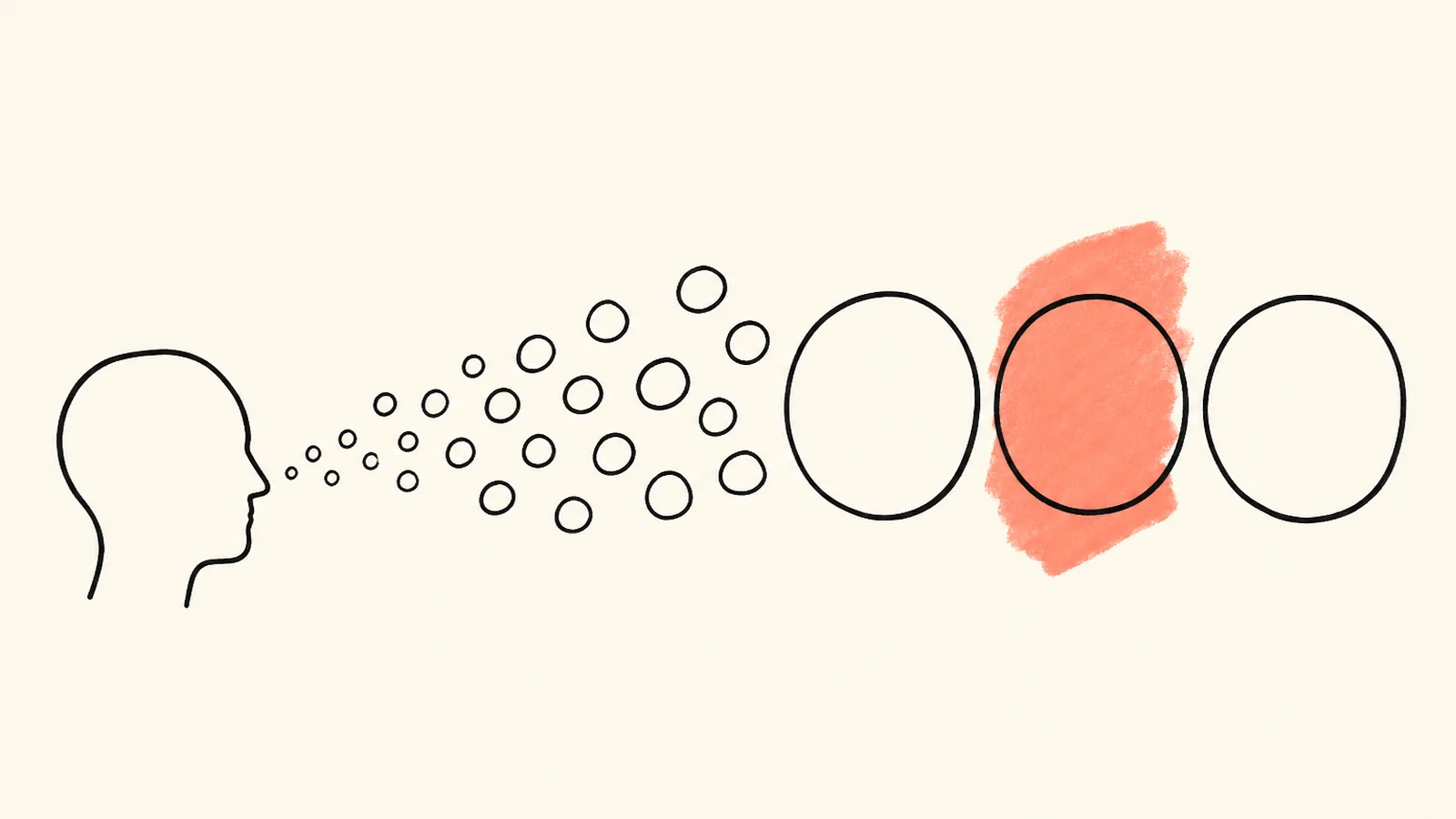
If you keep saying I can't stop thinking, the first fact is that nobody can. Eric Klinger's thought sampling research puts mind wandering at about a third to a half of waking thought, in segments of roughly five seconds, and in 2014 Timothy Wilson found most people dislike even a few minutes alone with their thoughts. What differs between people is the content. Spontaneous thought follows current concerns, the goals you have neither reached nor released, and in a 2013 experiment by Roberts, Watkins and Wills an unresolved goal produced more intrusive thoughts than a resolved one. So count before you fight. For ten minutes, write a short label for each thought that arrives and a mark for each repeat. The stream usually turns out to be a few concerns on rotation. Then give each one an ending: a next step with a day, a date to reopen it, or a deliberate decision to let the goal go. Fast, pressured thoughts with other sudden changes belong with a doctor.
On this page+
If you keep saying "I can't stop thinking", start with the fact that nobody can: a waking mind produces thoughts all day. What you can change is what it returns to. Tally your thoughts for ten minutes and the stream usually turns out to be a few open concerns, each of which can be acted on, scheduled or dropped.
You are probably here because it has gone on for days. You wake up and it has already started. It runs through the shower, the commute, the meeting you were meant to be listening to, and it is still going when the light is off. It does not feel like one worry. It feels like all of them, taking turns.
The usual advice for someone who says "I can't stop thinking" is to breathe, go for a run, or write in a journal, and each of those turns the volume down for an hour. This piece asks a different question: what is all that thinking about? If you already know it is one thing, there is a shorter route for a single thought you want off your mind, and another for a person who keeps coming back.
Yes. A waking mind that is not occupied by a demanding task thinks on its own, and it does so for a large share of the day. The psychologist Eric Klinger, who spent decades sampling people's thoughts, puts mind wandering at between about a third and a half of all waking thought. He found the typical thought segment lasts around five seconds, which gives a rough estimate of four thousand segments in a sixteen-hour day1. In 2010, Matthew Killingsworth and Daniel Gilbert pinged people on their phones at random moments and found they were thinking about something other than what they were doing almost as often as not2.
So constant thinking is the default setting, and "stop" is a target no one hits. It is also not a comfortable setting. In 2014, Timothy Wilson and his colleagues ran eleven studies in which people sat alone for 6 to 15 minutes with nothing to do but think. Most did not enjoy it, and many chose to give themselves an electric shock instead3.
Two things follow. If your mind won't shut off, nothing is broken in it. And the sentence "I can't stop thinking" is describing something other than the amount, because the amount is roughly the same for everyone. What differs is the content, and whether it goes anywhere.
Why can't I stop thinking about the same few things?
Because spontaneous thought follows your open goals. Klinger's term is a current concern: from the moment you commit to wanting something until you either get it or give it up, your mind stays tuned to anything connected with it. A word, a face, a quiet minute is enough to pull the thought up again1. When the mind drifts, it drifts toward the things it is still holding open.
An experiment published in 2013 shows how strong the pull is. Henrietta Roberts, Edward Watkins and Andy Wills asked people from a non-clinical sample to bring to mind either a personal goal they had not resolved or one they had. Then they tracked the thoughts that surfaced afterwards. The unresolved goal produced significantly more recurring, intrusive thoughts than the resolved one, and the effect was larger in people who already tended to ruminate4. The authors note it still needs repeating with people who are clinically depressed.
This is the honest answer to "why can't I stop thinking": the goal is still open, so the thought keeps getting sent. Pushing it away does not close the goal, which is part of why suppressing a thought brings it back. It also changes what the problem looks like. From the inside, "I can't stop thinking" sounds like a statement about quantity. Four thousand thoughts a day sounds unmanageable. A handful of open concerns, each sending the same message many times, is a list.
In sessions, this is the moment we watch for. Someone arrives saying their head is full of everything. Asked to name what the last few thoughts were actually about, they usually get to the end of the list much sooner than they expected.
How do you find out what your mind keeps returning to?
You count. "I can't stop thinking" is a guess about your own mind, and a guess can be checked. For ten minutes, write down the subject of each thought that pulls you away, and add a mark each time a subject comes back. Count subjects at the end, not thoughts. It is a small version of the thought sampling researchers use, done with a pen.
Pick something dull to do. Fold laundry, wash up, or sit with a cup of tea. A demanding task holds mind wandering down, and you want it free to show itself.
Label, don't describe. When a thought arrives, write two or three words for its subject: "Dad's operation", "the rent", "what I said to Priya". No sentences.
Mark repeats. If the subject is already on the page, add a tally mark next to it instead of a new line.
Don't argue with any of it. You are taking attendance. Solving comes later.
Stop at ten minutes and count the lines.
A worked example. Suppose the page ends with five lines: the rent (seven marks), Dad's operation (four), what I said to Priya (three), the unanswered email from the accountant (two), a song (one). Seventeen thoughts in ten minutes felt like a flood. On paper it is four concerns and a tune, and one of the four is doing nearly half the talking.
The page works because the list is yours and you can see all of it at once. A session in Inwitt AI, an AI thinking partner app, runs on the same principle: it asks one question at a time, and only what you confirm is drawn onto the thinking board, so the map of what is on your mind is one you made.
What do you do with each concern once it has a name?
Each concern on the page can end in one of three ways: you pursue it, you park it, or you drop it. A concern stays loud when it has been given none of the three. Go down the list and write one of them next to every line.
Pursue
Park
Drop
Fits when
There is a move you can make this week
Nothing can be done until a date or an event
You no longer want it enough to pay what it costs
The question to ask
What is the smallest next step?
When exactly will I look at this again?
Am I still trying to get this?
What you write
The step, the day, the place
The date, and what you will check then
"I am no longer trying to..." and the rest of the sentence
What goes wrong
The step is too big to start
No date, so it comes back tonight
Saying it without meaning it
Pursue is the familiar one. The rent becomes "call the landlord on Tuesday at lunch", not "sort out money". If the next step turns out to be a choice you have been circling, find what that decision is waiting on first.
Park is for the things you cannot move yet. Dad's operation is in three weeks; nothing you think tonight changes it. Write the date you will next do something about it. A parked concern without a date is only a postponed one, and a decision left open tends to get made for you.
Drop is the one almost no advice mentions. Some concerns keep running because you never told yourself the goal was over: the friendship you are not going to repair, the plan you have quietly stopped believing in. A current concern ends when the goal is reached or given up, and giving up on purpose counts.
A mind that will not stop is rarely full. It is usually repeating.
When are racing thoughts something else?
When the problem is speed and pressure rather than repetition, or when it arrives with other changes, the tally is the wrong tool. Sometimes "I can't stop thinking" describes something a list will not touch. Racing thoughts in the medical sense are fast, crowded and hard to follow, and they can come with needing far less sleep than usual, a sudden jump in energy or irritability, a new medication, or a lot of caffeine or other stimulants.
See a doctor or a therapist if the thoughts frighten you, if they are about harming yourself or someone else, if they have cost you sleep, work or appetite for more than a couple of weeks, or if the change came on suddenly. Do the same if the tally shows one subject that returns however many times you plan for it. None of that means you have failed at a technique. It means the cause may not be an open concern, and it deserves someone qualified to look.
What only feels like it stops the thinking
Most of the things people try when they say "I can't stop thinking" are aimed at the volume. These are the ones we see most.
Trying to go blank. An empty mind is not on offer. Aiming for it turns every new thought into a failure, and now you have a concern about thinking as well.
Filling every gap with a screen. It works while the screen is on. Wilson's studies suggest why it is so tempting: being alone with your thoughts is unpleasant enough that people will take almost any alternative. The concerns wait, and they arrive together when the phone goes down at night.
Thinking harder about all of it at once. Five concerns in rotation get a few seconds each. None gets long enough to end in a step, a date or a goodbye.
Keeping the list in your head. A list you have to remember is one more thing for the mind to rehearse. On paper it stops needing rehearsal.
Being told to stop thinking so much. It is advice about quantity given to a problem of content. A more useful thing for a friend to ask is "about what?"
Questions people ask when they can't stop thinking
Why can't I stop thinking at night?
Because night is the first long stretch with no task in the way. Everything your day held down shows up at once. Doing the tally in the early evening usually helps more than doing it in bed; there is a fuller routine in our piece on switching your brain off for sleep.
Can you ever stop thinking completely?
Not for long, and not by trying. Attention can rest on one thing, such as the breath or a hard task, and the stream thins while it does. People who meditate describe noticing thoughts and letting them pass, not having none. We cover what noticing can and cannot do for a loop separately.
Is constant thinking a sign of anxiety?
Not by itself. Everyone's mind produces thought most of the day. It leans toward anxiety when the content is mostly threat, the body is tense with it, and it gets in the way of ordinary life for weeks. A doctor can tell you which it is; an article cannot.
How do I stop thinking so much about everything?
Check whether it is everything. Behind "I can't stop thinking", ten minutes of tallying usually shows a short list. Then give each line an ending: a next step, a date, or a deliberate goodbye.
The question under all of this, "what is it still waiting for?", is the kind a session keeps asking until your own answer is on the board in your words. The receipt at the end holds the steps and dates you chose, and nothing you did not say. If "I can't stop thinking" has been your sentence this week, join the Inwitt waitlist and bring the tally page with you.
Footnotes
Eric Klinger, "Goal commitments and the content of thoughts and dreams: basic principles", Frontiers in Psychology 4, 415 (2013). Full text↩↩2
Matthew A. Killingsworth and Daniel T. Gilbert, "A wandering mind is an unhappy mind", Science 330(6006), 932 (2010). Journal record↩
Timothy D. Wilson and colleagues, "Just think: the challenges of the disengaged mind", Science 345(6192), 75-77 (2014). Journal record↩
Henrietta Roberts, Edward R. Watkins and Andy J. Wills, "Cueing an unresolved personal goal causes persistent ruminative self-focus: an experimental evaluation of control theories of rumination", Journal of Behavior Therapy and Experimental Psychiatry 44(4), 449-455 (2013). Journal record↩