Mindfulness helps with overthinking by changing how hard a repeating thought grips you, not by switching it off. In a 2010 experiment by Feldman, Greeson and Senville, fifteen minutes of mindful breathing loosened the link between how often a thought came and how upset it made people, and raised decentering, the ability to see a thought as an event rather than a fact. Over a month the frequency falls too: in Jain's 2007 trial, mindfulness meditation reduced rumination where relaxation did not. Most mindfulness overthinking advice stops at noticing, which suits thoughts that are noise. A thought that returns with the same words is usually an unfinished question, so the practice needs two more steps: sort each repeating thought into noise or question, then write the one question that would end it and who could answer it. A minority find meditation raises anxiety, and should stop and seek help if it does.
On this page+
Mindfulness helps with overthinking by changing how hard a repeating thought grips you, not by switching it off. In a 2010 experiment, fifteen minutes of mindful breathing loosened the link between how often a thought came and how upset it made people. Most mindfulness overthinking advice stops there. The loops that keep returning need one more step: a question.
You have probably tried it. You sat down, closed your eyes, followed the breath, and the thought you sat down to escape was there before the third exhale. You were told that was fine: notice it, let it go, come back to the breath. You did, and it came back. By the end of ten minutes you were watching the same worry with real skill and no less of it.
That is not a failure of mindfulness, and it does not mean mindfulness for overthinking is a myth. It means two different jobs are being asked of one practice. We have watched a lot of people bring a looping thought into a session, and the split is consistent: some loops are noise and fade once you stop feeding them, and some are questions that keep knocking until they get an answer. Mindfulness is very good at the first kind and only halfway useful for the second. This piece covers both halves.
What does mindfulness actually do to an overthinking loop?
It separates the thought from your reaction to it. That is what "changes your relationship with your thoughts" means once someone measures it, and the clearest measurement comes from a 2010 study by Gregg Feldman, Jeff Greeson and Joanna Senville. They gave 190 students fifteen minutes of one of three audio exercises: mindful breathing, progressive muscle relaxation, or loving-kindness meditation. Afterward each person rated how often repetitive thoughts had come up during the exercise and how upset those thoughts made them. After relaxation and loving-kindness, the two ratings moved together strongly: more thoughts, more distress. After mindful breathing they barely moved together at all. The thoughts still came; they stopped dragging the mood along with them.
The mindful breathing group also scored higher on decentering, the ability to see a thought as an event in the mind rather than a fact about the world. That is the skill in one line: you observe your thoughts instead of obeying them.
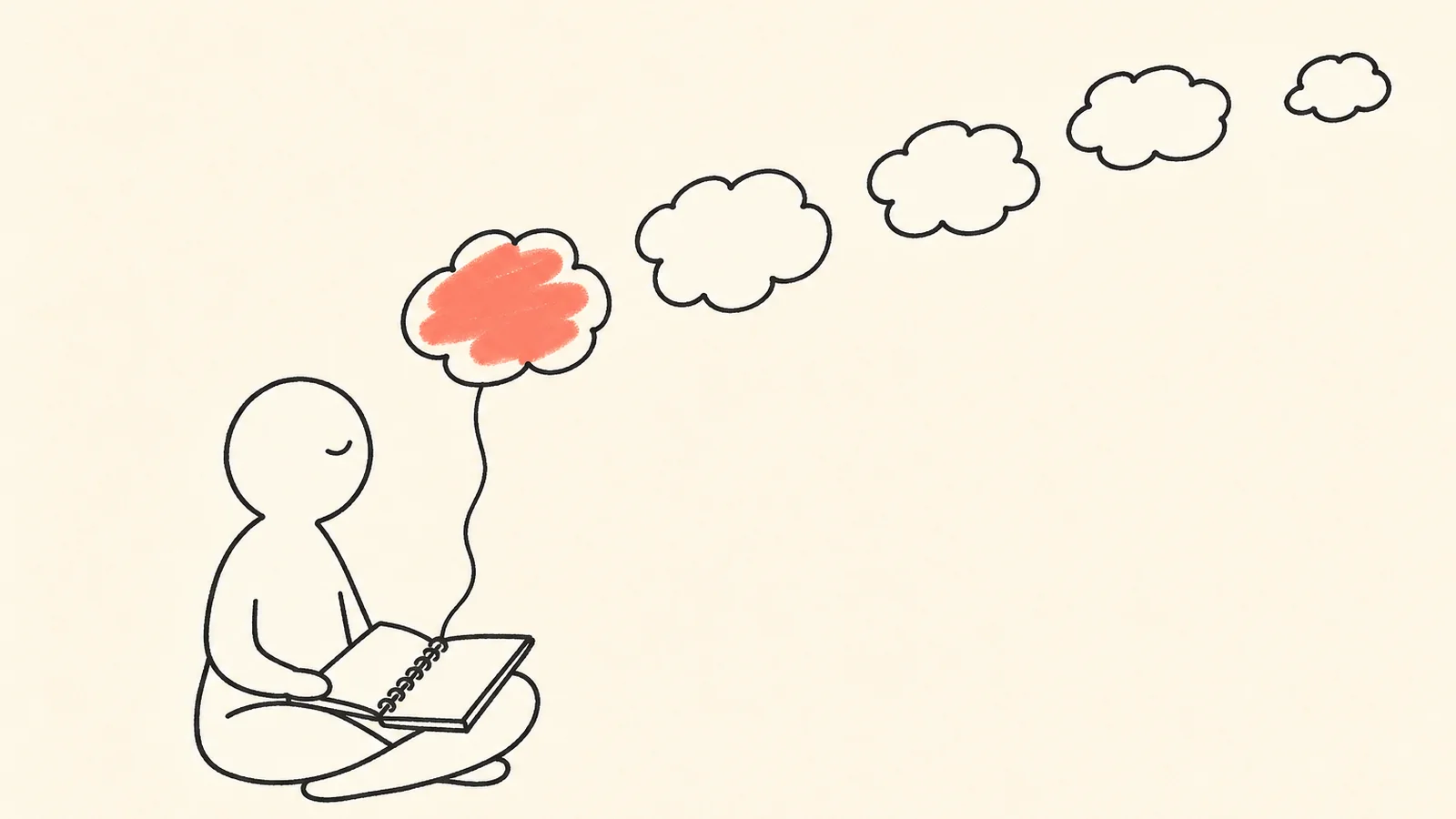
Decentering is why the advice to watch thoughts like clouds is more than poetry. A cloud you are standing inside is weather. A cloud you can see from the ground is a shape, passing. Rumination, the habit of turning the same thought over and over, happens from inside the cloud, and mindfulness is a way of stepping out of it.
Does mindfulness reduce overthinking over time?
Yes, modestly, with practice measured in weeks rather than minutes. In a 2007 randomized trial, Shamini Jain and colleagues gave 83 distressed students a month of either mindfulness meditation or relaxation training and compared both with a group who received neither.2 Both practices reduced distress, and by about the same amount. Only the meditation group showed a significant drop in rumination, and that drop explained part of its drop in distress. Relaxation settled people down. Mindfulness changed what their minds did once they were settled.
A 2015 review by Jenny Gu, Clara Strauss, Rod Bond and Kate Cavanagh pooled the studies that tried to explain why the two best-known eight-week programs, mindfulness-based stress reduction and mindfulness-based cognitive therapy, help people.3 The strongest and most consistent evidence was for reduced cognitive and emotional reactivity, the same unhooking Feldman's study caught in a single session. Reduced rumination and worry also showed up as mechanisms, with moderate evidence.
The caveats matter. These samples are mostly students, the measures are mostly self-report, Feldman's study is one session, and Gu's team say many of the studies they pooled had methodological weaknesses. The fair summary of mindfulness and overthinking is that it lowers the grip quickly and the frequency slowly, and that it works better on the general habit of rumination than on any one specific loop.
Why does your mind get louder when you try to be mindful?
Because you are finally counting. In the same 2010 study, the mindful breathing group reported more repetitive thoughts than the other two groups, not fewer. The researchers read that as awareness: relaxation pulls attention away from the mind, while mindful breathing asks you to watch it, so you see traffic that was there all along. If you have ever sat down to meditate and thought it was making things worse, you were probably measuring correctly for the first time.
The second reason is effort. Many people sit down aiming for an empty mind, which turns the practice into a quiet attempt to push thoughts away, and pushing thoughts away is a reliable way to get more of them (the white bear experiments in our post on getting out of your head show the rebound). Mindfulness asks for something else: let the thought be there, label it, and return to the breath without arguing with it.
Mindfulness teaches you to see the thought. It cannot tell you whether the thought is asking you something.
Where does mindfulness overthinking advice stop?
At the thought that comes back for the fortieth time with the same words. Most mindfulness overthinking advice treats every repeating thought as noise: label it, let it go, return to the breath. That works for noise. It does not work for a thought carrying an unfinished question, because that thought is not repeating out of habit. It is repeating because nothing has answered it.
In sessions, the loops people describe as a brain that will not shut up usually turn out to be one specific thing: an offer with a deadline, a message they have not replied to, a conversation they keep replaying because they never decided what they think about it. Labeling that thought "worrying, worrying" is accurate and incomplete. The thought is not asking to be observed. It is asking to be decided, asked, or scheduled, and a decision that has been analyzed for weeks usually needs a stopping rule more than another quiet sit.
Noise
A question in disguise
What it sounds like
A replay, a mood, a vague what-if
The same specific sentence every time
What happens when you label it
It fades and returns less often
It fades for a minute and comes back word for word
What it needs
To be seen and left alone
An answer, a person to ask, or a date
Where mindfulness fits
It is the whole fix
It is the first step
Next move
Back to the breath
Write it down and ask it one question
The sorting question is the gap in most guides on meditation for overthinking. It is also a move that mindfulness already prepares you for, because you cannot sort a thought you have not noticed. Decentering gives you the distance. The question tells you what to do with what you see from there.
How do you go from noticing a thought to asking it something?
Four steps: notice, name, sort, ask. The first two are mindfulness as it is usually taught. The last two are what finish a loop rather than only quieting it.
Notice. Sit for a minute with your attention on the breath. When a thought pulls you away, catch the moment you realize you have left.
Name. Give it one word: planning, worrying, remembering, judging. This is noting, a standard mindfulness technique, and keeping the label to one word stops you from starting to think about the thought.
Sort. When the same label and the same content come back a third time, ask whether this is noise or a question. A question has a specific subject and something that could, in principle, settle it.
Ask. For a question, write the one question that would end it, and who or what can answer it. "Should I take the job?" becomes "what would have to be true by Friday for yes to be right?" "Is she upset with me?" becomes "when will I ask her?", because some doubts are ones only the other person can answer. A worry about something nobody can know yet gets a date, the way worry postponement gives it an appointment.
Then go back to the breath. The point of sorting is not to stop practicing. It is to stop using a quiet practice to hold still a question that only a decision can settle.
That exercise is a session, slowed down. Inwitt AI is an AI thinking partner app that asks one question at a time and draws your answers onto a thinking board, so the loop you noticed becomes something you can see and test. It does not answer for you or say which option is right. It keeps asking until the question inside the thought is one you can answer yourself.
What only feels like mindfulness?
Five habits look like practice and keep the loop running.
Meditating to make one thought go away. If the goal of the sit is a particular thought's absence, the sit is suppression with better posture, and suppression rebounds. Let the thought stay and change your stance toward it.
Observing a decision indefinitely. Watching a thought about leaving your job every morning for three months is not detachment. It is a decision being postponed by a peaceful method, and not deciding has costs of its own, which is what happens when you do not make a decision: something else makes it.
Noting without ever sorting. Labeling "worrying" two hundred times trains a good label. If the content never changes, the repetition is telling you something: this one is a question.
Judging yourself for a wandering mind. The return is the practice, not the failure of it. Every catch is one repetition of the skill, and a sit full of wandering and returning is a full sit.
Pushing through when it makes you feel worse. A minority of people find that sitting with their thoughts raises anxiety rather than lowering it. If practice leaves you more agitated, flat or unsettled over several days, stop, switch to something grounding such as a walk or the 5-4-3-2-1 senses check, and talk to a professional if it persists.
Questions people ask about mindfulness and overthinking
Can mindfulness make anxiety worse?
For some people, sometimes. In a 2021 study of 96 people in eight-week mindfulness programs, Willoughby Britton and colleagues found that 58% reported at least one meditation-related adverse effect, 37% had effects that affected their functioning in some way, and 6% had effects lasting more than a month.4 The harmful ones were linked to over-arousal: feeling anxious, overstimulated, or emotionally flat. The rate is similar to other psychological treatments, and people underreported it unless asked directly, so tell a teacher or clinician if it happens to you.
How long does mindfulness take to work for overthinking?
The loosening of grip appeared after fifteen minutes in Feldman's 2010 study. The drop in rumination appeared after a month of practice in Jain's 2007 trial. Expect the first quickly and the second slowly, and expect a loop with a real question inside it to need more than practice.
Can you be mindful without meditating?
Yes. Mindfulness is a kind of attention, on the present moment and without judgment, and you can bring it to washing dishes, walking, or a body scan in bed. Formal meditation is the gym version: a set time to practice catching and returning. For racing thoughts at night, a few minutes of noting followed by writing down the one thought that keeps coming back is often enough to let you sleep.
Is mindfulness the same as meditation?
No. Meditation is a family of practices; mindfulness is one quality of attention that some of them train. Breath-focused meditation trains it directly. Loving-kindness meditation trains warmth, and in Feldman's study it did not separate thoughts from reactions the way mindful breathing did, which is worth knowing if overthinking is the reason you sit.
Mindfulness gets you to the moment where you can see the thought clearly. A session with a thinking partner starts at that moment: it asks the question that turns the loop into something you can decide, one question at a time, and leaves you a receipt of what you concluded, in your own words. Your first session shows what that looks like. If you would like the questions asked with you rather than for you, join the Inwitt waitlist.
Footnotes
Feldman, G., Greeson, J. and Senville, J. (2010). Differential effects of mindful breathing, progressive muscle relaxation, and loving-kindness meditation on decentering and negative reactions to repetitive thoughts. Behaviour Research and Therapy, 48(10), 1002-1011. https://pmc.ncbi.nlm.nih.gov/articles/PMC2932656/↩
Jain, S., Shapiro, S. L., Swanick, S., Roesch, S. C., Mills, P. J., Bell, I. and Schwartz, G. E. (2007). A randomized controlled trial of mindfulness meditation versus relaxation training: effects on distress, positive states of mind, rumination, and distraction. Annals of Behavioral Medicine, 33(1), 11-21. https://pubmed.ncbi.nlm.nih.gov/17291166/↩
Gu, J., Strauss, C., Bond, R. and Cavanagh, K. (2015). How do mindfulness-based cognitive therapy and mindfulness-based stress reduction improve mental health and wellbeing? A systematic review and meta-analysis of mediation studies. Clinical Psychology Review, 37, 1-12. https://pubmed.ncbi.nlm.nih.gov/25689576/↩
Britton, W. B., Lindahl, J. R., Cooper, D. J., Canby, N. K. and Palitsky, R. (2021). Defining and measuring meditation-related adverse effects in mindfulness-based programs. Clinical Psychological Science, 9(6), 1185-1204. Summary: https://www.brown.edu/news/2021-05-18/adverse-effects↩