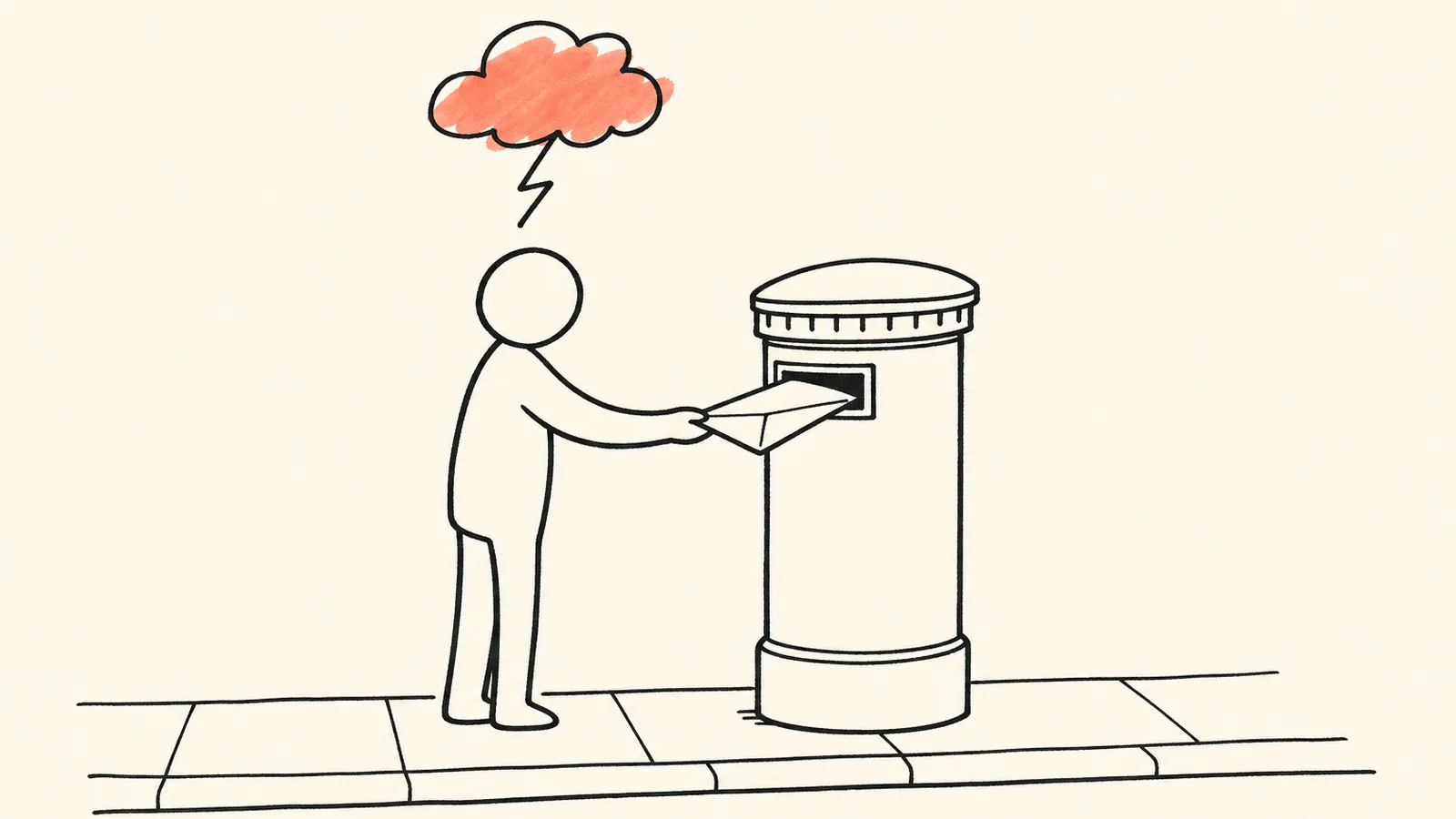
Rash decision making is choosing something lasting while a temporary state, such as anger, panic, excitement or relief, does the choosing. Speed is not the problem: fast decisions are fine when the checking happened earlier or little rides on them. A decision is rash when it mainly ends a feeling rather than the problem, and when it is hard to undo. Research on urgency by Cyders and Smith (2008) shows rash action follows intense good moods as well as bad ones, and that it repeats because the relief comes at once. Loewenstein's work on hot-cold empathy gaps adds that in a hot state people overestimate how stable their current preferences are, which is why rash choices feel certain. Three questions catch most of them: will I still want this in the state I will live with it in, what does undoing it cost, and does this end the problem or the feeling. An if-then plan made on an ordinary day makes the pause automatic.
On this page+
Rash decision making is choosing something that will last while a state that will not last (anger, panic, excitement, relief) does the choosing. It is not the same as deciding fast. A quick decision that has been checked is fine. A slow one made mainly to end a feeling can still be rash.
You probably know the shape from the inside. The message sent at midnight, the resignation typed during the worst week of the year, the yes to a plan that sounded wonderful at the end of a good evening. In the moment, each one felt like clarity. A rash decision is the mirror image of analysis that never stops: one skips the question that would have slowed it down, the other never stops asking. What follows covers what makes a decision rash, why the habit repeats, and three questions that catch it without turning you into someone who can't make a decision at all.
What makes rash decision making different from deciding fast?
A decision is rash when a temporary state signs off on something lasting and nobody checks the signature. Speed is a poor test. Plenty of good decisions are fast: an experienced nurse noticing that a patient looks wrong, a driver braking before they know why, ordering the lunch you always order. They are fast because the checking happened earlier, through years of practice, or because little rides on them. A rash decision is fast for another reason. The feeling wants out, and the decision is the door.
The difference shows up on four axes.
A quick decision
A rash decision
What drives it
Experience, or low stakes
A strong feeling right now
What it ends
The question
The feeling
Can it be undone
Usually, or it was checked first
Often not, and it was not checked
How it looks next week
The same
Different, because the mood has gone
The second row is the one to keep. A hasty decision that ends a question is just efficient. A rash one ends a discomfort and leaves the question where it was, usually with a new problem attached. That is why the same act can be rash for one person and sensible for another. Quitting on a Friday afternoon is rash if it is mostly an escape from one bad meeting, and fine if it is the last step of a plan you made in March.
Why do we make rash decisions?
Because strong feelings shrink the time horizon, and acting on them brings relief quickly, which teaches you to do it again. Psychologists Melissa Cyders and Gregory Smith reviewed the research on this in 2008 and gave the tendency a name: urgency, the disposition to act rashly while feeling something intensely1. Their reading of the evidence is that intense emotion uses up mental resources and pulls attention toward the immediate and away from long-term interests. The rash act then pays off at once. Snapping at your boss releases the anger. The regret arrives later, the relief arrived first, and so it is the relief that gets learned.
A second finding explains why rash decisions feel so certain. George Loewenstein, an economist who studies emotion, describes a hot-cold empathy gap: in a cool state, we underestimate how much a hot state will move us, and when hot, we underestimate how much it is moving us now2. In his words, people in hot states "overestimate the stability of their current preferences." The anger does not feel like anger. It feels like finally seeing the situation clearly, and it assumes it will still feel that way next month.
That is the trap in making rash decisions. The state does not announce itself as temporary. It presents its preference as your permanent one, and it argues well.
In sessions, when someone brings back a decision they made too fast, the story is rarely about missing information. They usually knew the facts. What they describe is a feeling they wanted gone (an argument, a stretch of boredom, not knowing where they stood), and the decision was the quickest way out of it.
Can a good mood make you rash too?
Yes, and it is the version most advice on rash decision making leaves out. Cyders and Smith separate negative urgency, rash action under distress, from positive urgency, rash action when a mood is extremely good1. Their own pair of examples is yelling at one's boss on one side and excessive celebratory drinking on the other. Both bring an immediate reward, and both trade the long run for the moment.
In ordinary life, positive urgency looks like the yes said at the end of a great evening, the trip booked within an hour of hearing about the bonus, the business partner agreed on after one inspiring coffee. Nothing feels wrong, so nothing feels like it needs checking. The excitement is real information about what you want. It is weaker information about whether you will want it on a normal Tuesday in March, when the bill arrives.
If your impulsive decisions cluster around good news, the pause matters there as much as after bad news. It only feels less necessary.
Why does stress make you decide faster?
Under stress, people lean on speed and habit rather than a fresh weighing of the options. In a 2020 lab study, Candace Raio, Anna Konova and Ross Otto put some participants through a short stress procedure (a hand held in ice water) before a choice task3. Stressed participants who scored higher on impulsivity made faster choices, and they kept repeating earlier choices whether or not those choices had paid off. In that task, stress did not produce a new look at the options. It produced speed and repetition.
That matches what impulsive decision making tends to look like outside a lab. Rash decision making under stress is often a familiar move made quickly: the same sharp reply, the same purchase, the same exit you took last time. A long day of small choices pushes the same way, which is one reason decision fatigue tends to end in impulsive choices as well as avoided ones.
The practical upshot is plain. When you are stressed, a decision that feels obvious deserves more suspicion, not less, because obvious under stress often just means familiar.
How to stop making rash decisions
Ask three questions before anything lasting, and treat any answer you would rather not give as the reason to wait. Waiting on its own is weak, because a hot state does not cool on a timer and tends to spend the wait rehearsing its case. The questions are what make the wait useful.
Will I still want this in the state I will live with it in? Not the state you are in now. Picture the decision on a flat, ordinary day three weeks from now. If it only makes sense in today's mood, it belongs to the mood.
What does undoing it cost, and who pays? A sharp message can be followed by an apology, but it cannot be unsent. A resignation can rarely be taken back. The harder the undo, the higher the bar.
Does this end the problem, or the feeling? This is the one that catches most rash decisions. Sending the email ends the anger; it does not fix the project. Booking the trip ends the restlessness; it does not change the job.
A fourth question handles pressure from outside: who set this deadline, and is it real? "Offer ends tonight" is sometimes true and often a sales technique. A real deadline with real stakes is a reason to run the three questions now. An invented one is a reason to step back.
A rash decision is a permanent answer to a temporary feeling.
None of this takes long. Most of the time the three answers take a minute, and most decisions pass. The ones that do not pass are the ones you would have regretted.
How do you slow a decision down without stalling it?
Decide the pause in advance, on an ordinary day, so the hot state does not have to invent it. Psychologists call this an if-then plan, or implementation intention: "If X happens, then I will do Y." In a 2006 meta-analysis of 94 tests, Peter Gollwitzer and Paschal Sheeran found that people who made if-then plans reached their goals more often than people who only intended to, with a medium-to-large effect, and that the plans helped protect a goal from interference along the way4. In rash decision making, the heated moment is exactly that interference, working against a goal you already hold.
Here is how it might go. Say a colleague takes credit for your work in a meeting, and by the afternoon you have a resignation email drafted. The first question: on a flat day three weeks from now, you might still want to leave this team, but not this week and not with no offer. The second: the undo is expensive.
The third is plain once it is written down. Sending it ends the humiliation, not the problem. The problem is the credit, and the smallest step toward it is a conversation with your manager about who did what. The if-then for next time: "If I draft a resignation, then I leave it unsent overnight and write down what I actually want to change."
This is the move Inwitt AI is built around. It is an AI thinking partner app that asks one question at a time and writes your answers onto a thinking board, so the line where you wrote "the feeling" stays in front of you instead of disappearing into the moment. It does not tell you whether to send the email. It keeps asking until you can see what the email was for.
What only feels like slowing down?
Several habits feel like caution and change nothing about rash decision making.
Sleeping on it while rehearsing. A night only helps if you stop arguing the case. Spending the evening drafting better versions of the angry reply keeps the state hot, and you wake up with a more polished version of the same decision.
Counting to ten, then doing it anyway. A pause with no question in it is only a delay. It works for a shout. It does very little for a decision you can make at ten as easily as at one.
Asking the friend who will agree. When you are hot, it is tempting to call the person most likely to say "you should absolutely quit." That is a second signature from the same mood, not a check.
Calming down and calling it decided. Breathing and grounding can get you out of your head for ten minutes, which is worth a lot. Feeling settled afterwards does not mean the decision was checked. Run the three questions once the heat has dropped.
Swinging to the other extreme. After one bad rash decision, some people stop deciding quickly about anything. That trades one failure for its mirror. Small, reversible, low-stakes choices are still fine to make fast.
Questions people ask about rash decision making
What is an example of a rash decision?
Quitting a job in the middle of one bad week with nothing lined up, replying to a hurtful message within a minute, or spending savings on something you first saw an hour ago. What they share is not speed but timing: each is a lasting move made while a short-lived feeling was at its peak.
Are impulsive decisions always bad?
No. Many fast choices are good because the checking happened earlier, through experience, or because little rides on them. Impulsive decisions go wrong when they are hard to undo and mostly end a feeling. Fast and reversible is usually fine.
Is impulsive decision making a sign of ADHD or something else?
It can be part of ADHD, bipolar disorder, substance use and other conditions, and the questions in this piece are not a treatment for any of them. If rash decisions are frequent, getting worse, or seriously hurting your money, work or relationships, that is worth raising with a doctor or a therapist.
What should you do after a rash decision?
Check whether it can still be undone, and how cheaply. Then judge how the decision was made, not only how it turned out, and write the if-then sentence that would have caught it. One rash decision is information about your triggers, not a verdict on your character.
The three questions take a minute on paper, and they work best when something keeps asking after the first quick answer. That is what a session does: it asks, you answer, and what you decided ends up on a session receipt in your own words, written after the heat has gone. If there is a decision that keeps tempting you to act fast, join the Inwitt waitlist and bring it to your first session.
Footnotes
Cyders and Smith, "Emotion-based dispositions to rash action: Positive and negative urgency", Psychological Bulletin 134(6), 807-828 (2008). Journal record↩↩2
Loewenstein, "Hot-cold empathy gaps and medical decision making", Health Psychology 24(4, Suppl.), S49-S56 (2005). Journal record↩
Raio, Konova and Otto, "Trait impulsivity and acute stress interact to influence choice and decision speed during multi-stage decision-making", Scientific Reports 10 (2020). Open-access paper↩
Gollwitzer and Sheeran, "Implementation intentions and goal achievement: A meta-analysis of effects and processes", Advances in Experimental Social Psychology 38, 69-119 (2006). Repository record↩