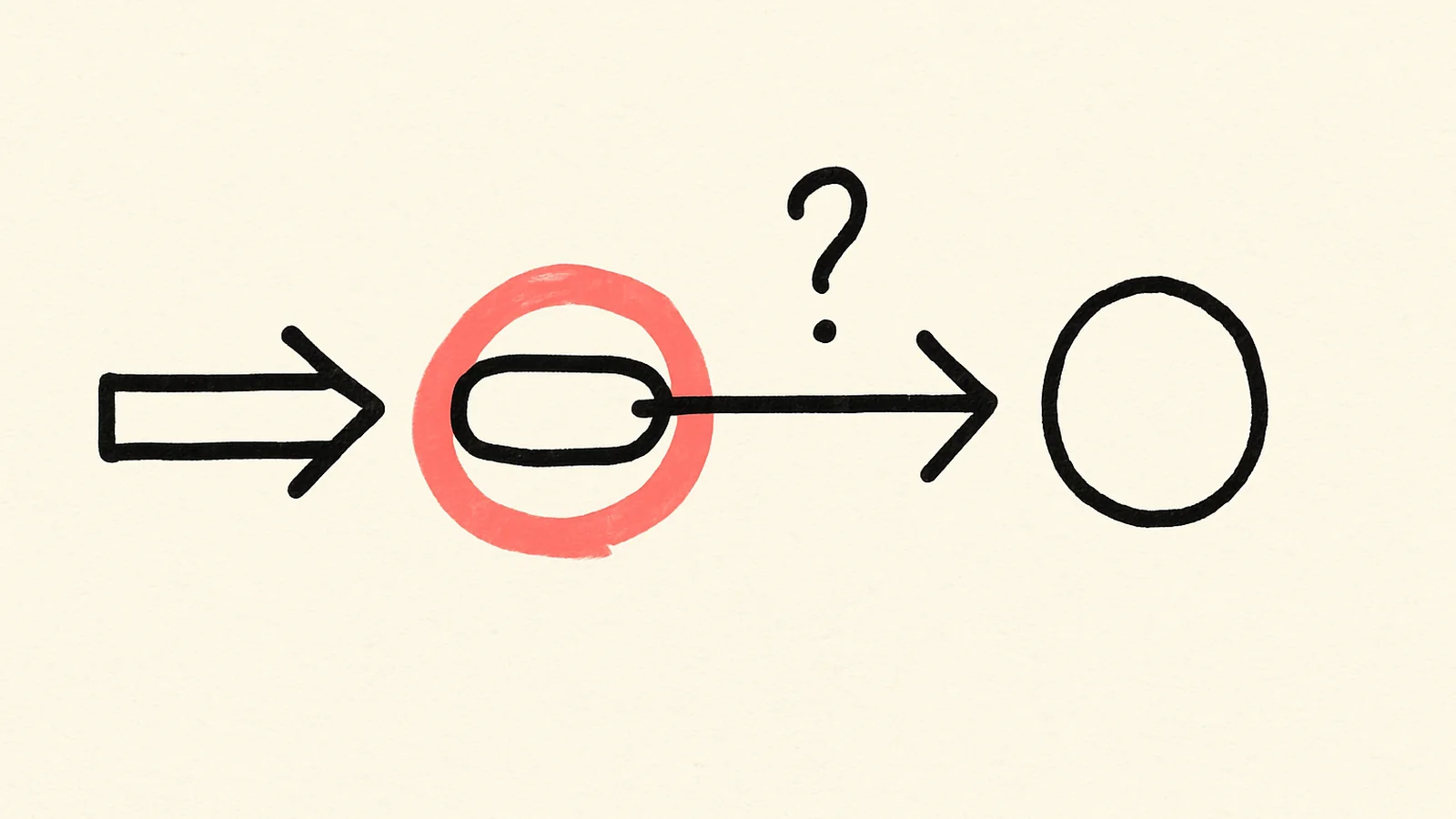
Reasoning critically means holding a conclusion open to its own reasons: naming the claim, the evidence behind it and the assumptions underneath, then testing each one against the strongest question you can find. Robert Ennis defines it as reasonable, reflective thinking focused on deciding what to believe or do, and a 1990 expert panel named six skills involved, with self-regulation, examining and correcting your own reasoning, as the one most people skip. The difficulty is structural. Mercier and Sperber argued in 2011 that reasoning evolved to devise and evaluate arguments for other people, which is why it works well in a discussion and drifts toward confirmation bias when a person reasons alone. The practical fix is to make the argument visible on paper and interrogate each reason with a question you did not write, such as what would be an example, and what would not be one, though close. Reasons that cannot answer are justifications, and the conclusion has to stand on what remains.
On this page+
Reasoning critically means holding a conclusion open to its own reasons: naming the claim, the evidence behind it, the assumptions underneath, and then testing each one against the strongest question you can find. Robert Ennis, who spent a career on the subject, calls it "reasonable and reflective thinking focused on deciding what to believe or do."1 The hard part is the testing, and it rarely happens alone.
You probably arrived here with a specific conclusion already in hand. A job you are fairly sure you should take. A plan that has felt right for three weeks without moving. You know the phrase "critical reasoning" from a course or a job description, and you suspect it is the thing you are supposed to be doing to that conclusion, but nobody ever showed you what the move looks like from the inside.
This piece shows the move: the definition, why it is so hard to make on your own, and a step-by-step version you can run on paper with one real decision worked through.
What does reasoning critically actually mean?
Reasoning critically is the act of treating your own conclusion as a claim that still has to earn its place. You separate three things that usually arrive fused together: the conclusion, the reasons you give for it, and the assumptions those reasons quietly depend on. Then you test them. In 1990 a panel of forty-six experts convened by the American Philosophical Association reached consensus on what that testing involves, and named six core skills: interpretation, analysis, evaluation, inference, explanation, and self-regulation. The first five are what most people picture when they hear "critical thinking." The sixth is the one that matters here.
Self-regulation means examining your own reasoning while it is happening and correcting it. The other five reasoning skills depend on it, because none of them help if you only ever point them at other people's arguments. Reasoning critically, in plain terms, is pointing all six at yourself. That is why a person can be excellent at spotting weak logic in a meeting and still reason badly about their own career. The skill was never the problem. The direction was.
Ennis breaks the analysis part into concrete moves: identify the conclusion, identify the reasons or premises, identify the assumptions, see the structure of the argument.1 Each is a thing you can do with a pen. None is a feeling.
How is reasoning critically different from just reasoning?
Plain reasoning gets you from what you know to a conclusion. Reasoning critically turns around and asks whether the trip was legitimate. Both use logic, evidence and inference; the difference is what they are pointed at and when they stop. Ordinary reasoning stops when it reaches a conclusion that feels sufficient. Critical reasoning stops when the conclusion has survived a serious attempt to break it, or has been revised because it did not.
Logical reasoning, the formal kind, is narrower still. It checks whether a conclusion follows from its premises, and it is indifferent to whether the premises are true. Critical reasoning has to care about both, and it also has to care about the premises nobody stated.
Reasoning
Reasoning critically
Direction
From reasons toward a conclusion
From a conclusion back to its reasons
Stops when
The answer feels sufficient
The answer has survived a real test
Treats assumptions as
Background
The first thing to write down
Question it asks
"What follows from this?"
"What would have to be true for this to be wrong?"
Typical failure
Missing a step
Never checking the steps you took
In practice the second column is much rarer than the first, and the next section is about why.
Why is it so hard to reason critically about your own decision?
Because reasoning did not evolve to check your conclusions. It evolved to defend them. That is the central claim of a 2011 paper by Hugo Mercier and Dan Sperber in Behavioral and Brain Sciences, and it explains a great deal that the textbook picture cannot.3 Humans depend on communication more than any other species, which makes them vulnerable to being misled. Reasoning, on their account, developed as a tool for producing arguments that persuade others and for evaluating the arguments others produce, and it is good at both.
What it is not built for is quietly auditing its owner's beliefs in an empty room. Left to reason alone, people "are not after the truth but after arguments supporting their views," which, they note, is exactly the pattern psychologists call confirmation bias. The bias is not a bug in an otherwise truth-seeking machine. It is the machine working as designed, in the wrong setting.
The same paper points to the flip side: people are good at evaluating arguments when someone else makes them, and reasoning "should produce its best results when used in argumentative contexts."3 Put a conclusion in front of a person who disagrees and the evaluation skills switch on. Leave the same person alone with the same conclusion and they collect supporting reasons instead.
We see this in sessions constantly. Ask someone for the reasons behind a decision they have already made and the first thing out is fluent, confident and shaped like a reason. Ask for an example of it and there is a pause. The first answer was the justification, produced by the part of the mind that argues. The reason, if there is one, is underneath it, and it only surfaces when a question arrives that the person did not choose.
A reason you have never had to defend is a feeling with a sentence around it.
This is the honest limit of every "think harder" guide. You cannot reason critically about your own conclusion by staring at it with more intensity. You need an interlocutor, and if there is nobody in the room, you have to build one.
How do you reason critically, step by step?
The method is to make the argument visible and then interrogate it with questions you did not write. Five steps, in order:
Write the conclusion in one line. Not the situation, not the story. The thing you currently believe or intend to do.
List the reasons underneath it. Write them as you would say them to a friend.
Name the assumption under each reason. What has to be true for this reason to count? Write that too, even when it feels obvious. Especially then.
Ask each reason a challenge question. Ennis's list is a good source because the questions are short and none of them can be answered with "yes": "What would be an example?", "What would not be an example, though close to being one?", "What difference does it make?", "What are the facts?"1
Cross out what did not survive, and look at what is left. The conclusion may stand. It may stand on fewer legs than you thought. Either is a result.
Writing it down is not decoration. A reason inside your head cannot be argued with; it is too quick and too close. On the page it holds still. That is the same reason a thinking board turns a conversation into something that can be checked: once the reasoning is external, it can be wrong in a way you can see.
Here is what that looks like on a real shape of decision: leaving a stable job for a smaller company. Conclusion: "I should take the offer." Reasons on the page: more ownership, the current role has stalled, the money is close enough.
Run the questions. "What would be an example of more ownership?" produces something concrete: a product line, a hiring decision. "What would not be an example, though close?" is where it gets interesting, because "ownership" in an offer letter can mean more tasks rather than more say, and nothing so far has ruled that out. Reason one survives, but it has turned into a question for the hiring manager.
Reason three, the money, survives cleanly; the numbers are the numbers. Reason two, "the role has stalled," cannot produce an example. It produces a mood. Crossed out.
The conclusion may well still be "take the offer." But it now rests on one tested reason and one open question, instead of three feelings, and the person knows exactly what to find out before signing. In a session, that is what the receipt records at the end: the conclusion, the reasons that survived, and the question still open.
This is also the move Inwitt AI, an AI thinking partner app, is built around. It does not tell you whether to take the offer. It asks the next question, one at a time, and writes only what you confirm, so the interlocutor Mercier and Sperber say reasoning needs is there even when you are alone at the desk. Critical mode runs the five steps above as a whole session.
What only feels like reasoning critically
Some habits look like critical reasoning from the outside and are its opposite.
Collecting reasons for a conclusion you already hold. This is the default, and it feels productive because the list gets longer. Mercier and Sperber's phrase for the outcome is that reasoning "favors decisions that are easy to justify but not necessarily better."3 The test is simple: did any reason on the list arrive after the conclusion? If all of them did, you have been working as a lawyer, not a judge.
Mistaking fluency for evidence. The justification comes out first and it sounds like a reason, because producing persuasive sentences is what reasoning is good at. A reason that cannot survive "what would be an example?" was a sentence, not a reason, no matter how well it was phrased.
Asking "am I sure?" instead of "what would have to be true for this to be wrong?" The first question returns a feeling, and the feeling is usually yes. The second returns a condition, and a condition can be checked.
Treating an answer from an AI assistant as the test. Asking a chatbot whether your decision is right produces a second conclusion, not a test of the first. Both are still untested. An answer you did not build cannot check your reasons; it replaces them. The useful version of the tool is a partner that asks instead of answers, because a question is the only input that makes you go back to your own premises.
Questions people ask about critical reasoning
Is critical reasoning the same as logical reasoning?
No. Logical reasoning checks whether a conclusion follows from its premises and does not care whether the premises are true. Critical reasoning has to care about both, and about the assumptions that were never stated. Logic is one tool inside critical reasoning, and a good one, but it will happily validate a perfectly structured argument built on a false first line.
Can reasoning critically be learned, or is it a personality trait?
It can be learned, and the 1990 expert panel said so explicitly: a person can "critically examine and evaluate one's own reasoning processes" and get better at it.2 What tends to be mistaken for a trait is the disposition Ennis describes, caring that your beliefs be true and your decisions justified.1 The skill is teachable. The willingness to point it at yourself is a habit, and habits are built by repetition, not temperament.
What is a simple example of reasoning critically?
Any time you write down a conclusion and then ask what would have to be true for it to be wrong. "This meeting is a waste of time" becomes "what would a useful version of this meeting look like, and has one ever happened?" The conclusion may survive. The point is that it was asked.
What is a critical reasoning test?
Usually an aptitude test used in hiring or admissions: a short passage, an argument, and questions about which statement strengthens or weakens it, or which assumption it depends on. It measures the same skills described above, pointed at someone else's argument on a page. That is worth practicing. It is also the easy direction.
Does reasoning critically mean being negative about everything?
No. The 1990 consensus describes the ideal critical thinker as "open-minded," "fair-minded in evaluation" and "willing to reconsider," none of which is the same as skeptical by default.2 Reasoning critically is not about rejecting conclusions. It is about only holding the ones that have earned it, including the ones you wanted to be true.
The exercise above is, almost exactly, what happens in a first session: one conclusion on the board, one question at a time, and a record at the end of which reasons held. If you would rather have the question asked than ask it yourself, join the Inwitt waitlist.