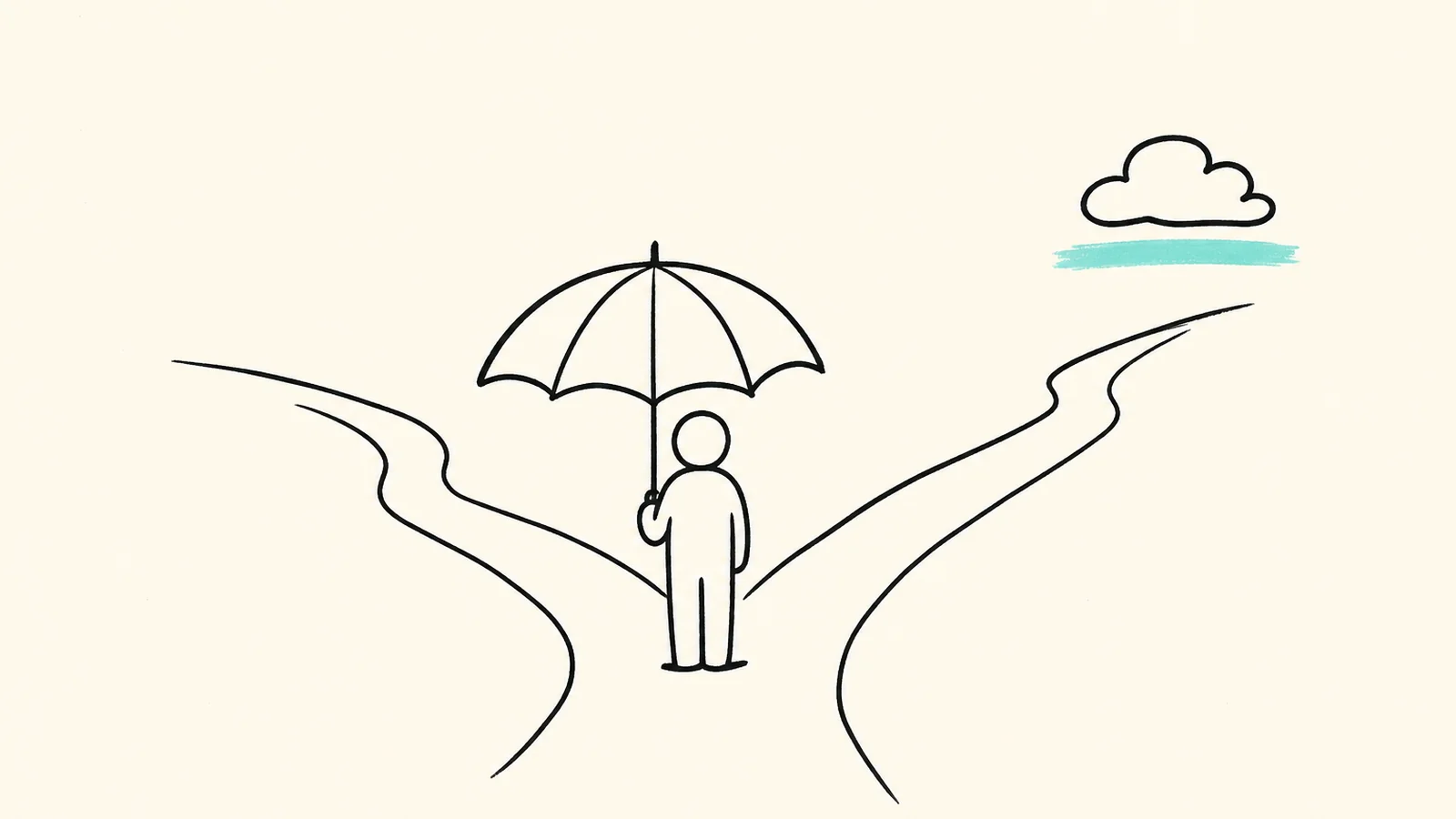
Anticipated regret is the regret you forecast before deciding: you picture the choice going badly and blaming yourself for it. It does not only make people cautious. It pushes toward whichever option you imagine regretting less. A 2016 meta-analysis of 81 health studies by Brewer, DeFrank and Gilkey found that expecting to regret acting weakened intentions, while expecting to regret not acting strengthened them. Zeelenberg and colleagues showed in 1996 that people also favor the option that spares them from learning how the other one turned out, risky or safe. Connolly and Zeelenberg's decision justification theory splits the feeling into two parts: regret about the outcome, which luck settles, and self-blame for a choice that was unjustified, which you can reduce before deciding. Gilbert and colleagues found in 2004 that people overpredict that self-blame. The useful move is to write both regrets down, separate the two parts, and act only on the self-blame part, by making a choice you could explain.
On this page+
Anticipated regret is the regret you forecast before you decide: you picture choosing, things going badly, and kicking yourself for it. It shapes choices strongly, and in either direction. Research splits it into two parts: regret about the outcome, which luck settles, and regret about the choice itself, which you can reduce by deciding in a way you could defend.
You are probably here because a decision has a voice attached to it. Take the offer, and the voice says you will regret leaving a good team. Turn it down, and the same voice says you will regret playing it safe. Every option comes with a small film of you, later, wishing you had done the other thing.
That film is not noise. It is one of the strongest forces in how people choose, and it is often right about what matters to you. It is also biased in ways that are well documented, and it bundles together two different fears that need different treatment. What follows separates the two, and shows how to use the feeling on paper so it informs a choice instead of making it.
What is anticipated regret?
Anticipated regret, sometimes called anticipatory regret, is an emotion you feel in advance about a decision you have not made yet. It differs from worry in one way: it is about your own choice. Worry says "something bad might happen". Anticipated regret says "something bad might happen, and I will wish I had chosen differently." Noel Brewer and colleagues, reviewing the research in 2016, put the difference this way: regret carries "the wish to have made a different decision", which expected anxiety, guilt, disappointment or anger do not.
Economists built it into a formal model in the early 1980s. Regret theory, from Graham Loomes and Robert Sugden, holds that people compare what they got with what they would have got from the option they turned down, and that they anticipate this comparison when choosing2.
It is also different from feeling uneasy about a choice in general. Anxiety about a decision is mostly about uncertainty. Anticipated regret is about responsibility: the future you, holding the result, looking back at the present you who picked it.
Which way does anticipated regret push you?
Toward whichever option you imagine regretting less, and that can be either the bold one or the safe one. The common claim that regret makes people cautious is only half true.
The clearest evidence is a 2016 meta-analysis by Brewer, Jessica DeFrank and Melissa Gilkey, pooling 81 studies with 45,618 people on decisions like vaccination and screening1. Anticipated regret was linked to what people intended to do and, more weakly, to what they did. Expecting action regret ("I'll wish I hadn't done it") predicted weaker intentions and less of the behavior. Expecting inaction regret ("I'll wish I had") predicted the opposite.
It also predicted behavior better than other expected emotions, and better than plain risk estimates such as how likely or how bad an illness would be.
Their own example shows both pulls at once. A retiree might expect to regret a flu shot if it brought serious side effects, and expect to regret skipping it if she then got the flu. The decision goes to whichever film is more vivid. That is why it helps to remember that waiting is also a choice, with its own film.
What you will never find out shapes the choice too
A second pull is stranger. In 1996, Marcel Zeelenberg and colleagues gave people two gambles they had first adjusted to be equally attractive, one risky and one safe2. Then they varied which gamble's result would be revealed. Across three experiments, people tended to choose the option that spared them from learning how the other one turned out. When only the risky gamble would be revealed regardless, more people took the risky gamble; when the safe one would be revealed, more took the safe one. The authors concluded that anticipated regret "can promote risk-averse and risk-seeking choices".
Real decisions work the same way. Staying in a job usually means you never see how the other job would have gone. That hidden comparison is part of what makes staying feel safe, and it has nothing to do with whether staying is better.
Anticipated regret does not push you toward safety. It pushes you toward whatever you will never have to compare.
What are the two parts of anticipated regret?
One part is about the result and one part is about you. Terry Connolly and Marcel Zeelenberg called this decision justification theory in 20023. Regret about a decision, they argued, is a combination of two components: regret that the outcome is worse than some standard, usually the option you rejected, and self-blame regret, the feeling that the decision was, in retrospect, unjustified.
The two "do not necessarily go together", and their examples make the point. You leave a party after too many drinks and drive home instead of taking a cab. You arrive safely, and the next morning you are racked with regret anyway: the outcome was fine, but you know the choice was indefensible.
Now a parent who consults doctors, reads, thinks hard, and decides to vaccinate their child, knowing the vaccine sometimes has side effects. The child is unlucky and gets them. The parent regrets the outcome, but has no reason to blame themselves. The decision was justified, and that removes a whole layer of the pain.
Outcome regret
Self-blame regret
What it says
"It turned out worse than the other option"
"I chose badly, and I knew enough to choose better"
Who decides it
Luck, other people, time
Mostly you, before you choose
What reduces it
Not much, once it happens
A choice you can explain with reasons
Can you work on it now
No
Yes
The studies Connolly and Zeelenberg review show that justification is doing real work. In one, regret about a bad purchase tracked whether the buyer's decision was justified, not whether they had switched brands or stuck with the old one. When the researchers asked people which justifications worked best, one of the strongest was simply having made "a careful, competent decision based on a wide range of input information". This is the same idea behind judging how a decision was made rather than only how it turned out.
Is your regret forecast accurate?
Often not, and the part it gets most wrong is the self-blame. Daniel Gilbert, Carey Morewedge, Jane Risen and Timothy Wilson tested it in four studies published in 20044. Students in a contest predicted that nearly winning would feel much worse than clearly losing. Subway riders predicted that nearly catching a train would bring much more regret and self-blame than missing it by a wide margin. When it actually happened, the difference was far smaller than predicted. The authors' explanation: "people are remarkably good at avoiding self-blame", much better than they expect to be.
So the forecast tends to overstate exactly the part you could have worked on. Gilbert and his colleagues concluded that people who pay to avoid future regret "may be buying emotional insurance that they do not actually need". If you have read about the age-80 version of this forecast, this is the same blind spot from another side: the imagined regret is louder than the lived one.
None of this means ignoring the feeling; it often points at something you care about. It means the forecast is a draft, and the most useful check is to separate its two parts.
How to use anticipated regret without letting it decide
Write the forecast down, split it, and act only on the part you can change. The fear of regret becomes manageable once it stops being one big feeling and turns into a few specific sentences.
Write both regrets. For each option, finish the sentence "If this goes badly, I will kick myself because..." Make both as specific as each other. A vivid regret on one side and a vague one on the other is how the forecast tips the scale.
Mark each reason. Is it about the result (O) or about how you chose (B)? "The startup folds in a year" is O. "I never asked what their runway was" is B.
Leave the O lines alone. You cannot fix luck today. Noting them is enough; they tell you what is at stake.
Turn every B line into a step. If you would blame yourself for not asking about the runway, ask. If you would blame yourself for deciding while angry, wait until you are not. Each B line is a to-do item disguised as a fear.
Write down why you chose. Before the outcome is known, put your reasons in a sentence or two. This is the justification Connolly and Zeelenberg describe, written at the only time it can be written honestly.
In sessions, the regret people write first is almost always about the outcome: "it doesn't work out". The blame part usually needs a second question before it appears, and when it does, it tends to be short and fixable.
The B column is usually shorter than the fear suggested, and it is the only column you can act on. This is the kind of question Inwitt AI asks. It is an AI thinking partner app: it asks one question at a time, and the Decision thinking mode keeps asking about the regret you wrote vaguely until it is as specific as the other one. It does not tell you which option to pick. At the end, your reasons are on the session receipt in your own words, dated before you knew the outcome.
What only feels like avoiding regret
Picking the option whose alternative you will never see. This is the Zeelenberg effect in daily life. Staying put often feels safe because nobody will ever show you the other path, not because it is better. Ask whether you would still choose it if you were guaranteed to find out how the other option went.
Researching things that cannot change the choice. Gathering information feels like reducing regret. If no answer to the question would change what you do, it is delay with a reason attached.
Keeping both options open. Holding off feels like it avoids both regrets. It usually gives you a third one, and a deadline or another person tends to choose in the meantime.
Letting someone else decide so they carry the blame. Handing the choice to a partner, a parent or a chatbot can feel like it removes the self-blame. It does not remove the outcome regret, and it adds a new kind: "I didn't even choose."
Questions people ask about anticipated regret
What is an example of anticipated regret?
Deciding whether to get a flu shot is the standard one. You might picture regretting the shot if it causes side effects, or regretting skipping it if you get the flu. Both are anticipated regret; they push in opposite directions, and whichever you picture more vividly tends to win.
Is anticipated regret the same as regret aversion?
Not quite. Anticipated regret is the forecast: the feeling you expect to have. Regret aversion is the behavior it drives: choosing in a way that avoids that feeling. One is the emotion, the other is what you do about it.
Is anticipated regret a cognitive bias?
It is better described as an input than as a bias. It often points at something you genuinely care about. It misleads in predictable ways: it overstates self-blame, it favors options that hide comparisons, and it follows whichever regret was imagined in more detail.
How do you stop fear of regret from paralyzing you?
Split it into what is about the result and what is about how you chose, act on the second, and set a date to decide. If you are still stuck after that, the decision is probably waiting on something else, such as a missing fact or a conversation, rather than on more feeling.
The two columns take five minutes. Getting the vague regret as clear as the vivid one is the slow part, and it goes faster when something keeps asking. That is what a session does: one question at a time, your answers drawn onto a thinking board, and the reasons you chose kept for later. If there is a decision you keep forecasting instead of making, join the Inwitt waitlist and bring it to your first session.
Footnotes
Noel T. Brewer, Jessica T. DeFrank and Melissa B. Gilkey, "Anticipated regret and health behavior: a meta-analysis", Health Psychology 35(11), 1264-1275 (2016). Author manuscript↩↩2
Marcel Zeelenberg, Jane Beattie, Joop van der Pligt and Nanne K. de Vries, "Consequences of regret aversion: effects of expected feedback on risky decision making", Organizational Behavior and Human Decision Processes 65(2), 148-158 (1996). Journal record↩↩2
Terry Connolly and Marcel Zeelenberg, "Regret in decision making", Current Directions in Psychological Science 11(6), 212-216 (2002). Journal record↩
Daniel T. Gilbert, Carey K. Morewedge, Jane L. Risen and Timothy D. Wilson, "Looking forward to looking backward: the misprediction of regret", Psychological Science 15(5), 346-350 (2004). Paper (author site)↩