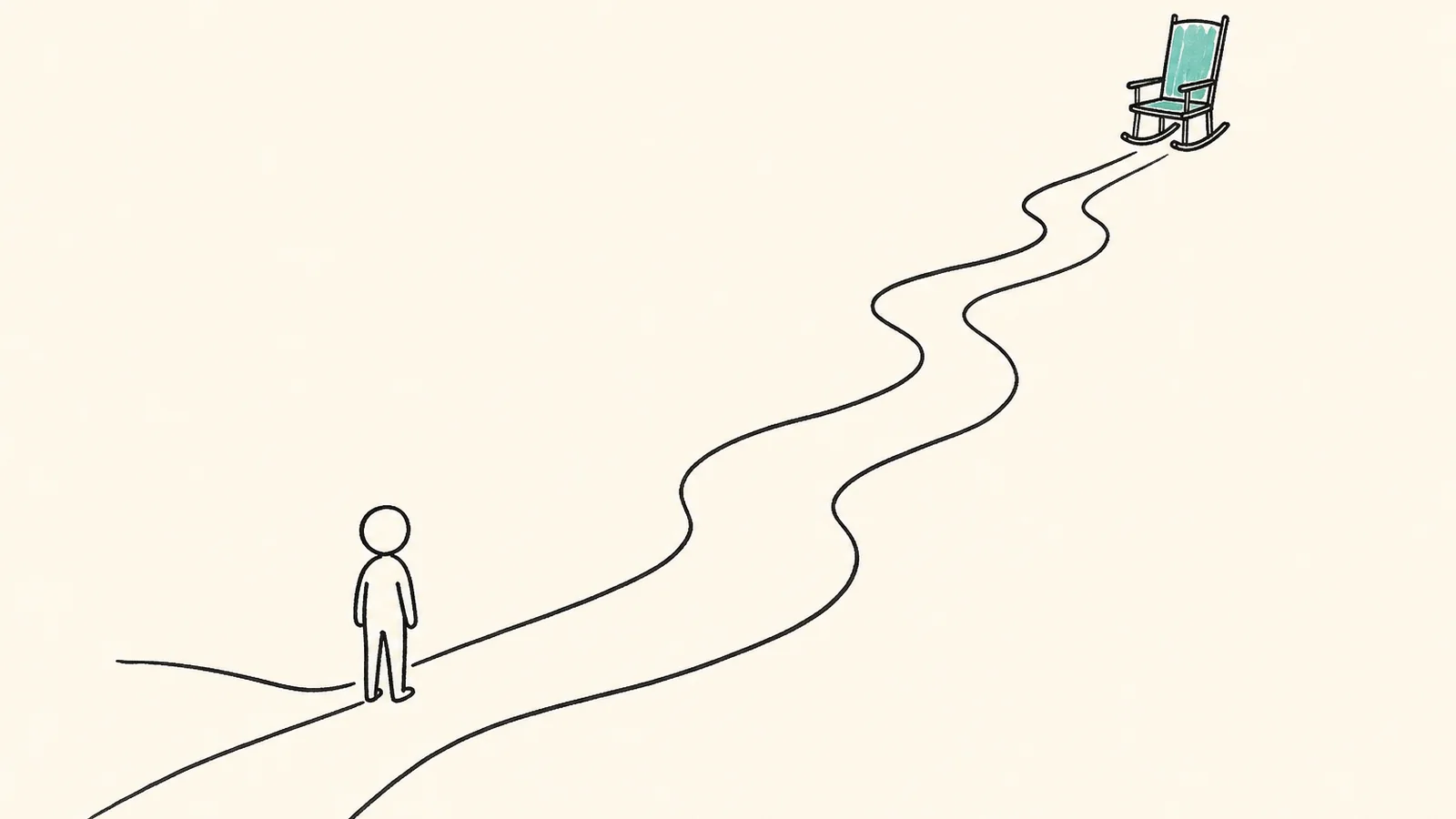
The regret minimization framework is a decision method Jeff Bezos described in a 2001 interview: project yourself to age 80, look back, and choose the path that leaves the fewest regrets. It works because regrets change over time. Gilovich and Medvec (1994) found that actions hurt more in the short term while inactions are regretted more over a lifetime, partly because people repair what they did and leave what they never did open. Its weakness is that the 80-year-old is imagined. Gilbert and colleagues (2004) showed people overpredict future regret, and the regret of not trying is usually pictured more vividly than the regret of trying badly, which tilts the test toward leaping. To run it honestly, write both regrets in equally specific sentences, mark each as about who you wanted to be or what you owed, ask whether it could be repaired, look for the smallest version of trying, and take the 48 hours Bezos took.
On this page+
The regret minimization framework is a decision method Jeff Bezos described in a 2001 interview: imagine yourself at 80, look back on your life, and pick the path that leaves you with the fewest regrets. It suits large, hard-to-reverse choices. It works honestly only when you picture both regrets: never trying, and trying badly.
You are probably here because of a choice that will not settle. Leave the job or stay. Move or don't. Start the thing or keep it as a someday. Lists of pros and cons have come out even, friends have split down the middle, and the age-80 question sounds like a way to cut through.
It can be. It also has a blind spot that almost every explanation of it skips, and the research on regret shows exactly where that blind spot is. What follows covers where the framework came from, why it works, where it misleads, and how to run it on paper so it tests your choice instead of flattering it.
What is the regret minimization framework?
It is one question asked from a different place in time: when I am 80 and look back, which choice will I regret less? Bezos used it in 1994, when he was deciding whether to leave a well-paid job on Wall Street to start an online bookstore. In an interview recorded for the Academy of Achievement in 2001, he called it a framework "which only a nerd would call" a "regret minimization framework". He said: "I wanted to project myself forward to age 80". Then he looked back at the decision from there. His conclusion was blunt: "I knew that if I failed I wouldn't regret that, but I knew the one thing I might regret is not ever having tried."
Two details from the same interview rarely make it into retellings. His boss took him on a two-hour walk in Central Park and "convinced me to think about it for 48 hours before making a final decision". And Bezos said that walking away from an annual bonus is the kind of thing that "in the short-term can confuse you". The framework, in his own telling, was a way to stop small near-term costs from deciding something large. It was not a way to decide fast.
Why does looking back from 80 change the answer?
Because regrets genuinely change shape over time, and the jump to 80 lets you see the shape they settle into. Psychologists Thomas Gilovich and Victoria Medvec spent the early 1990s asking people what they regretted, in phone surveys, questionnaires and interviews with groups from students to nursing-home residents2. Their summary: "Actions cause more pain in the short-term, but inactions are regretted more in the long run."
The numbers make the pattern clear. When people listed their biggest regrets in life, failures to act outnumbered actions 63% to 37%. In another study, people looking back over the past week were split almost evenly, but looking back over their whole lives, 84% said they regretted what they failed to do more than what they did. So the age-80 vantage point is not a trick. It approximates where regrets of inaction tend to end up.
Gilovich and Medvec also found part of the reason. People act on the mistakes they made: 65% said they had done more to repair their most regrettable action than their most regrettable inaction. What you did, you fix, explain or learn from. What you never did stays exactly as open as the day you didn't do it.
Regret of action
Regret of inaction
In the short term
Sharper, more painful
Easier to ignore
Over a lifetime
Fades, gets explained
Grows, stays open
Can you repair it
Often, and people do
Rarely, the chance has passed
How you picture it
One concrete event
A vague better life
Which regrets last longest?
The ones about who you wanted to be. In a 2018 paper, Shai Davidai and Thomas Gilovich separated regrets about the "ideal self" (hopes, goals, ambitions) from regrets about the "ought self" (duties and obligations)3. Across six studies, people named ideal-self regrets far more often, 72% to 28%, and 76% said their single biggest regret was a failure to live up to their ideal self.
Gilovich's explanation fits the table above: "The failure to be your ideal self is usually an inaction." Ought regrets tend to get acted on, apologized for, repaired and filed away. Ideal regrets stay vague and unfinished, so they keep their weight. This is why the method below asks you to mark each regret. If both of your regrets turn out to be ideal-self regrets, the framework has a real job to do. If one is about a duty to someone else, such as a parent who needs care or a promise you made, the biggest regrets research does not say that duty should lose. It only says which kind tends to linger.
Where does the 80-year-old test go wrong?
It goes wrong because the 80-year-old is imagined, not consulted, and our imaginations are biased in a predictable direction. Daniel Gilbert and colleagues tested how well people predict their own regret4. Students in a contest and riders on the subway predicted they would feel much worse after a near miss than after a clear loss. When it happened, they did not. The authors concluded that "people are less susceptible to regret than they imagine", and that decision makers who pay heavily to avoid future regret "may be buying emotional insurance that they do not actually need".
Put that next to the table above and the blind spot appears. When you run the age-80 question, the regret of not trying usually arrives as a vivid story: the life you could have had. The regret of trying and failing arrives as a vague worry, if at all. We see this in sessions all the time: the regret of not trying gets written in one vivid line, and the other one stays at "it might not work" until something asks for it again. That gives the framework an action bias. It reliably tells you to leap, because the leap's downside was never drawn in the same detail as its upside.
There is a second problem. Regret follows outcomes, and outcomes include luck. Bezos's story is told by the person it worked out for. A framework judged by its most famous success will always look better than it is, which is why it helps to judge how a decision was made rather than only how it turned out.
How do you use the regret minimization framework without fooling yourself?
Write both regrets down in the same detail, then question each one before you compare them. The core of regret minimization is a shift in vantage point; the fix is to make that vantage point see both paths clearly. Six steps, with a pen:
Name the two options as actions. Not "should I leave?" but "leave in spring" and "stay and ask for the transfer". Doing nothing is an option too, and not deciding is still a choice that someone or something will make for you.
Write the regret of each, at 80, in one sentence. Start with "I wish I had" or "I wish I hadn't". Make both equally specific: a place, a year, a sum, a person.
Mark what kind of regret it is. Is it about who you wanted to become, or about something you owed someone? Ideal-self regrets are the ones that linger.
Ask whether it could be repaired. A failed attempt can often be undone, retried or learned from. A door that closes for good cannot.
Find the smallest version of trying. Many regrets of inaction can be answered by a test that costs a month, not a career.
Wait the 48 hours. Bezos's boss asked him to, and he did. The pause is part of the method, not a delay.
Your 80-year-old self only knows what you tell them, so tell them both stories.
What does a regret minimization framework example look like?
Here is a regret minimization framework example, using a common situation rather than a real person. Say you have a stable job and a side project that has started earning a little. The age-80 question, asked the usual way, answers itself: "I wish I had gone all in." That is the vivid regret.
Now write the other one with the same care. "I wish I hadn't quit that spring with four months of savings, then spent two years paying them back in a job I liked less." That sentence is specific and plausible, and it changes the conversation. Mark them: the first is about who you wanted to become; the second is mostly repairable. Then step 5 asks for the smallest version of trying: three months of going part-time, with a number the project has to reach. The framework did not choose for you. It showed you that the real choice was not "all in or never" at all.
The one that was harder to write is usually the one you have been avoiding, and that is the one worth a second question. This is the move Inwitt AI is built around. It is an AI thinking partner app that asks one question at a time, and its Decision thinking mode keeps asking about the regret you wrote vaguely until it is as clear as the one you wrote first. It does not tell you which regret is worse. You decide that, looking at both.
When should you not use it?
Skip it for small, reversible or routine decisions. The age-80 view is built for choices you will live with for years; asking it about a laptop or a weekend plan makes every choice feel momentous. Skip it, too, when you are in the middle of a strong feeling. The question "will I regret not doing this?" sounds wise and can be a polished excuse for a rash decision made in a hot moment.
It is also a poor fit when money is the right unit. If the question is how to invest savings or which offer pays more over five years, arithmetic does the job better than imagined feelings. And it cannot settle a conflict between two people's futures on its own. Your imagined 80-year-old has no access to how your partner or your children will look back.
What only looks like minimizing regret
Writing one regret and calling it a framework. If only the regret of not trying made it onto the page, you have not run the test; you have written a pep talk. The other regret needs the same sentence and the same detail.
Treating regret as the only cost. A path can leave no regret and still cost your health, your savings or someone else's stability. Regret is one input among several, not the scoreboard.
Running it again and again. If you have asked the age-80 question ten times and keep getting different answers, more rounds will not help. You need a stopping rule, which is the same trap as analysis that never ends.
Borrowing the answer from the famous example. Bezos's choice was his. The method travels; the conclusion does not. Your two sentences are the only ones that count.
Questions people ask about regret minimization
Is the regret minimization framework really from Jeff Bezos?
The name is his. He described it in an interview recorded for the Academy of Achievement in 2001, about his 1994 decision to start Amazon. Anyone looking for the source of the Jeff Bezos regret minimization framework should start with that interview, linked in the sources below, rather than the many retellings.
Is it the same as minimax regret?
No. Minimax regret is a rule from decision theory and game theory that picks the option whose worst-case shortfall is smallest, usually computed from a table of payoffs. The Bezos regret minimization framework is an informal thought experiment for life decisions. They share a word, not a method.
What if I would regret either choice?
That is common, and it usually means both options matter to you, not that the framework failed. Mark each regret as ideal or ought, and repairable or not, then look for the smallest version of the path you would regret skipping. If you are still stuck, find what the decision is waiting on before asking the age-80 question again.
How long should the decision take?
Long enough to write both regrets in the same detail and sleep on them. Bezos took 48 hours at his boss's request. For most large decisions, a day or two after the writing is enough; weeks of repeating the question rarely add new information.
The two sentences take two minutes. Getting the second one as clear as the first is the hard part, and it goes faster when something keeps asking. That is what a session does: it asks, you answer, and both regrets end up on a session receipt in your own words, next to what you decided. If there is a decision you keep sending to your 80-year-old self, join the Inwitt waitlist and bring it to your first session.
Footnotes
Jeff Bezos, interview for the Academy of Achievement, Academy Class of 2001, part 12. Video and transcript↩
Gilovich and Medvec, "The temporal pattern to the experience of regret", Journal of Personality and Social Psychology 67(3), 357-365 (1994). Journal record↩
Gilbert, Morewedge, Risen and Wilson, "Looking forward to looking backward: The misprediction of regret", Psychological Science 15(5), 346-350 (2004). Paper (author site)↩