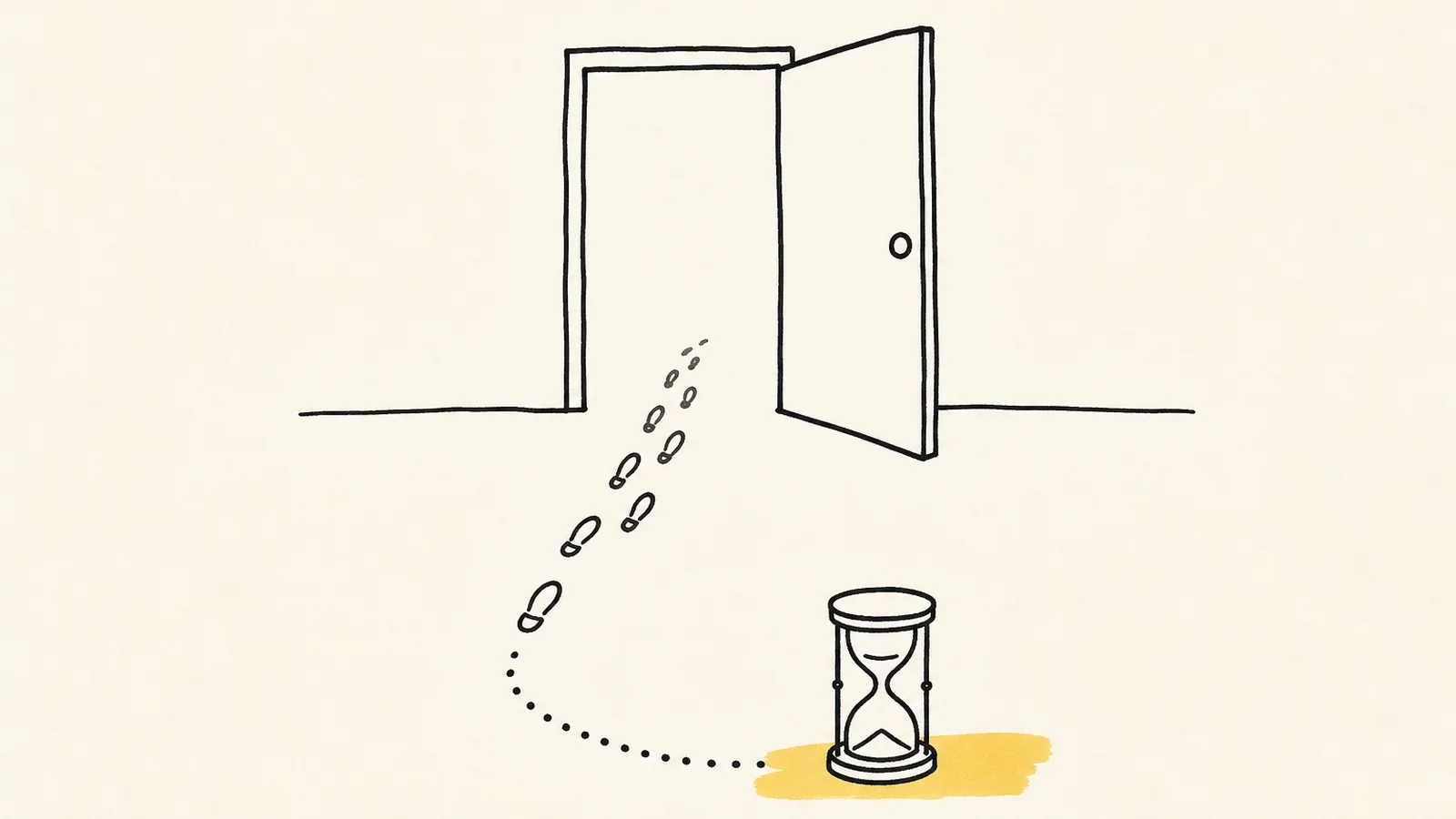
Reversible vs irreversible decisions differ in the cost of undoing them: a reversible choice can be walked back at a price you would accept, an irreversible one cannot. Jeff Bezos called them two-way and one-way doors in his 2015 shareholder letter, and argued that the first kind should be made fast and the second slowly. In personal life most decisions are partly both, so the useful test asks three things: what exactly cannot be undone, what undoing the rest would cost and who would pay, and until when. Reversibility also expires. Return windows end, other people adjust, and you start to feel committed, as Stacy Wood's return-policy studies found. Keeping a choice open has a cost too. In Gilbert and Ebert's 2002 study, people who could swap their choice liked it less, though only one of them swapped. Decide two-way doors quickly with a review date, and slow down for the one part that sticks.
On this page+
Reversible vs irreversible decisions differ in what undoing them would cost. A reversible decision can be walked back at a price you would accept. An irreversible one cannot, or only at a price you would not pay. Most personal decisions are partly both, so the useful question is which part of yours sticks.
You probably met the idea as one-way and two-way doors, in a piece about how companies should move faster. Almost everything written about reversible vs irreversible decisions is about companies: launches, pricing, hiring. Your decision is likely closer to home. A job, a lease, a move, a conversation that would change a relationship. Somewhere in your thinking sits the sentence "I can always go back", and it is carrying more weight than anyone has checked.
This piece applies the test to a personal decision, shows how two-way doors quietly close, and covers the research on what keeping a choice open costs you.
Reversible vs irreversible decisions: what is the difference?
The difference is the cost of undoing, not whether undoing is possible in principle. Almost anything can be reversed by someone willing to pay enough. The line falls where the price stops being one you would accept.
Jeff Bezos gave the distinction its best-known names in his 2015 letter to Amazon shareholders, as type 1 and type 2 decisions. Type 1 decisions are one-way doors: consequential, irreversible or nearly so, and worth making slowly. Type 2 decisions are two-way doors: if you dislike what you find, you walk back. His warning was that organizations treat too many decisions as type 1 and pay for it in speed. We used the same test for .
In a personal life the two kinds rarely arrive separately. Most choices bundle a reversible part with a one-way part, and the bundle gets the label of whichever part you happened to notice first.
Decision
The two-way part
The one-way part
Quitting a job
Finding other work in your field
This role, this team, and how you left
Moving to another city
The address: you can move again
A year of your time, and friendships that thin without you
Buying a home
Selling it later
The costs of buying and selling, and what prices do meanwhile
Telling a friend a hard truth
Apologizing for how you said it
Them having heard it
Having a child
Almost nothing
Almost everything
The last row is why examples of irreversible decisions all sound alike: marriage, children, emigration, selling a business. The rows above it matter more, because those are the decisions people misfile.
How do you tell if a decision is reversible?
Ask three questions in order and write the answers down: what exactly cannot be undone, what undoing the rest would cost and who would pay, and until when that cost holds. The test for reversible vs irreversible decisions is really these three questions.
What exactly cannot be undone? Not "the decision" but a specific thing. A sentence said, a notice period started, money that will not come back, a person who will know. If you cannot name anything, it is a two-way door. If you can name one thing, that thing is the real decision, and the rest is logistics.
What would undoing the rest cost, and who pays? Count more than money. Time, your reputation for following through, and other people's arrangements are all part of the cost of undoing. A move you could reverse in six months might also move a partner's job or a child's school. When other people pay part of the bill, the door is heavier than it looks from your side.
Until when? Reversible usually means reversible for a while. An offer can be declined until you sign, a purchase returned for thirty days, a new role abandoned while your old one is still open. Write down the date the price goes up.
In sessions, the first question does most of the work. People arrive saying it is a huge decision and, asked what exactly could not be taken back, name something much smaller than the whole: one conversation, one signature. Once the one-way part has a name, the rest often turns out to be a two-way door they had been treating as a wall. For the stage before this one, we wrote up five questions worth asking before you decide.
Why do reversible decisions stop being reversible?
Because three things close the door behind you: time limits, other people, and you. Calling a choice reversible describes the day you make it, not the months after.
Time limits are the obvious ones. Return windows end, notice periods run out, the job you left gets filled, and the apartment you gave up goes to someone else. A door that was two-way in March can be one-way by June without anything you would call a decision.
Other people adjust. A partner who moved for your job starts building a life there. A team you left reorganizes without your role. Going back is still possible, but you would be going back to something that no longer exists in the form you left. This is also why waiting is not neutral: an open decision gets closed by a default or a deadline if you leave it long enough.
And you adjust. In return-policy studies from her doctoral research at the University of Florida, reported in 1998, Stacy Wood found that people offered a lenient policy ordered more readily and spent less time deciding, treating the order as a trial2. By delivery they "feel like they own it", in Wood's words, and they were less likely to send it back. Her 2001 paper puts it as ownership depending more on perception than possession3. The option to undo made the decision quick, then mostly went unused.
Most two-way doors close on a timer. Check the timer before you walk through.
What does keeping a decision reversible cost?
It costs some of your satisfaction with whatever you chose, and people do not see that cost coming. The option to change your mind feels free. The studies say it is not.
Daniel Gilbert and Jane Ebert ran a small experiment in a Harvard photography course, published in 20024. Students printed two of their photographs and kept one; some could swap within a few days, the rest could not. Those who could swap liked their kept print less, while a group asked to predict the result expected no difference. The detail we find most telling: of the students allowed to swap, only one did. The rest paid for the open door without using it, a cost we looked at in why giving up the other option is so hard.
In 2013, Laura Bullens and three colleagues looked at why5. Across three studies, a final decision made the good points of the chosen option and the weak points of the rejected one easier to bring to mind. A reversible decision did the opposite: the chosen option's flaws and the rejected option's strengths came forward. A door left open keeps you looking back through it.
None of this argues for making every choice final. It argues for deciding when you will look again. A reversible decision with a review date ("I will judge this flat on the first of March") lets you stop comparing until then.
How much time should each kind of decision get?
Two-way doors deserve a quick call and a review date. One-way doors deserve more time, spent on questions rather than on gathering facts, and a date by which you will decide. Reversible vs irreversible decisions fail in opposite directions, so they need opposite guards.
For reversible decisions, the main risk is delay. Each week spent researching a choice you could undo is a week not learning what you would learn by trying it. Decide, write down what would make you reverse it, and put the review in your calendar. If you notice yourself collecting information that would not change the choice, that is research that will not change your mind, and the door test is a quick way out: if it is two-way, go through.
For irreversible decisions, the main risk is being wrong in a way you keep. Slow is right here, but slow means a particular kind of work: naming the one-way part, asking what you would need to believe for it to be the right call, and waiting until the mood of the week has passed. Some of the worst irreversible decisions are rash ones, where a passing mood signs off on something lasting. The date protects you from the opposite failure, where careful slowly turns into never.
Can you make an irreversible decision reversible?
Often you can make a large part of it reversible, by splitting off a smaller first step that tests the one-way part before you commit to it. The decision does not have to be taken whole.
Try a version: a month of remote work from the new city before moving there. Shrink it: a side project before quitting. Stage it: tell one person before telling everyone. Each buys information at a two-way price about a one-way choice.
Take moving in with a partner. The lease length, the furniture and whose place are all reversible. The part that sticks is what living together will show you both, and the conversation you would have if it went badly, with the cost of undoing carried by two people. A couple who see that might choose a shorter lease, or agree in advance what "this is not working" would look like. The decision is as big as it was, but its one-way part is now small and named.
This is the kind of question Inwitt AI asks. It is an AI thinking partner app: in Decision, one of its six thinking modes, it asks one question at a time, such as what exactly could not be undone, and draws your confirmed answers onto the thinking board. It does not tell you which column a choice belongs in. You sort it, and the sorting stays on the page.
Where does the door test go wrong?
The test itself is simple. Most mistakes with reversible vs irreversible decisions come from answering it in your head:
Trusting "I can always go back" without checking. Ask whether the thing you would go back to will still be there. Old jobs get filled, and people move on.
Calling everything a one-way door. Fear makes every choice feel permanent. If you cannot name the specific thing that cannot be undone, it is probably two-way.
Treating reversible as careless. A two-way door still deserves a few minutes of thought. It does not deserve a month.
Counting only money. Time, trust and other people's plans are often the real cost of undoing.
Forgetting the other side of the door. Your choice can be two-way for you and one-way for someone else. The friend who turned down another offer to join your project cannot take that refusal back.
Reopening it every night. A reversible choice reviewed daily is never really made. Set the review date and leave it alone until then.
Using big tools on small doors. Picturing yourself at eighty suits choices you will live with for years. On a weekend plan it makes every choice feel momentous.
Questions people ask about reversible vs irreversible decisions
Who came up with one-way and two-way doors?
Jeff Bezos used the terms in his 2015 letter to Amazon shareholders, released in April 2016. The underlying idea, that how easily a choice can be undone should set how carefully you make it, is much older; his image is what stuck.
Is quitting a job reversible?
Partly. Finding work again is often possible, so your career is closer to a two-way door. The specific role, the team and the way you leave are closer to one-way. The cost of undoing tends to rise the longer you are away.
Are most decisions reversible?
Most everyday ones are, at a modest cost. Most big personal decisions are mixed: a reversible bulk with one or two parts that stick. That is why the useful question is which part, not which kind.
Is an irreversible decision the same as a high-stakes one?
No. Stakes are how much rides on the outcome. Reversibility is whether you can change course once you see how it is going. A risky choice you can exit quickly may need less care than a modest one you are locked into, and the ones to slow down for are high on both.
The two-column page is a slow version of what a session does: one question at a time, your answers on the board, and at the end a receipt in your own words with what you realized, what you decided, and what you planned next, such as the date you said you would look again. If there is a door in front of you and you cannot tell which kind it is, join the Inwitt waitlist and bring it with you.
Footnotes
Jeff Bezos, 2015 Letter to Shareholders, Amazon.com, filed with the SEC as Exhibit 99.1 (April 2016). SEC filing↩
University of Florida News, "UF study: retailers get unexpected benefits from lenient return policies" (November 1998), reporting Stacy Wood's doctoral research. News release↩
Stacy L. Wood, "Remote purchase environments: the influence of return policy leniency on two-stage decision processes", Journal of Marketing Research 38(2), 157-169 (2001). Journal record↩
Daniel T. Gilbert and Jane E. J. Ebert, "Decisions and revisions: the affective forecasting of changeable outcomes", Journal of Personality and Social Psychology 82(4), 503-514 (2002). Journal record↩
Laura Bullens, Frenk van Harreveld, Jens Förster and Joop van der Pligt, "Reversible decisions: the grass isn't merely greener on the other side; it's also very brown over here", Journal of Experimental Social Psychology 49(6), 1093-1099 (2013). Journal record↩