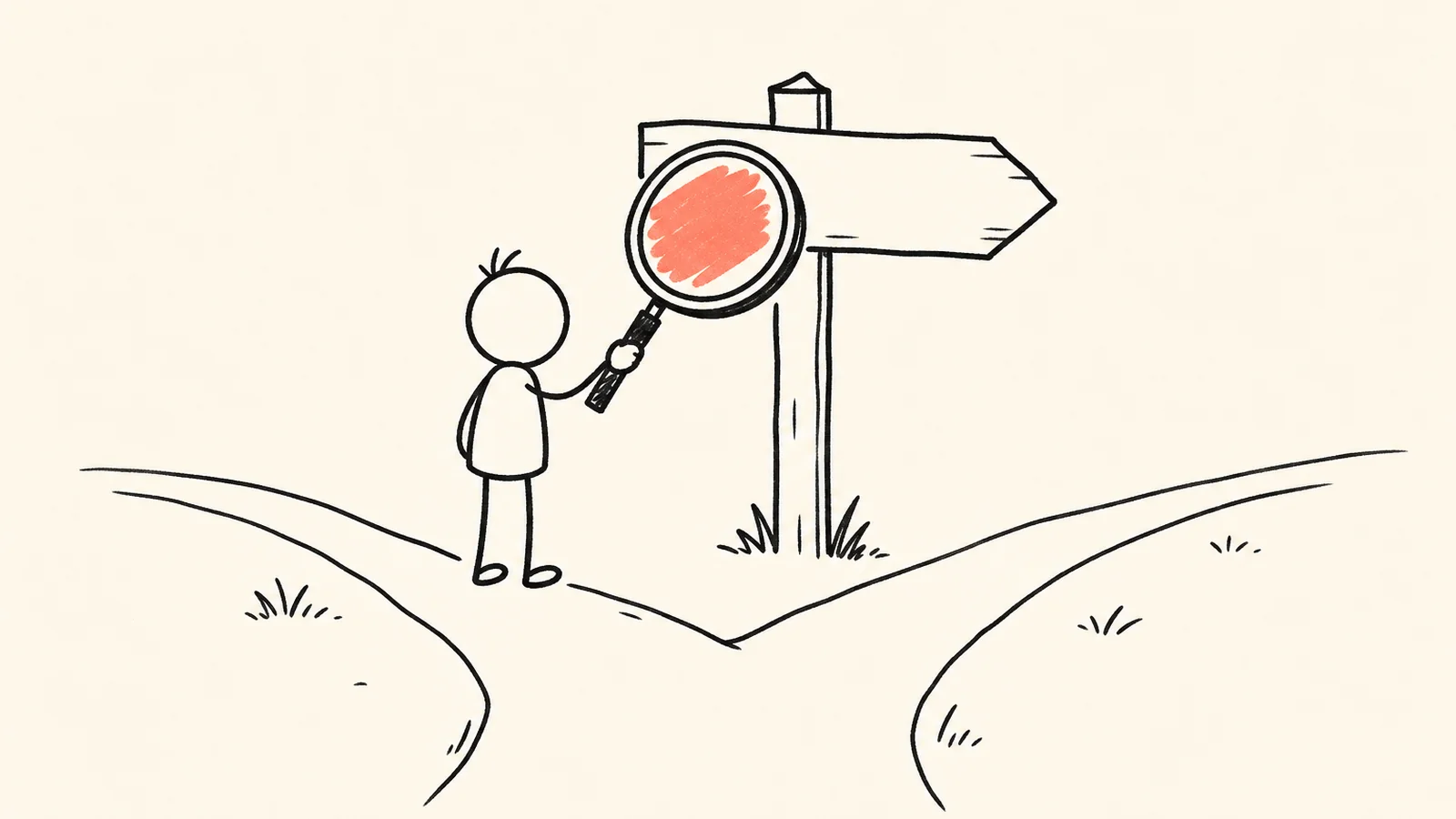
Critical thinking with examples is clearest as a before-and-after: the sentence a person believed by default, the question that tested it, and what they believed after looking. The expert consensus Peter Facione summarizes (2023 update) defines critical thinking as purposeful, self-regulatory judgment built from interpretation, analysis, evaluation, inference, explanation and self-regulation, and the last skill is the one most examples leave out. This piece runs six situations in three beats each: a claim online, a job someone wants to quit, an argument with a partner, a business idea, a student's convenient source, and a plan that keeps slipping. In every case the move is a version of one question: what would I have to see to change my mind? Wineburg and McGrew's 2019 fact-checker study shows the habit is learned, not innate. Fact checkers left a page to check the page and reached better conclusions in a fraction of the time. The setting changes; the question does not.
On this page+
Critical thinking with examples is easiest to understand as a before-and-after: the sentence you believed by default, the question that tested it, and what you believed once you had looked. Every example below runs in that order, because the setting (a job, a news story, an argument) matters far less than the move.
You have probably read a page of examples of critical thinking already: a nurse triages patients, a manager weighs a promotion, a student checks who funded a study. They all end the same way, with the person having "analyzed the situation carefully". What none of them show is the moment the thinking turned, which is the only part you can copy. This piece shows that moment six times, then shows you how to produce it on purpose.
What does critical thinking actually look like in an example?
Critical thinking looks like a person pausing on a sentence they already believe and asking what it rests on. The most cited definition comes from a cross-disciplinary expert panel whose consensus Peter Facione has summarized in a report updated through 2023: critical thinking is "purposeful, self-regulatory judgment which results in interpretation, analysis, evaluation, and inference, as well as explanation of the ... considerations upon which that judgment is based".1 Six skills sit inside that sentence: interpretation, analysis, evaluation, inference, explanation and self-regulation. The last one is the odd one out. It means checking your own thinking, not the problem.
That is why a good example needs three parts, not one. The default thought: what you believed before you looked. The question: the single move that put the belief under load. And the result on paper: what you believe now, with the reason attached.
A scene with only the setting and the happy ending is a story about a careful person. A scene with all three parts is an example you can repeat. We have written about reasoning critically, step by step as a process; this piece is the same idea shown in pictures.
Critical thinking with examples: six real situations
Each example follows the same shape. The settings are the ones we see most in sessions: everyday life online, work, a relationship, a business idea, a student's essay, a plan that keeps slipping.
Reading a claim online
Default thought: "This site has a proper logo, a .org address and an About page. It looks legitimate."
The question: who else says this organization is what it says it is?
On paper: in a 2019 study, Sam Wineburg and Sarah McGrew watched ten professional fact checkers, ten PhD historians and twenty-five Stanford undergraduates evaluate two websites about bullying, one from the American Academy of Pediatrics and one from the similarly named American College of Pediatricians, a small splinter group.2 Historians and students stayed on each site and read it closely; students overwhelmingly judged the splinter group more reliable. Every fact checker left the page within seconds, opened new tabs, and searched for what others said about the source. The authors called it lateral reading, and the fact checkers "arrived at more warranted conclusions in a fraction of the time".
The critical thinking here was not deeper reading. It was a refusal to let the page vouch for itself. The same instinct is why Inwitt makes you guess before the research reveal: you commit to what you expect before the sources can settle it for you.
Deciding whether to quit a job
Default thought: "I am unhappy, so I should leave."
The question: what, specifically, would have to change for me to stay?
On paper: the list usually has two or three items, and they are rarely "the job": a manager, a commute, a project that ended in April. Once they are written down, the decision splits into two smaller ones: can any of these change, and how long am I willing to wait to find out? The person may still leave, but they leave a situation they have described, not a feeling they have obeyed. That is the difference between a decision and an escape, and it only appears once the default thought is turned into a testable one.
An argument with a partner
Default thought: "They never listen to me."
The question: what is the most recent time they did, and what was different about it?
On paper: there is nearly always a time. It was usually calmer, earlier in the day, or about a smaller thing. Now the belief has changed shape. "Never" has become "not when we are both tired and the stakes feel high", which is a problem with a schedule, not a verdict on a person. Critical thinking in a relationship is rarely about who is right. It is about replacing the absolute with the specific, because the specific is something two people can act on.
A business idea that will not resolve
Default thought: "People would definitely pay for this."
The question: what is the cheapest thing I could do this week that would embarrass this belief if it is wrong?
On paper: a landing page, ten conversations, a pre-order form. Founders in sessions tend to answer this question fast and then go quiet, because the honest answer is that they have been avoiding it. Inference, in Facione's sense, is drawing the conclusion the evidence supports.1 But you can only infer from evidence you were willing to collect. The move here is not clever analysis. It is choosing a test that could fail.
A student and a too-convenient source
Default thought: "This article says exactly what I need for my essay."
The question: who paid for this, and what would the same topic look like from someone who disagreed?
On paper: a sponsor, a date, or a missing method. Sometimes the source survives the check and the student uses it with more confidence. Sometimes it does not, and the essay gets harder and better. Either way the student has done what the assignment was secretly asking for: not "find a quote" but "tell a good source from a convenient one". It is the fact checkers' move, one tab to the side.
A plan that keeps slipping
Default thought: "I just need more discipline."
The question: on the days it slipped, what was true at 7am that was not true on the days it held?
On paper: a meeting that ran over, a night with less sleep, a task that was too big to start. Discipline explains nothing; it is a label for the outcome. The specific conditions explain a lot, and each one suggests a change smaller than "be a better person". Self-regulation, the sixth skill on Facione's list, is exactly this: examining how you reached a judgment about yourself, not just about the world.1
Why do textbook examples never match your situation?
Pages that teach critical thinking with examples are tidy because the examples are written backwards from a good outcome. Real situations arrive tangled, mid-way through, with feelings attached and three other things going on. In sessions we have watched this gap frustrate people who know the theory well: they can recite the six skills and still cannot see what to do with the argument they had this morning.
What we notice is that the question underneath is not. In every example above, the move was a version of the same thing: what would I have to see to change my mind? For the news claim it was another source; for the job, a list of changes; for the argument, one counter-example; for the plan, one morning's conditions. The setting decides what the evidence looks like. The question decides whether you go and get it.
The setting changes every time. The question does not.
This is close to what a session with Inwitt AI, an AI thinking partner app, does, one question at a time. The thinking board records only what you have confirmed, so the sentence you believe and the test you named sit next to each other where you cannot skip either one.
Is critical thinking a skill or a habit?
It is both, and the habit is the part that transfers. Facione's expert panel was clear that skills alone do not make a critical thinker; they described dispositions too, an "ideal critical thinker" who is "habitually inquisitive, well-informed, trustful of reason, open-minded, flexible, fair-minded in evaluation, honest in facing personal biases".1 Skills are what you can do when asked. Dispositions are what you do when nobody is asking.
The fact-checker study is the clearest evidence we have read that the habit is learnable rather than innate. The fact checkers were not smarter than the historians or the Stanford students. They had three named practices, which Wineburg and McGrew call taking bearings, lateral reading and click restraint: get a sense of the terrain before reading deeply, leave the page to check the page, and scan the whole results list before clicking anything.2 Each is teachable in an afternoon. Doing it every time is not, which is where practice comes in. We have covered what actually improves critical thinking elsewhere; the short version is that one real decision worked through on paper does more than ten articles read.
Recalling the six skills is a lower-order task. Applying them to a belief you hold is evaluation, one of the higher order reasoning skills that only develop through use.
What only feels like critical thinking
Some habits feel rigorous and are not. Any honest page on critical thinking with examples should include the counterfeits, because each one produces the sensation of having thought hard without the result.
Looks like critical thinking
What it actually does
The move that fixes it
Doubting everything
Treats all sources as equal, which is the same as trusting none and deciding by mood
Ask which claim you could check, and check that one
Doing more research
Delays the decision while feeling productive
Name what evidence would end the research, then stop when you have it
A long pros-and-cons list
Hides the one assumption both columns depend on
Write the assumption at the top; the list usually collapses
Asking an AI assistant to decide
Produces a fluent answer you did not build and will not defend
Write your own sentence first, then use the tool to attack it
The last row deserves a word. A tool that answers is not a substitute for the move, because the move is yours by definition: it is your belief being tested. Facione puts it plainly: critical thinking is about how you approach the question, and "there still are no guarantees, no answers in the back of the book of real life".1 The evidence on why AI should not be used in education says the same thing: the harm comes from trusting the output before you have formed your own.
Being skeptical is also not the same as being critical. Skepticism is a mood that points outward. Self-regulation points inward, and it is the skill most critical thinking with examples pages leave out, because it is the least flattering to show.
Questions people ask about critical thinking examples
What is an example of critical thinking in everyday life?
Checking who is behind a website before trusting its claim is the most common one. Others from this page: writing down what would have to change for you to stay in a job; finding one counter-example to an absolute like "never"; choosing a test that could prove a business idea wrong; looking at the conditions on the days a plan slipped instead of blaming discipline. Each one is a belief, a question, and a result you can point to.
How do you show critical thinking in an interview?
Describe a belief you held, the thing that made you test it, and what you did differently after. Interviewers are not looking for the word "analyzed". They want critical thinking with examples from your own work: a moment where you changed your mind for a reason, and the reason. Three sentences in that order will beat a paragraph of adjectives.
What is the difference between critical thinking and problem solving?
Problem solving starts once you have agreed what the problem is. Critical thinking is the part before that, where you check whether the problem is what you think it is. In the job example above, problem solving would be "how do I find a new job". Critical thinking was "is the job the problem". Skipping the second step is how people solve the wrong thing well.
What does poor critical thinking look like?
Absolutes ("always", "never", "definitely"), conclusions with no stated test, sources trusted because they look official, and a preference for more information over a decision. In the fact-checker study, the students who trusted the wrong site were reading carefully; they were reading the wrong thing.2 Effort is not the signal. The question is.
Critical thinking with examples comes down to one sentence, one question, and the willingness to go and look. That is what a session is built to do: it asks the question, you write the sentence, and the board keeps both in front of you until the test is named. If you would like to work through a decision this way, join the Inwitt waitlist and bring the one you are circling.