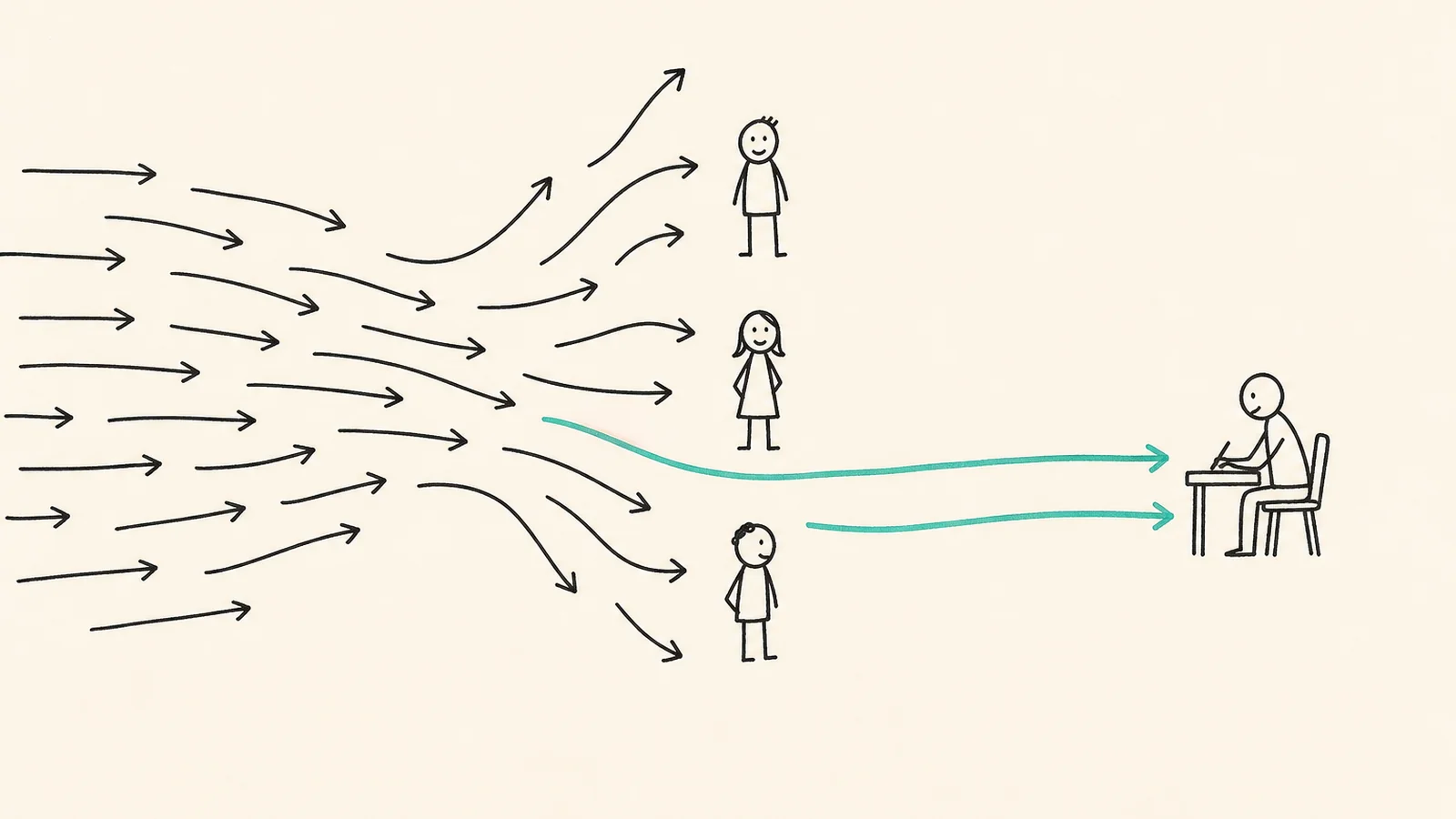
Decision fatigue in business is the decline in judgment that sets in when too many decisions route to one person, usually a founder or senior manager. It shows as stalled approvals, safe defaults and snap yeses. The evidence on the mechanism is mixed: a 2019 study of stock analysts by David Hirshleifer and colleagues found forecasts grew less accurate, and more likely to follow the consensus, repeat the analyst's last number or round off, as the day's forecast count rose, while a 2025 study of triage nurses found no drift. What does not depend on the mechanism is routing. Decisions reach you because nobody else has the right to make them, because reversible two-way doors are handled like one-way doors, or because a settled decision was never written down. Sort each one: keep the calls that are hard to undo, give reversible ones an owner and a limit, and record what was decided and what would reopen it.
On this page+
Decision fatigue in business is the decline in judgment that sets in when too many decisions route to one person, usually the founder or a senior manager. It shows up as stalled approvals, safe defaults and snap calls. The fix is less about stamina than about routing: which decisions reach you, and how often they come back.
You probably know the day. Nothing large happened, and by four o'clock you have approved a discount, a new hire's start date, a supplier invoice, two versions of a logo and a refund, and said "let me think about it" to the one thing that mattered. The advice you will find says sleep more, decide early, delegate. The last word is right and almost never explained. What follows is about which decisions should reach you at all, and how to stop the rest coming back.
What does decision fatigue in business look like?
Decision fatigue in business looks like a queue with your name on it. Approvals wait for you, then get waved through late in the day, then return a week later because nobody wrote down what was agreed. The tiredness is the visible part; the queue is the cause.
Paul Rogers and Marcia Blenko opened their 2006 Harvard Business Review piece on decision roles with a line most owners recognize: "At many companies, decisions routinely get stuck inside the organization like loose change." In a small company, the place they get stuck is usually one person. Each question on its own is small. Together they set the pace of the whole business, because nothing moves until you answer.
The symptoms are behaviors you can see in a calendar or an inbox. Approvals pile up, then clear in a rush just before you leave. You say yes to whatever is in front of you to make it go away, which is where snap approvals late in the day come from. You defer the big call again, and a deferred decision still gets made, by a deadline or by someone else. And you find yourself deciding the same thing twice.
In sessions with founders, we see the same pattern often: the decision they arrive with is rarely the one wearing them out. The weight is in the dozens of smaller calls that reached them that week and had no business doing so.
Is executive decision fatigue real, or just a full calendar?
Executive decision fatigue has support from one field study of skilled professionals and a null result from another, so the honest answer is that the drift shows up in some work and the mechanism is unsettled.
The study closest to business is about stock analysts. In 2019, David Hirshleifer, Yaron Levi, Ben Lourie and Siew Hong Teoh published an analysis of sell-side analysts' earnings forecasts in the Journal of Financial Economics. They found that "forecast accuracy declines over the course of a day as the number of forecasts the analyst has already issued increases."2 The more forecasts an analyst had already issued that day, the more they leaned on shortcuts: staying close to the consensus, reissuing their own previous number, and rounding.
That detail matters more than the accuracy drop. Tired judgment at work does not look like chaos. It looks like the safe default: agree with what everyone else said, repeat what you decided last time, pick the round number. Nobody gets fired for any of those, which is why nobody notices.
The counterweight is a 2025 study of 174 nurses at a Swedish telephone triage service, whose judgments did not drift across their shifts3. The lab evidence for the "limited tank" story is weak too; we went through it on the personal side of decision fatigue. So treat the mechanism as open. What you can do about decision fatigue in business does not depend on it: a person who decides everything will drift toward defaults, and the number of things that reach that person is a design choice.
Why do so many decisions end up on your desk?
Most decisions reach you by one of three routes: nobody else has the right to make them, they are treated as more permanent than they are, or they were made once and never recorded. Each route has its own fix, which is why "delegate more", the standard advice on decision fatigue in business, rarely works on its own.
The first route is decision rights. If someone on the team can do the work but must ask before acting, the decision is still yours, whatever their job title says. Handing over the task while keeping the decision only adds a step.
The second route is the one Jeff Bezos described in his 2015 letter to Amazon shareholders. Some decisions are "one-way doors": hard or impossible to undo, and worth making slowly. Most are two-way doors, reversible at modest cost, and "Type 2 decisions can and should be made quickly by high judgment individuals or small groups." His warning was that growing companies drift toward "the heavy-weight Type 1 decision-making process on most decisions, including many Type 2 decisions," and that the result is "slowness, unthoughtful risk aversion, failure to experiment sufficiently."4 A small company does the same thing with one person. Every reversible call gets routed to the founder, because the founder is where careful decisions get made.
The third route is the quietest. A decision is made in a meeting or a message, nobody writes down what was decided or why, and three weeks later the same question arrives as if it were new.
Route to your desk
What it looks like
What fixes it
No one else has the right
"Can I go ahead with this?"
An owner, and a limit they decide inside
A two-way door treated as one-way
A reversible call waits for a meeting
The door test: what would undoing it cost?
Decided once, never recorded
The same question, a month later
One line: what was decided, and what would reopen it
A decision you delegated without a limit is a decision you will make twice.
How to reduce decision fatigue at work: sort by door and owner
To reduce decision fatigue at work, sort every decision that reaches you by two questions: can it be undone cheaply, and who else could own it? Keep the ones that are hard to undo. Hand off the rest with a limit, and write down what was decided so it stays decided.
List what reached you. One working week, every decision someone brought to you or you picked up yourself. Not tasks: only the points where something had to be chosen.
Run the door test. For each, ask what it would cost to undo in a month. If the answer is a refund, an apology or a redo, it is a two-way door. If it is a lost client, a signed contract or someone's job, it is one-way.
Give every two-way door an owner and a limit. Name the person, then the boundary inside which they decide without asking: refunds up to a set amount, supplier changes under a set cost, design choices that do not touch the brand. Delegating decisions without the limit sends them back to you as questions.
Write down what was decided. One line each: what was chosen, by whom, and what would have to change to reopen it. The last part is what stops a settled question from coming back with every new opinion.
Keep the one-way doors, and date them. These are the job. Give each a day to decide by, so it does not run in the background all month.
None of this means making reversible decisions carelessly. Reversible decisions still deserve thought; they just do not need yours every time.
Here is how a typical list sorts:
A customer refund above the usual amount: T, owned by the support lead, with a ceiling.
Next quarter's pricing: O.
Switching the packaging supplier: T, owned by operations, inside a cost and delivery limit.
Whether the new hire starts Monday or Wednesday: T.
The same discount question, raised for the third time: R.
Five items, and one left on the O list. That is a normal ratio for decision fatigue in business: the load is real, and most of it was never yours.
That sort is close to how a session in Inwitt AI, an AI thinking partner app, runs. The Decision thinking mode asks one question at a time, about what undoing a choice would cost and who else could make it, and draws your answers on the thinking board; it does not choose for you. What you settle goes into a session receipt in your own words, which gives the R items a record to point to.
What only feels like it helps
Most decision fatigue leadership advice is aimed at your energy rather than your queue, so some popular fixes feel productive and leave the routing exactly as it was.
The open-door policy. It feels generous. It also tells everyone that any question can come to you at any time, which is the problem stated as a value.
Approving to be safe. Asking people to check with you "just in case" turns every two-way door into a one-way door with you as the lock.
Delegating the task, keeping the decision. If the work moves and the approval stays, you have the same number of decisions plus a status update.
Consensus on two-way doors. A reversible call does not need everyone's agreement. The point of the Bezos letter is that small groups should make these quickly; more voices add meetings, not quality.
A framework for every call. A full grid of pros and cons on a reversible choice is research that changes nothing. Save the heavy process for the one-way doors.
Doing the big ones in the morning. A fine habit, but if the queue is unchanged, the morning fills up with it instead.
Decision fatigue in business: common questions
Is decision fatigue worse for founders and small business owners?
Often, because in a small company there is no layer between a question and the founder. Decision fatigue for founders is mostly a routing issue: everything reaches one person by default until someone decides otherwise. Naming two or three owners with clear limits usually removes more load than any personal habit.
How do you stop delegated decisions coming back to you?
Give the owner a limit, not only the task, and agree how you will review their calls. Review the way they decided, not only the result, since a good call can turn out badly by luck; judge how a call was made before you overrule it. If you overrule outcomes, every future call will come to you first.
Is decision fatigue the same as burnout?
No. Decision fatigue is short-term and tied to choosing; burnout builds over months, and rest alone does not fix it. A long run of routing everything to yourself can feed both. If the exhaustion lasts for weeks whatever you change at work, talk to a doctor.
Do people really make 35,000 decisions a day?
We could not find a study behind that number, and it depends entirely on what you count as a decision. The useful count is smaller and checkable: how many decisions reached you this week, and how many of them had to.
The sheet with three letters is a slow version of what a session does: one question at a time, your answers on the thinking board, and a receipt that records what you decided and what would reopen it. If keeping the one-way doors and letting go of the rest is the part you keep putting off, join the Inwitt waitlist.
Footnotes
Paul Rogers and Marcia W. Blenko, "Who has the D? How clear decision roles enhance organizational performance", Harvard Business Review, January 2006. Article page↩
Hirshleifer, Levi, Lourie and Teoh, "Decision fatigue and heuristic analyst forecasts", Journal of Financial Economics 133(1), 83-98 (2019). NBER working paper record↩
Andersson, Lindberg, Tinghög and Persson, "No evidence for decision fatigue using large-scale field data from healthcare", Communications Psychology 3, article 33 (2025). Open-access paper↩
Jeff Bezos, 2015 Letter to Shareholders, Amazon.com, filed with the SEC as Exhibit 99.1 (April 2016). SEC filing↩