Learning how to stop overthinking social interactions starts with separating what you saw from what you concluded, then correcting the conclusion for a known bias. During a conversation your attention is mostly on yourself, and research shows what that does to the replay. In the spotlight effect studies (Gilovich and colleagues, 2000), people consistently overestimated how much others noticed them. In the liking gap studies (Boothby and colleagues, 2018), people underestimated how much their conversation partners liked them, while outside observers saw the signs they missed. Replaying itself is ordinary: in a 2020 experience-sampling study, healthy adults went back over about 96% of their embarrassing interactions. The useful move is a short written check. List what the other person actually did afterward, list what you decided it meant, and cross out every conclusion with no evidence behind it. Then answer one question: is there anything to repair? If yes, send one sentence. If no, write that down and stop.
On this page+
To learn how to stop overthinking social interactions, separate what you saw from what you concluded, then correct the conclusion for a known bias: during the conversation, you were mostly watching yourself. Research shows people overestimate how much others noticed and underestimate how much they were liked. Repair anything real with one message, and close the rest on paper.
You know the drive home. The dinner went fine, probably, except for the joke that landed a beat late, the moment you talked over someone, and the way she said "anyway" after your story. By midnight you have replayed it six times, and each replay finds something new. Nothing about the evening has changed since ten o'clock. Your verdict on it has changed four times.
Most advice on how to stop overthinking social interactions tells you to challenge the thought, breathe, or find a distraction. Some of that helps for an evening. What it skips is a plainer problem: the replay is a reconstruction made by the one person in the room who was least able to see what happened. Below is that problem, and a short written check that closes the loop instead of quieting it for a night.
Why do I overthink every social interaction?
Because going back over a social moment is close to universal, and because the replay is trying to answer a question about someone else's mind, which it cannot reach from inside yours. Overthinking social interactions is not a sign that something is broken. It becomes a problem when the replay never reaches a verdict.
In 2020, Čolić and colleagues gave 284 adults smartphones for a week, with five check-ins a day. After interactions people rated as embarrassing, repetitive thinking about the moment showed up about 96% of the time, and the healthy control group did it just as often as people with depression or social phobia.1 Psychologists call this post-event processing: going back over a social situation after it ends, usually focused on how you came across.
So the replay itself is ordinary. What varies is what it produces. A replay that ends with "I talked over my friend, I will mention it" has done its job. One that ends with "they probably think I am strange" and then starts again is a loop, and the difference between thinking that produces something and thinking that only circles is most of the story.
Why is your replay of a conversation so unreliable?
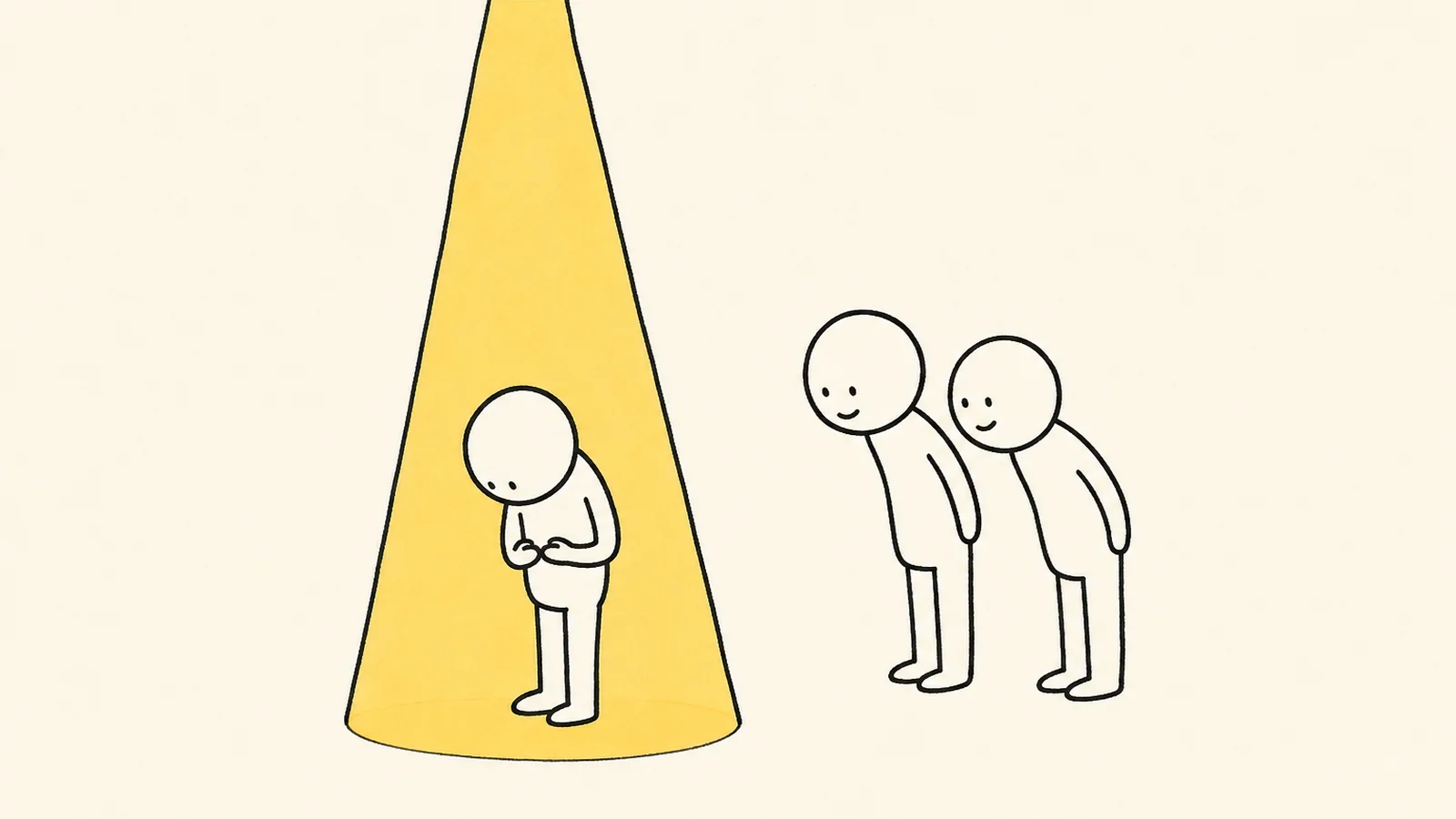
Because during the conversation your attention was largely on yourself, and the research on what that does is consistent: you remember being more noticed than you were, and less liked than you were. Replaying conversations means rewatching footage from a camera pointed mostly at your own face.
Two findings carry most of the weight. In 2000, Thomas Gilovich and two colleagues ran five studies, the best known involving students who walked into a room of peers wearing an embarrassing T-shirt. The wearers consistently overestimated how many people had noticed the shirt, and the same held in group discussions. The authors called it the spotlight effect, and traced it to anchoring on your own vivid experience of the moment, then adjusting too little for everyone else's.2
In 2018, Erica Boothby, Margaret Clark and colleagues found the other half. After conversations between strangers in a lab, between new college dorm mates, and between members of the public at a workshop, people systematically underestimated how much their partner liked them and enjoyed their company. Among the dorm mates, the gap lasted for months. The authors described their participants as a bit too self-focused, and outside observers watching the same conversations picked up the signs of liking that the participants themselves had missed.3
Put together, the error has a direction. The replay overstates what others saw and understates how warmly they saw it. A bias with a known direction can be corrected, the way you would correct a bathroom scale you know reads two pounds heavy, and that is why how to stop overthinking social interactions starts with the evidence rather than the feeling. You do not throw the reading away. You adjust it.
What separates reviewing a conversation from replaying it?
A review asks one question, gets one answer, and stops. A replay asks the same question again because the answer it wants (what did they really think of me?) is not in the footage. You can review a conversation in five minutes and learn something; you can replay one for a week and learn nothing new.
Review
Replay
The question
Did I do anything I want to repair or repeat?
What did they think of me?
Evidence used
What they said and did
How you felt in the moment
Answerable from memory
Mostly yes
No
When it ends
When you have a yes or a no
When something else takes your attention
What it leaves
A lesson, or a message to send
A worse version of the evening
The difference matters beyond one evening. A 2024 meta-analysis by Edgar and colleagues pooled the research on post-event rumination and social anxiety and found a moderate association, a correlation of about 0.45.4 That is a link, not proof that replaying causes anxiety, but it is strong enough that the authors flag the replay as a target for treatment.
It also fits what we see when people bring a conversation to a session. The replay is rarely short of detail. It is short of a question it could actually answer, which is the same habit applied to texts and decisions.
How to stop overthinking social interactions, step by step
Write down what you saw, write down what you decided it meant, and check the second list against the first. Then ask one question that has an answer: is there anything to repair? That is the whole method for how to stop overthinking after social interactions, and it takes about ten minutes with a pen.
Name the moment in one sentence. The specific moment, not the whole party: "I interrupted a friend's story about her move." A vague unease cannot be checked, but a specific worry can.
Write the verdict you have reached. Exactly what you fear they concluded: "She thinks I do not listen." Seeing it written often shrinks it, because the sentence is more extreme than the evidence.
List what they did afterward. Observable things only: they kept talking to you, laughed at the next thing, replied to your message the next morning, asked a follow-up question. An expression you only half caught does not go on the list.
Correct for the camera angle. For every line in the verdict, find a line in the evidence that supports it. Remember the direction of the error: people noticed less than you think and liked you more than you think. Anything without support gets crossed out.
Decide whether there is anything to repair. If yes, write the one sentence you would send, and send it or decide not to, today. If no, write "nothing to repair" and the date.
Step five is where the loop ends. A replay is short of a decision about what, if anything, to do, and once that is written down the mind has less reason to bring the moment back.
You are replaying a conversation you were only half watching, and the half you missed was them.
The hard part is keeping what you saw apart from what you inferred while you are still embarrassed, which is close to impossible alone in your own head. That is the move Inwitt AI is built around. It is an AI thinking partner app that asks one question at a time (what did they actually do next?) and draws your answers onto the thinking board, so the evidence and the verdict sit side by side and you can see which one is doing the talking. It does not tell you what they thought. You work that out.
How do you stop overthinking during a conversation?
Give your attention a job that points outward. You cannot monitor yourself and read the other person at the same time, and the liking gap research suggests the self-monitoring is exactly what hides the signals you are afraid of missing. The simplest outward job is a question you actually want answered.
That is the practical answer for anyone looking up how to stop overthinking conversations while they are still happening. Before you walk in, pick one thing you would like to find out about someone there: how the new job is going, what they made of the trip. When you catch yourself drafting your next line or grading the last one, go back to the question. Curiosity is not a trick for seeming interested. It moves the camera.
Two other small moves help. Let a pause sit for a second before you fill it; silences feel longer from inside than they look from outside. And if you put something clumsily, name it once, briefly, and move on. A repair now costs a sentence. At 1 a.m. it costs the night.
What only feels like it helps?
Most lists of how to stop overthinking social interactions are not wrong so much as aimed at the wrong part of the loop.
Asking three friends the same question. "Was that weird?" feels like gathering evidence, but your friends were not there, or were not watching closely either. Each answer soothes for an hour and then the question comes back. Reassurance does not end a replay, because the replay was never short of comfort.
Journaling about it with no end point. Some clinicians warn against writing about social worries at all, and for open-ended journaling they have a point: three pages on how awkward you were is the replay in ink. Writing helps when it is a form with a finish, two columns and a yes or a no, not a diary of the feeling.
Apologizing for things nobody registered. If your evidence column is empty, the apology can create the moment it was meant to erase. Save repairs for things someone could actually point to.
Skipping the next invitation. Avoidance protects you from the next replay and starves you of the evidence that would correct this one. Overanalyzing social interactions tends to shrink when you have more of them, not fewer.
Ordering yourself to stop. Telling a thought to leave tends to bring it back. If the replay arrives at a bad hour, postponing it to a set time works better than fighting it, and the two-column check is a good use of that time.
Questions people ask about overthinking after conversations
Is it normal to replay conversations in your head?
Yes. In the 2020 study above, people with no diagnosis replayed embarrassing interactions as often as anyone. Replaying the same moment for days without reaching a conclusion is the part worth changing.
Is overthinking social interactions a sign of social anxiety?
It can be one sign, but it is not proof. Post-event processing is linked with social anxiety, and it is one of the things therapy for social anxiety works on directly. If the replays lead you to avoid people, cancel plans, or dread events for days beforehand, that is worth raising with a doctor or a therapist rather than handling alone.
Why do I cringe at things I said years ago?
Embarrassing memories are vivid and easy to recall, and an unresolved one can surface on its own long after everyone else has forgotten it. The same check applies: what did you actually see, and is anything left to repair? When one particular person keeps coming back, the question they left open is often the thing to look at.
Should I text them to check if it was weird?
Only if your evidence column has something in it. If you can name a specific thing you said or did that could have stung, a short message ("I realized I cut you off earlier, sorry, I wanted to hear the rest") closes it for both of you. If the column is empty, the text asks them to reassure you about a moment they probably did not notice.
Can you learn how to stop overthinking social interactions for good?
You can make the replays shorter and rarer, which is more realistic than making them disappear. Each time you run the two-column check, you collect evidence that your verdicts run harsher than the facts, and that record is harder to argue with than a pep talk. Over time the replay starts arriving with its own correction attached.
The two columns are the core of how to stop overthinking social interactions, and a small version of what a session does: one question at a time, your answers on a board, and a receipt at the end with what you saw and what you decided, in your own words. If you would like the questions asked for you the next time the drive home gets loud, join the Inwitt waitlist.
Footnotes
J. Čolić and colleagues, "Post-event processing after embarrassing situations: comparing experience sampling data of depressed and socially anxious individuals", Clinical Psychology in Europe, 2020, 2(4), e2867. https://doi.org/10.32872/cpe.v2i4.2867↩
T. Gilovich, V. H. Medvec and K. Savitsky, "The spotlight effect in social judgment: an egocentric bias in estimates of the salience of one's own actions and appearance", Journal of Personality and Social Psychology, 2000, 78(2), 211-222. https://doi.org/10.1037/0022-3514.78.2.211↩
E. V. Edgar and colleagues, "Post-event rumination and social anxiety: a systematic review and meta-analysis", Journal of Psychiatric Research, 2024, 173, 87-97. https://doi.org/10.1016/j.jpsychires.2024.03.013↩