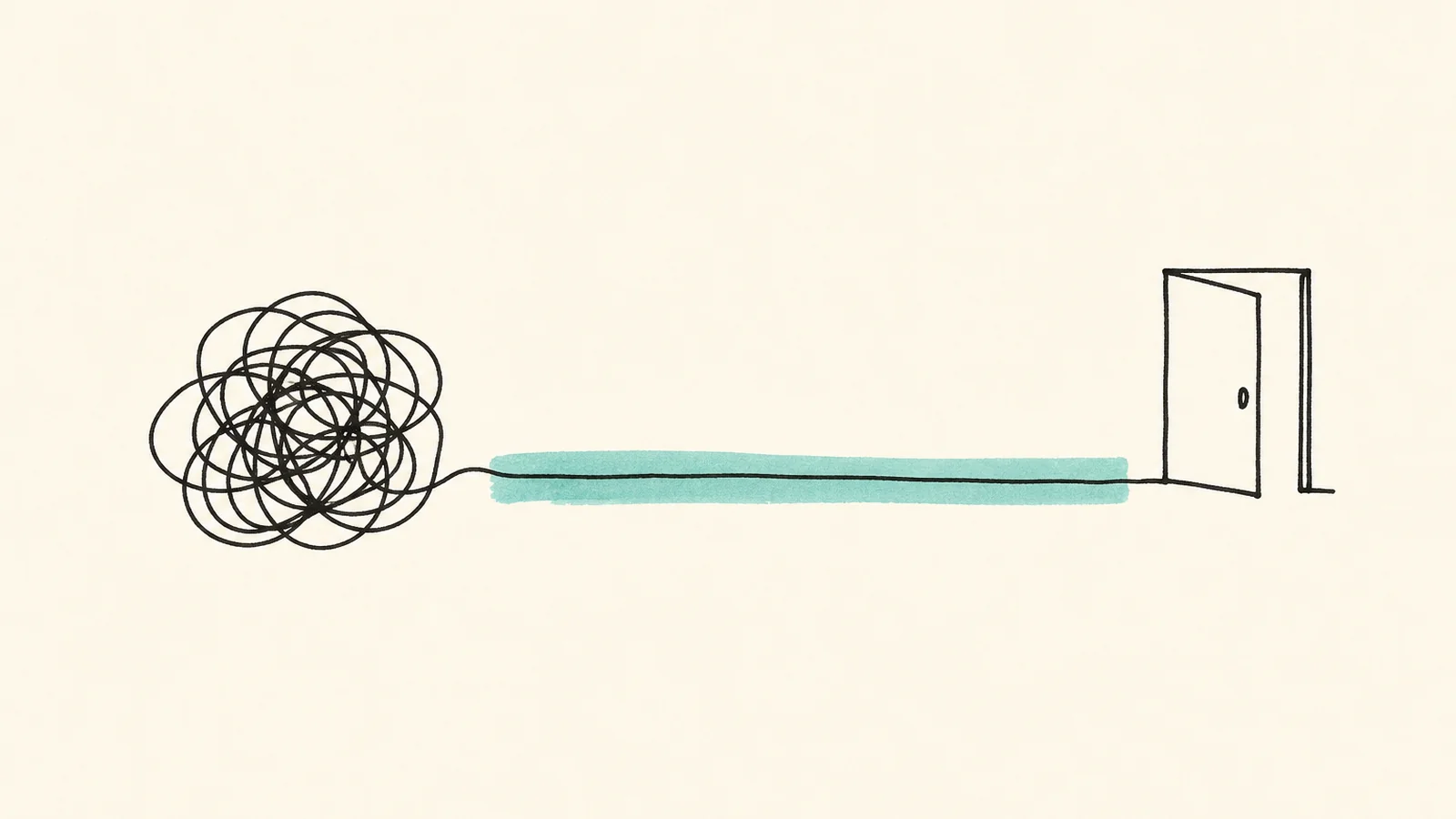
Overthinking is repetitive thinking about a worry, a choice or a past event that carries on after it has stopped producing anything new. Psychologists call it repetitive negative thinking, and the Perseverative Thinking Questionnaire (Ehring and colleagues, 2011, 1,832 participants) describes five features: it repeats, it intrudes, it is hard to disengage from, it feels unproductive, and it captures mental capacity. Only one of those can be checked from outside your head: whether the thinking produced anything. That matters because repetition alone is not the problem. Edward Watkins's 2008 review found repeated thought can help or harm, with much everyday worry being successful problem-solving; abstract why-thinking tended to keep people stuck, concrete what-next thinking tended to move them. So the useful overthinking definition is about output, not amount: write what the last hour added. If the line is empty, it was overthinking. It is not a diagnosis, though persistent loops are worth raising with a professional.
On this page+
Overthinking is repetitive thinking about a worry, a choice or something that already happened, which carries on after it has stopped producing anything new. By the overthinking definition psychologists use, it repeats, it intrudes, it is hard to switch off, and it feels unproductive. The test is not how much you think. It is what the thinking produces.
You probably searched this because someone used the word about you, or you used it about yourself, and you want to know whether it fits. Maybe you spent an evening on a message you have not sent, or a week on a decision that still looks the way it did on Monday. The question underneath is usually this: was that careful thinking, or was it the other thing? What follows gives you a definition you can check against one specific thought, on paper, and get an answer.
What is overthinking?
Overthinking is thinking about something past the point where more thinking changes anything. Dictionaries define it as thinking about something too much or for too long, and that is a fair description of how it feels. As an overthinking definition you can test, it fails, because "too much" depends on the problem. A month on a career change can be exactly right. Ten minutes on which sandwich to order can be too long.
In everyday use, the overthinking meaning covers two different habits. The first, and the one most people mean, is the loop: the same worry or memory coming back in the same words, at the same hour, and leaving where it started. The second is over-deliberation: picking apart a choice that would have gone better on a quick judgment, or analysis that never agreed on what would settle it. The second has its own post on . This one is mostly about the first.
What the two share is the part a useful definition needs. In both, the thinking has stopped producing anything you can use: no new fact, no new option, no decision, no next step. The effort is real, but the output is missing, which is why it is exhausting in a way that hard, productive thinking usually is not. Hard thinking costs energy and pays some of it back. Overthinking costs the energy and keeps the question.
What is the overthinking definition in psychology?
Psychologists do not use the word "overthinking" much. Their term is repetitive negative thinking, and it covers both of the loops people describe: worry, which runs forward ("what if the interview goes badly?"), and rumination, which runs back ("why did I say that?"). Researchers came to treat these as one process with different topics, because the way the thinking runs matters more than what it is about.
The clearest working definition comes from a measure. In 2011, Thomas Ehring and colleagues published the Perseverative Thinking Questionnaire, 15 items tested on 1,832 people across two studies, clinical and non-clinical1. It was built to measure the process regardless of the topic, and its structure describes the thing itself. Repetitive negative thinking, on this model, is thinking that:
repeats: the same content comes back
intrudes: it arrives without being invited
is hard to disengage from: you try to stop and it continues
feels unproductive: it does not seem to get anywhere
captures mental capacity: it crowds out other things you were doing
The first three are what the loop feels like. The last two are what it costs. Only one of the five can be checked from outside your head, by looking at what the thinking left behind: the fourth. Repetition, intrusion and stickiness are hard to judge while they are happening. Whether an hour of thought produced anything can be judged in two minutes with a pen, which is why the overthinking definition at the top of this page leans on it.
Where does thinking end and overthinking begin?
Thinking ends and overthinking begins at the point where repetition stops adding anything. Repeating a thought is not the problem in itself. In a 2008 review of the evidence in Psychological Bulletin, Edward Watkins concluded that repetitive thought "can be both helpful and unhelpful"2. Diary studies he summarizes found that a large proportion of everyday worry is an attempt to solve a problem, and that those attempts often succeed. Students who repeatedly pictured the steps toward an exam studied more and earned better grades than students who pictured only the result. Going over a loss, given time, is part of how people make sense of it.
So the line is not volume, and it is not the topic. Watkins points to the level the thinking runs at. Abstract, evaluative thinking (why did this happen, what does it say about me) tended to keep low mood going and made problem-solving worse in the studies he reviewed. Concrete thinking (what exactly happened, what specifically comes next) tended to recover faster and solve more. Another post covers taking a loop from why to what in detail. For the overthinking definition, the point is simpler: the same hours can be either thing.
Thinking it through
Overthinking
The question
Changes as you learn
Stays in the same words
The level
Concrete: what, which, when
Abstract: why, what it means about me
New material
Facts, options, objections appear
Old points come round again
How it ends
A decision, a next step, or a clear "not yet, because"
It stops when you are tired or distracted
How you feel after
Tired, but somewhere
Tired, and in the same place
The last row is the one people trust most, and it is the least reliable. Productive thinking can feel awful while it happens, and a loop can feel like work. The other rows can be checked on paper.
What does overthinking look like on paper?
It looks like a list where the same item appears three times in different clothes. Here is one worry, written out twice. The situation: a manager said "let's talk tomorrow" at the end of a meeting, with no topic.
Written as overthinking, the page goes something like this:
Why would she say that? It was the report.
Or it was my tone in the meeting. Why did I push back on that point?
She looked annoyed. Maybe it is about the report.
If it is the report, does she think I can't do the job?
Why didn't she say what it was about?
Every line is a why or a what-if. The report appears twice, the tone once, the job once. No line could be checked tonight, and no line ends in something to do.
Written as thinking, the same evening goes differently:
What do I actually know? She asked for a talk and gave no topic.
What could it be? The report, the meeting, or something unrelated like scheduling.
Which of those can I prepare for? The report: I can reread it and note the two weak sections.
Is there anything to do tonight beyond that? No, so the question is closed until tomorrow at ten.
Both pages took about the same time. The second one is shorter, and it ends. The difference is not discipline or a quieter temperament. It is that the second page asked questions with answers, and the first asked the same question with different words.
In sessions we see the first page more than the second, and the moment it shows is specific. Someone restates their opening question twenty minutes in, in nearly the same words, and is surprised to see it written above. In your head the repeat feels like progress. On a page it looks like a repeat.
Thinking about something for a long time is not overthinking. Thinking about it the same way for a long time is.
The empty line is the hard part to see alone, because a loop is good at feeling busy. This is the move Inwitt AI is built around. The AI thinking partner app asks one question at a time, starting with the one you keep circling, and draws your answers on a thinking board, so a repeat shows up as a repeat. It does not answer the question for you. It asks what each answer adds until the page has something new on it, or shows clearly that it does not.
What is overthinking a sign of?
Most often, overthinking is a sign of stress, of a decision with high stakes and no clear deadline, or of a question that cannot be answered yet. It is not a diagnosis. Repetitive negative thinking does show up across anxiety and depression, and the questionnaire above was designed to measure it in people with and without those conditions. That link is why it is worth paying attention to how long the loops last and what they cost.
A practical line: if the loops are taking your sleep, your work or your mood for weeks at a time, or if they come with low mood that does not lift, talk to a doctor or a therapist. They can tell what the overthinking is a symptom of, which a definition cannot.
For everyday loops, the useful question is narrower: what is this particular loop waiting for? Sometimes it is a fact you could get, sometimes a decision you are avoiding. Sometimes nothing at all would close it, and that is worth knowing too.
What do most definitions of overthinking get wrong?
Four mistakes come up again and again, in almost every overthinking definition online and in the way people talk about themselves.
Measuring by amount. "Thinking too much" makes careful people feel guilty for the wrong thing. A long, slow decision that keeps turning up new considerations is not overthinking. A two-minute thought you have had forty times is.
Assuming it has to be negative. The clinical term says "negative" because that is the version linked to harm. Watkins's broader category, repetitive thought, covers any content, and the tone of the content is only one of the three things he found decide whether it helps. Rehearsing a perfect future conversation for the tenth time can be as empty as replaying a bad one. The check is the same: what did it produce?
Treating it as a personality. "I'm an overthinker" turns a habit into a fact about you, and facts about you do not get examined. It also hides the two beliefs that keep the loop running: that the thinking helps, and that it cannot be stopped.
Thinking the opposite is thinking less. The opposite of overthinking is not a quick decision. Closing a question too early has its own cost, and waiting on facts that would not change the choice is a different problem from not thinking enough. The aim is thinking that ends somewhere on purpose, not less of it.
Questions people ask about overthinking
Is overthinking a mental illness?
No. Overthinking is a pattern of thought, not a diagnosis, though it often travels with anxiety and depression. If it is affecting your sleep, work or mood for weeks, it is worth talking to a professional. For the everyday kind, postponing the loop to a set time has trials behind it.
Is overthinking the same as anxiety?
Not quite. Worry, the forward-looking kind of overthinking, is a central feature of anxiety, but plenty of people overthink without an anxiety disorder, and anxiety has physical and behavioral parts that thinking does not. A worry is easier to work with once it is made specific and split into the part you can act on and the part you cannot.
What are the types of overthinking?
The research splits it by direction: worry (about what might happen) and rumination (about what did happen). Everyday use adds a third, over-deliberation, where a choice gets analyzed past the point of usefulness. All three fail the same test: the thinking continues and the output does not.
Why do I overthink everything?
Usually because a few open questions are leaking into everything else, not because every thought is a loop. A mind that will not settle is often holding several unfinished things at once, and a mind never goes fully silent anyway. Sorting which thoughts are loops and which are just noise is the first step.
The empty line in the exercise is an overthinking definition you can carry around: if the thinking added nothing, it was overthinking, and if it added something, it was not, however long it took. A session works the same way, one question at a time, with the answers written where you can see whether they are new. If one thought has been going round for weeks, join the Inwitt waitlist and bring that one.
Footnotes
Thomas Ehring, Ulrike Zetsche, Kathrin Weidacker, Karina Wahl, Sabine Schönfeld and Anke Ehlers, "The Perseverative Thinking Questionnaire (PTQ): validation of a content-independent measure of repetitive negative thinking", Journal of Behavior Therapy and Experimental Psychiatry 42(2), 225-232 (2011). Journal record↩
Edward R. Watkins, "Constructive and unconstructive repetitive thought", Psychological Bulletin 134(2), 163-206 (2008). Journal record↩