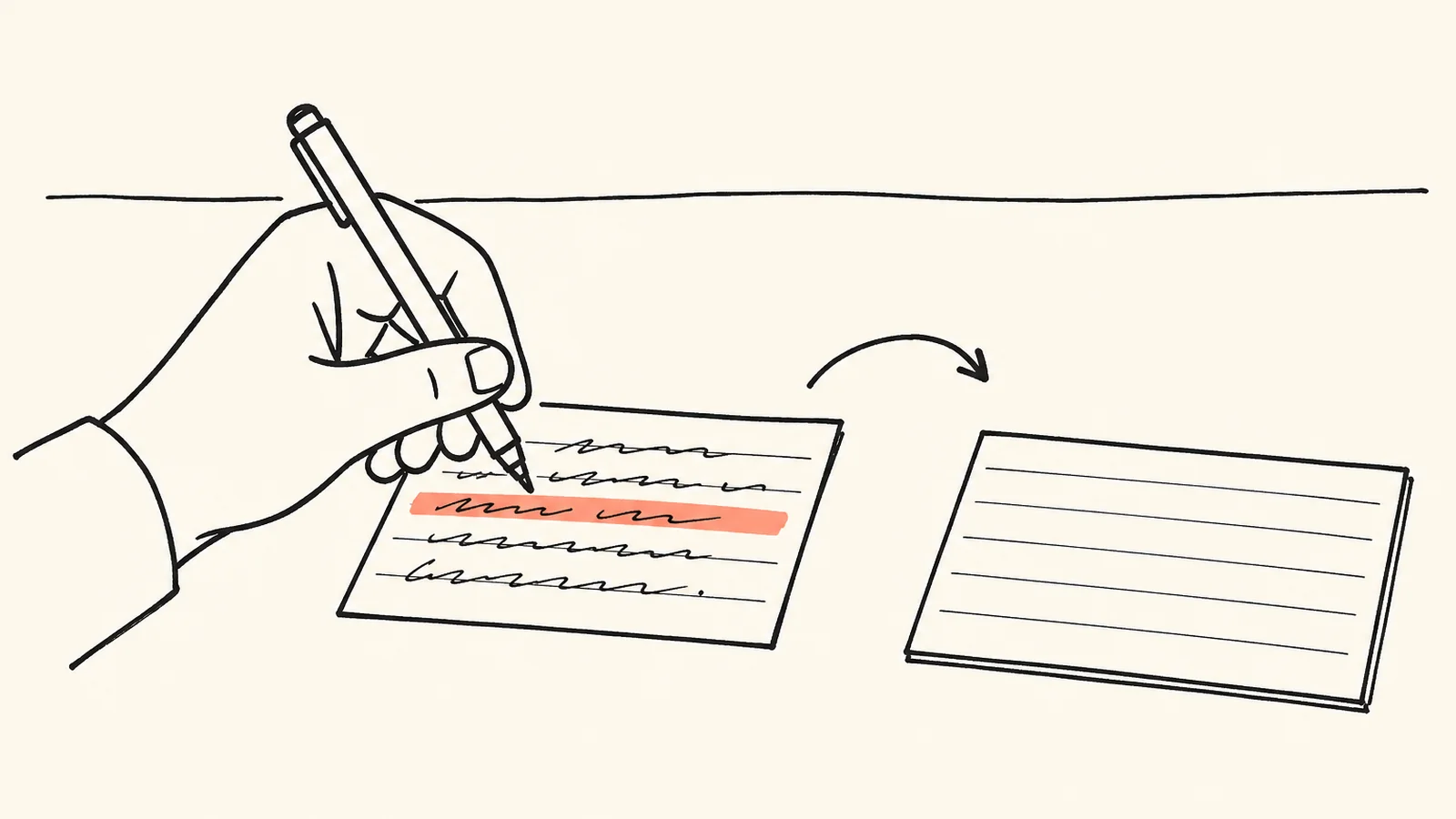
Over reliance on AI is accepting an AI's output without a way to tell whether it is right, so its errors become yours. Researchers score it as agreement with the AI on the cases where the AI is wrong, which means it is about catching mistakes, not about how often you use AI. The pattern is older than chatbots: a 2012 review of 74 studies on automation bias found clinicians 26% more likely to decide wrongly when their decision support was wrong, and some changed a correct first answer after seeing the advice. Inexperience, time pressure and low confidence in your own judgment make it worse. The best-tested fix is order. In a 2021 Harvard experiment, people who had to decide before seeing the AI agreed with its wrong answers less often, though they liked that design least. A 2023 MIT study found AI feedback framed as questions made people better at spotting flawed reasoning than explanations did. In practice: write your own answer first, then compare.
On this page+
Over reliance on AI is accepting an AI's output without a way to tell whether it is right, so its mistakes become yours. Researchers measure it as how often people agree with the AI on the cases where the AI is wrong. It depends less on how much you use AI than on whether your own answer existed first.
You probably did not come here because you use AI too much. You came because something slipped through: a figure you pasted into a report that turned out to be invented, a summary that left out the one clause that mattered, a plan that sounded right until someone asked why. This piece is about that problem, accepting output you could not check, and the one change of order that the research keeps pointing to.
What is over reliance on AI?
Over reliance on AI is a gap between how much you trust a system and how often it is actually right. Researchers usually define it through its opposite, appropriate reliance: accepting the AI's output when it is correct and catching it when it is not. Overreliance is failing the second half. Its mirror image, underreliance, is rejecting output that was right, which costs you too, just less visibly.
The useful thing about this definition is that it has nothing to do with volume. Someone who uses AI forty times a day and catches its errors is relying appropriately. Someone who asks it one question a month and pastes the reply straight into an email is overrelying. The grid below is how researchers score it, and it is a fair way to score yourself.
Notice what the grid assumes: that you have some independent way of telling the two columns apart. Over reliance on AI is what happens when you do not, because the only version of the answer you have ever seen is the AI's. So the rest of this piece is less about trusting AI less and more about having something of your own to compare it with.
How do you know if you rely on AI too much?
You rely on AI too much when you can no longer tell which parts of a result you could have checked yourself. Most lists of signs of over reliance on AI describe a mood, like "blind trust" or "complacency". The signs worth having are facts you can check against your last week of use:
You cannot say what you expected. Before reading the output, you had no guess of your own, not even a rough one.
You have not disagreed with it lately. Every system makes errors. If you agree with nearly everything it says, you are probably not catching the ones it made.
You check only when it sounds wrong. Fluent, confident text gets waved through; only awkward text gets a second look. Fluency and accuracy are different properties.
Your edits are cosmetic. You change the wording and the tone, never a claim or a number.
You cannot explain the why. If a colleague asked how you reached the conclusion, you would have to reopen the chat.
The task stops when the tool does. When it is unavailable, the work does not slow down. It halts.
One or two of these on a low-stakes task is normal. The pattern matters where a mistake would cost you something, which is also where AI dependence tends to creep in, because those are the tasks that feel hardest to start alone. For a version of this checklist that works on any choice, not just AI-assisted ones, see seven signs of a poorly made decision.
Why do people over-rely on AI even when they know better?
People over-rely on AI mostly for reasons that have nothing to do with AI. The pattern has a name older than chatbots: automation bias, the habit of treating a machine's output as a substitute for looking yourself. A 2012 systematic review by Kate Goddard, Abdul Roudsari and Jeremy Wyatt pulled together 74 studies from healthcare, aviation and other fields, and described it as using computer output "as a heuristic replacement of vigilant information seeking"1.
The numbers from medicine are sobering. Pooling four studies of clinical decision support, the review found that when the system gave wrong advice, clinicians were 26% more likely to make a wrong decision than without it. In 6% to 11% of cases, they had the right answer first and changed it to the wrong one after seeing the advice. These were trained professionals who knew the system could err.
The review also named what makes it worse. Inexperience with the task raises it. Heavy workload and time pressure raise it. And the factor the authors flagged as possibly the strongest is the balance between how much you trust the system and how confident you are in your own judgment. When your confidence is low, the machine's answer stops being a second opinion and becomes the only one. That explains why the hard, unfamiliar tasks are exactly where over reliance on AI concentrates.
Does deciding first reduce overreliance on AI?
Yes, and it is one of the few fixes that has been tested directly. In a 2021 experiment, Zana Buçinca and Krzysztof Gajos of Harvard, with Maja Barbara Malaya, asked 199 people to look at photos of meals and pick the ingredient to swap out to cut carbohydrates, with an AI suggesting answers that were deliberately wrong on some questions2. Some participants saw the AI's suggestion with an explanation. Others got what the researchers called cognitive forcing functions: they had to make their own decision before seeing the AI's, or wait 30 seconds for it, or click to ask for it.
On the questions where the AI was wrong about which ingredient was highest in carbs, people who saw plain explanations agreed with the wrong answer 64% of the time. With cognitive forcing, that fell to 48%. Better, not cured: people working with no AI at all still did better on those questions than either group.
Two other findings matter more for everyday use. The designs that reduced overreliance most were the ones participants liked least, found hardest and trusted least. And they helped most the people who already enjoy effortful thinking. The fix works, and it feels worse while it works.
If the AI's answer arrives before yours exists, you have nothing to check it against.
The ordering is the part you can copy without special software. The authors cite earlier work showing that people who see an AI recommendation first anchor on it, while people who decide first and then look decide better. Your own answer, however rough, turns the AI's answer from a verdict into a comparison.
What does appropriate reliance look like in practice?
Appropriate reliance looks like a small disagreement with the AI that you settled on evidence. It is not suspicion of everything, which is underreliance with extra steps. It is having enough of your own view to notice where the two of you differ, and then working out which one holds.
How the AI responds matters too. In a 2023 study with 210 participants, Valdemar Danry, Pat Pataranutaporn, Yaoli Mao and Pattie Maes at the MIT Media Lab compared AI feedback that explained why a statement was valid or flawed with feedback that asked the reader a question about it3. The questioning version made people significantly better at spotting logically flawed statements, and more inclined to look for other sources before making up their minds. An explanation hands you a conclusion to accept. A question leaves the conclusion with you.
This is the design behind the research reveal in Inwitt AI, an AI thinking partner app: when you ask for facts in a session, the findings stay locked until you have written your guess, and then you choose which of them are relevant. The help centre explains how the guess-first research reveal works. The point is the same as the pen exercise: your answer goes down first, so the AI's answer has something to be measured against.
Is over reliance on AI in education a different problem?
Over reliance on AI in education is the same problem with one extra layer. A professional who accepts a wrong answer usually could have caught it. A student often cannot yet, because the skill needed to check the answer is the one they are there to learn. Goddard's review found that inexperience raises automation bias, and students are inexperienced by definition.
That is why two separate problems get blurred together in classrooms. One is accepting output you cannot verify, which is what this piece is about. The other is never building the skill in the first place, which we covered in what AI does to the skills you skip. They feed each other: the less you practice, the less you can check, so the more you have to trust. Our piece on how college students use AI shows where that loop surfaces first: on exam day, when the tool is gone and the checking skill was never built.
The decide-first rule works for students too, with one adjustment. The first attempt does not need to be right. It needs to exist, on paper, before the answer arrives.
Common mistakes when trying to rely on AI less
The most common mistake is treating overreliance as a matter of quantity and cutting back. Using AI less changes nothing if the uses you keep are still the ones where you accept output you cannot check. Where you use it matters more than how often, so sorting AI uses by who does the thinking is a better cut than counting them.
The second is asking the AI to explain itself and treating the explanation as verification. Buçinca and colleagues note that adding explanations does not appear to reduce overreliance, and that some studies suggest it may increase it. A fluent reason makes an answer feel checked without checking it.
The third is asking the AI to review its own work and calling that a second opinion. It is a second pass by the same source. A real check comes from something independent: your own first answer, a primary source, a person who knows the field.
The fourth is swinging to blanket distrust. Rejecting correct output is still a reliance error, just in the other column of the grid. A rule of "never trust it" stops you judging the output, which was the problem to begin with. For the habit underneath all of this, see what reasoning critically involves.
Questions people ask about AI overreliance
Is over reliance on AI the same as AI dependence?
Not quite. AI dependence usually means you cannot do a task without the tool. Overreliance means you accept its output without the means to judge it. You can depend on AI for first drafts and still catch its errors, and you can use it rarely and still over-rely when you do.
Does it help if the AI shows its sources?
Sources help only if you open them. A list of links you do not read can make an answer feel more trustworthy without making it any more checked. Open at least the one source the key claim rests on, and see whether it says what the answer says it does.
Can AI help you avoid relying on it too much?
It can, if it asks before it tells. The MIT study above found that feedback framed as a question made people more discerning than feedback framed as an explanation. Any setup that makes you commit to a view first pushes in the same direction.
How can I tell if I'm over-relying on AI at work?
Run the decide-first exercise on three real tasks this week. If you cannot produce a first answer of your own for one of them, or every AI answer matches yours exactly, start there. The same variable runs through how AI affects critical thinking: who ends up doing the reasoning.
The pen exercise is the whole idea in small: your answer first, then the comparison, then a decision you can defend. An Inwitt session runs that loop with you, one question at a time, and the reasoning you confirm goes onto a thinking board that stays yours. If you want to work through a real question that way, join the Inwitt waitlist.
Footnotes
Kate Goddard, Abdul Roudsari and Jeremy C. Wyatt, "Automation bias: a systematic review of frequency, effect mediators, and mitigators", Journal of the American Medical Informatics Association 19(1), 121-127, 2012. Review of 74 studies; meta-analysis of four clinical decision support studies. Journal record↩
Zana Buçinca, Maja Barbara Malaya and Krzysztof Z. Gajos, "To Trust or to Think: Cognitive Forcing Functions Can Reduce Overreliance on AI in AI-assisted Decision-making", Proceedings of the ACM on Human-Computer Interaction 5(CSCW1), 2021. Preprint on arXiv. ↩
Valdemar Danry, Pat Pataranutaporn, Yaoli Mao and Pattie Maes, "Don't Just Tell Me, Ask Me: AI Systems that Intelligently Frame Explanations as Questions Improve Human Logical Discernment Accuracy over Causal AI Explanations", CHI 2023. MIT Media Lab project page. ↩