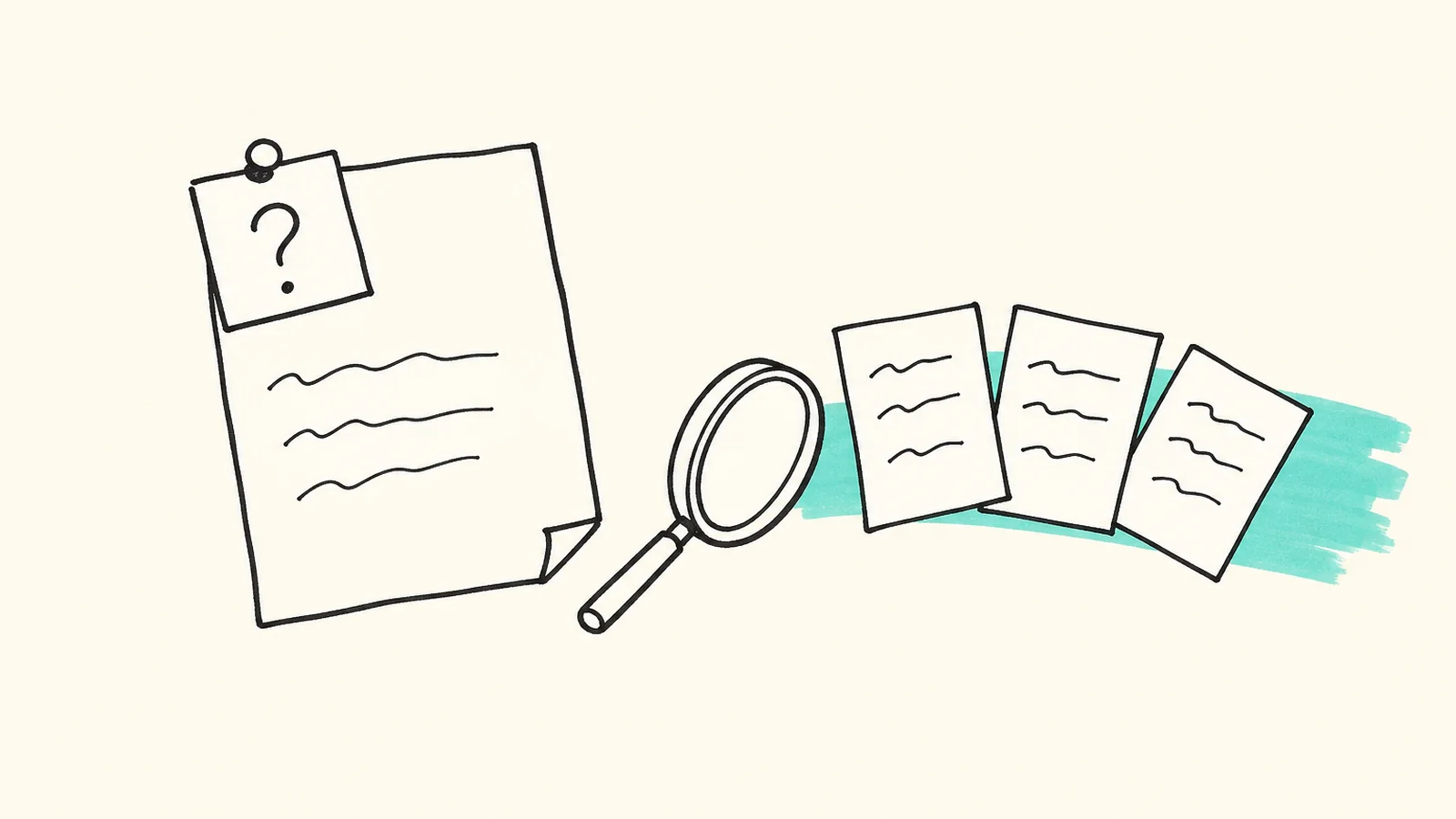
Research and critical thinking meet at three moments: before you search, when you judge a source, and when you decide you have enough. Before searching, write the question in one sentence, your best guess at the answer, and the finding that would change what you do; in Richland, Kornell and Kao's 2009 experiments, attempting answers before reading improved learning even on questions people got wrong. When judging a source, leave the page first and find out who is behind it: Wineburg and McGrew found professional fact checkers who read this way reached better conclusions in a fraction of the time taken by historians and students who read from inside the page. Before stopping, ask what you would have found if the opposite were true, a question Lord, Lepper and Preston showed reduces bias more than trying to be fair. Research gathers material; critical thinking decides what it is for.
On this page+
Research and critical thinking meet at three moments: before you search, when you judge a source, and when you decide you have enough. Research gathers what is out there. Critical thinking decides which question you are answering, whether a source deserves belief, and what would change your conclusion. Skip those three moments and the search engine does the thinking.
You may be here for a literature review, a class that grades both skills together, or a decision you are researching on your own time: a job offer, a treatment option, a landlord. Most guides on research and critical thinking say the thinking belongs "at every stage" and then list the stages. That is true, and it does not tell you what to do with nine tabs open. This piece covers the three moments where the thinking happens, and one move for each.
How are research and critical thinking connected?
Research and critical thinking are connected the way a question is connected to its answer: research finds material, and critical thinking decides what the material is for. Research without it is collecting. Critical thinking without research is opinion. The thinking does not spread evenly across a project. The writer Tom Chatfield, asked where critical thinking matters most in research, answered "at the beginning and end," because "it can be easy to narrow things down too soon, without really knowing what's out there," and just as easy to reflect too narrowly on what you found.
Between those two points sits a third moment that every source passes through: the second you decide whether to believe it. So the role of critical thinking in research comes down to three jobs. Fix the question before the search fixes it for you. Judge each source from outside it. Decide in advance what would make you stop.
That is also why critical thinking and research skills are usually taught together, and why one can look strong while the other is missing. A student can find forty sources and still be answering the wrong question. Someone else can reason well about the three sources they happened to find first. If you want the full sequence the second skill runs through, our piece on the steps of critical thinking lays it out; here the focus is where research tends to switch it off.
Why does critical thinking drop out once the searching starts?
Critical thinking drops out once the searching starts because a search answers whatever you typed, and typing is faster than deciding what you want to know. The phrase in the search box becomes the research question by default. The first page of results then sets the frame: which terms count, which side seems to be the mainstream, what a normal answer looks like. By the time you are reading carefully, the most important decisions have already been made by a query you wrote in four seconds.
The second reason is that searching feels like thinking. Each new tab is a small reward, and a pile of open sources looks like progress. In sessions we often see the same shape: a person arrives having read for hours, with strong impressions and no written question. When asked what they are trying to find out, the first answer is usually a topic ("remote work", "this medication", "the new role"), not a question. Turning the topic into a question takes a minute, and it changes which half of their reading still matters.
The third reason is that people read most carefully the sources that agree with them. Open-mindedness, the trait most often credited to good researchers, is one of the attributes of a critical thinker that fail quietly on beliefs you care about. Research makes this worse, because there is always another source willing to agree.
If you did not write the question down before you searched, the search wrote it for you.
What should you write down before you search?
Before you search, write three things: the question in one sentence, your best guess at the answer, and the answer that would change what you do. It takes two minutes, and it turns every source you read afterwards into evidence for or against something specific.
The question. A sentence, not a topic: "Is a four-day week worth a 10% pay cut for me?" is a research question, while "four-day weeks" is a reading list.
Your guess. What you expect to find, even if you feel you know nothing; it shows your assumptions and gives every result something to be compared against.
The deciding answer. The finding that would make you act differently. If none would, you are looking for permission, not researching a decision.
The guess is the part people resist, because a wrong guess feels like wasted effort. The evidence says the opposite. In 2009, Lindsey Richland, Nate Kornell and Liche Kao ran five experiments in which students read an essay about vision.2 Some were first asked questions about the essay, which they mostly got wrong. Others were simply given extra time to read. On the final test, the students who had attempted answers first did better, and the analysis counted only the questions they had missed on the pretest. In one experiment, trying to answer the questions beat reading the same questions and memorizing them.
A failed guess still made the reading work harder. Wanting to know what you want before you look is the same move we described in feeling overwhelmed by choices, applied to information instead of options.
This is the order we built Inwitt AI around. It is an AI thinking partner app that asks rather than answers, and its research mode works the same way as the exercise: when you ask for facts, the findings stay locked until you have made a guess, and then you pick which ones are relevant. The results are neutral. Deciding what they mean is left to you.
How do you evaluate a source without trusting it first?
You evaluate a source by leaving it. Before reading a page closely, find out who is behind it from other sites, then come back and read. This sounds backwards, and it is what the best evaluators in one well-known study did. Evaluating sources from inside the page is the habit that most often fails.
Sam Wineburg and Sarah McGrew at Stanford watched 45 experienced internet users judge live websites: 10 historians with PhDs, 10 professional fact checkers and 25 Stanford undergraduates.3 The historians and students mostly read vertically. They stayed on a site, studied its design, its About page and its references, and decided from there. The fact checkers read laterally. They scanned the page briefly, opened new tabs and looked up the organization behind it before reading further. They also showed what the researchers called click restraint: they read the list of search results before choosing what to open. Stanford's report summarized the outcome plainly: the fact checkers "arrived at more warranted conclusions in a fraction of the time."4 In one task comparing two pediatric organizations with similar names, most historians judged both reliable, and the students mostly preferred the advocacy group's site.
Reading vertically
Reading laterally
First move
Read the page carefully
Leave the page and search its source
Trust comes from
Design, tone, references, the About page
What independent sources say about it
Weak spot
A polished page by an interested party
Needs a few extra minutes up front
Search results
Click the top result
Read the list, then choose
A checklist applied from inside the page asks the page to vouch for itself. Lateral reading asks something simpler: who is this, and what do people who are not them say?
How do you know the research is finished?
The research is finished when the next source could not change what you would do. That is why the third line of the exercise matters: it gives you a stopping rule written before you were tired, bored or attached to an answer. Without one, research ends either too early (when you find a source that agrees) or never (when every new source feels important). Endless reading is one of the faces of analysis paralysis: gathering facts that would leave the choice exactly where it is.
Before stopping, run one check on your conclusion: if the opposite were true, what would you expect to have found? In 1984, Charles Lord, Mark Lepper and Elizabeth Preston tested this instruction directly.5 Across two experiments on biased judgment, asking people to consider the opposite reduced their bias more than asking them to be "as fair and unbiased as possible". Good intentions did less than a specific question.
We covered why this is the step most analysis skips in analysis and critical thinking; in research it has a practical form. Search once, on purpose, for the best case against your conclusion. If it holds up, trust the conclusion more. If not, you have caught a confident mistake.
This is the plainest answer to why critical thinking is important in research: it is the only part of the process that can tell you the research has gone wrong.
What only feels like critical research?
Several habits look like research and critical thinking working together and do none of the thinking. Each one produces visible effort.
Counting sources that agree. Ten articles repeating one claim may all trace back to a single study, or to none. Agreement tells you a claim is popular, not that it was checked.
Treating more tabs as more rigor. Volume is not scrutiny. Three sources read laterally beat twenty read from the inside.
Running a checklist from inside the page. Asking whether a site looks current, professional and referenced rewards whoever paid for good design. The page cannot vouch for itself.
Reading the abstract as the finding. Abstracts report what the authors want you to take away. The sample, the comparison group and the limits sit further down, and they give the claim its real size.
Asking an AI for a summary before you have a guess. A fluent summary arrives with nothing of yours to compare it to, so it gets accepted rather than tested. That is the pattern we described in over reliance on AI: not frequent use, but agreeing by default. Write the guess first and the same summary becomes something to check.
Questions people ask about research and critical thinking
Is research a critical thinking skill?
Research is a separate skill that depends on critical thinking at a few key points. Finding sources, using databases and taking notes are research skills. Choosing the question, judging credibility and deciding what the evidence shows are critical thinking applied to research. Someone can be good at the first set and weak at the second.
Does doing research improve critical thinking?
It can, but not automatically. Research builds critical thinking when it forces you to make and check judgments, such as writing a guess or arguing against your own conclusion. It builds much less when it is mainly collecting, because collecting can be done well without ever deciding anything.
What is the difference between research and critical thinking?
Research is the work of finding and gathering information. Critical thinking is the work of deciding what that information is worth and what follows from it. Research answers "what is out there?" Critical thinking answers "what should I believe, and what would change my mind?"
How do you use critical thinking in a literature review?
Write the review's question and your expected answer before you start, read each key source's origin and funding before its argument, and group papers by what they actually tested rather than by what they claim. Then look on purpose for the strongest paper against your expected answer, and give it a paragraph.
The three lines in the exercise above are research and critical thinking at their smallest, and a short version of what a session does: a question you wrote, a guess you can check, a finding that would change your mind, all kept where you can see them. A session takes the same idea to the length a real decision needs, one question at a time, with your reasoning drawn onto a thinking board in your own words. If you are researching something you have to decide, join the Inwitt waitlist and bring it with you.
Footnotes
Tom Chatfield and Janet Salmons, "Two perspectives on critical thinking and research", Sage Research Methods Community. Sage Research Methods Community↩
Lindsey E. Richland, Nate Kornell and Liche Sean Kao, "The pretesting effect: Do unsuccessful retrieval attempts enhance learning?", Journal of Experimental Psychology: Applied 15(3), 243-257 (2009). Author PDF↩
Sam Wineburg and Sarah McGrew, "Lateral reading and the nature of expertise: Reading less and learning more when evaluating digital information", Teachers College Record 121(11) (2019). Journal record↩
Stanford Graduate School of Education, "Stanford scholars observe 'experts' to see how they evaluate the credibility of information online" (24 October 2017). Stanford GSE news↩
Charles G. Lord, Mark R. Lepper and Elizabeth Preston, "Considering the opposite: A corrective strategy for social judgment", Journal of Personality and Social Psychology 47(6), 1231-1243 (1984). Journal record↩