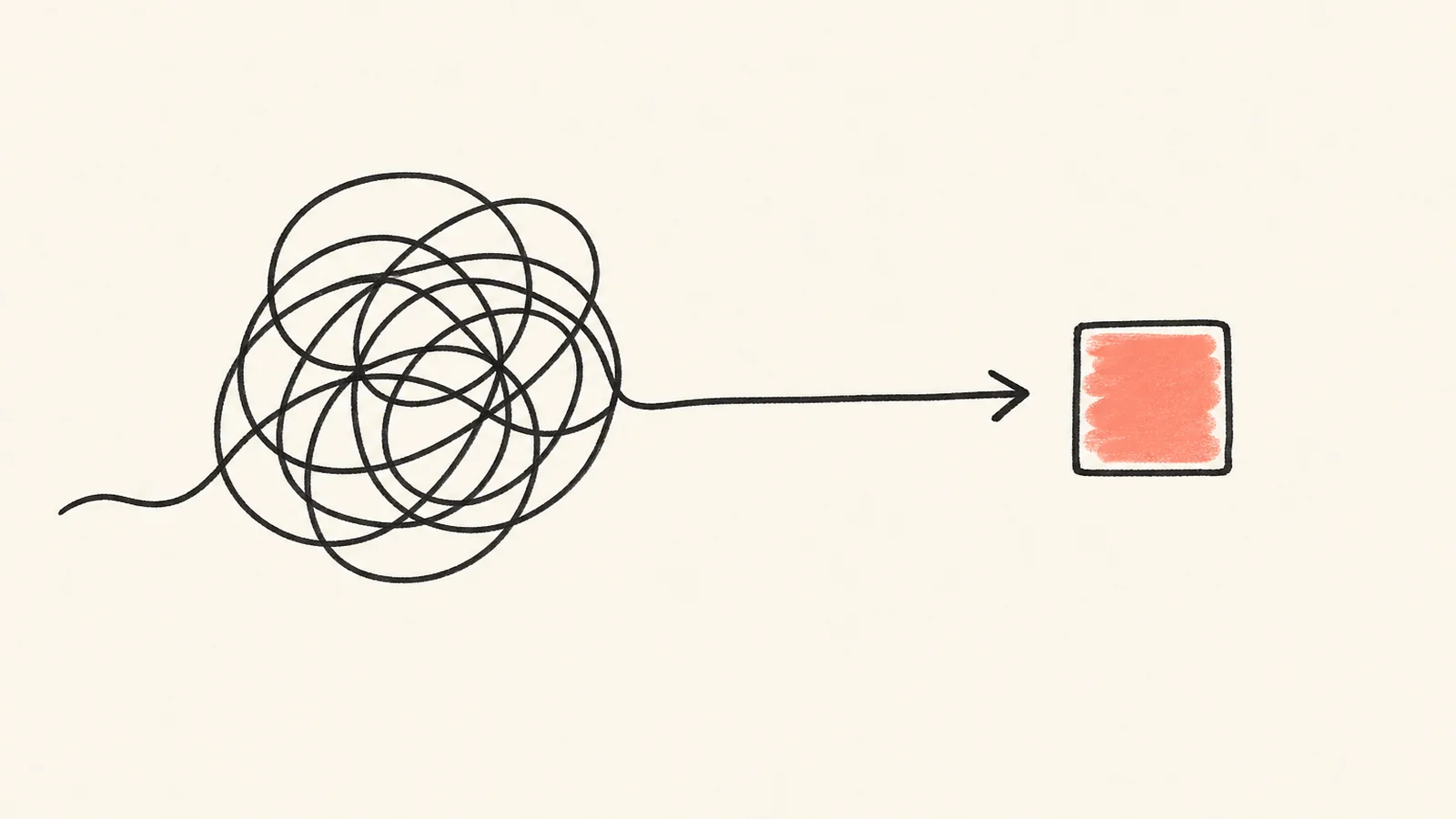
Overthinking is a habit, not a skill, but it contains one: the ability to stay with a problem, imagine what could go wrong and test it. Research on rumination separates two kinds of repetitive thinking. Brooding asks judgmental questions about yourself, such as why you can't handle things better, and it predicted more depressive symptoms a year later in a 2003 community study. Reflection is intentional pondering aimed at solving a problem; it felt no better at the time but predicted fewer symptoms a year later. Worst-case thinking can also help when it is tied to a specific task and ends in preparation, a strategy psychologists call defensive pessimism. So is overthinking a skill? The useful part is the question you ask inside it. Move the question from you to a situation, decide what the thinking must produce, and write it down.
On this page+
Is overthinking a skill? Not on its own. Overthinking is a habit, but it holds a skill inside it: staying with a problem, picturing what could go wrong and testing it. Research splits repetitive thinking into two kinds. One asks questions that something could answer and ends in a plan. The other asks why you are like this, and never ends.
You may have searched this half hoping for a yes. The mind that replays a meeting for three days is the same one that spots the flaw in a plan nobody else saw, and it would be nice to learn those are one talent. They are related, and the research says fairly precisely where they part. What follows puts the two kinds side by side, using the questions psychologists actually use to measure them, and ends with an exercise that turns the first kind into the second.
Is overthinking a skill or a habit?
Overthinking is a habit, and the skill is a narrower thing that the habit borrows. The habit is a loop: the same question, asked in the same words, long after the asking has stopped producing anything new. The skill is the equipment the loop runs on. You can hold a problem in mind for a long time, generate detail other people skip, and imagine how things could go. Those abilities are real and they are useful at work, in planning and in any decision with consequences.
What turns them into overthinking is not the amount of thought. It is the question the thinking serves and whether anything comes out the other end. That is why is more useful than "thinking too much".
So, is overthinking good? The attention is. The loop is what wastes it. If an hour of thought leaves you with a decision, a test to run or a question for someone else, it was a skill at work. If it leaves you where you started, only more tired, it was the habit.
What do psychologists call the useful kind?
They call it reflection, and they measure it separately from its unhelpful twin, brooding. In 2003, Wendy Treynor, Richard Gonzalez and Susan Nolen-Hoeksema re-analyzed the questionnaire most researchers use to measure rumination, with data from a randomly selected community sample1. After removing items that simply described being depressed, they found the scale held two separate factors. Brooding is passive, judgmental pondering of your own mood. Reflection is contemplative, intentional pondering with a focus on problem solving2.
The two behaved differently over time. Higher brooding went with more depressive symptoms and predicted increases in them a year later. Reflection also went with more symptoms at the time, which is worth knowing: it does not feel better while you are doing it. But it predicted lower levels of depression a year later.
Popular articles frame this as reflection vs rumination. In the research, reflection is one part of rumination: the part that tends to pay off later rather than now. That is the most precise answer the evidence gives to "is overthinking a skill?": one kind of it behaves like one.
The questions themselves show the difference better than the labels do. These are items from the scale, as listed in a 2011 follow-up by Anson Whitmer and Ian Gotlib2:
Item from the scale
Kind
Could anything answer it?
"Why can't I handle things better?"
Brooding
No. It is a verdict phrased as a question.
"Why do I always react this way?"
Brooding
No. "Always" rules out the cases that would test it.
"What am I doing to deserve this?"
Brooding
No. It assumes the answer before asking.
"Analyze recent events to try to understand why you are depressed"
Reflection
Partly. Events can be checked.
"Write down what you are thinking about and analyze it"
Reflection
Yes. The page gives you something to check.
Brooding questions are about you as a person. Reflection points at events and something you can look at. In sessions we see the same pattern: the brooding version is the one people say fastest, because they have said it so many times, and the reflective version usually takes a minute to find.
There is a limit worth stating plainly. Whitmer and Gotlib tested the split again in 800 adults and found it held for people who had never been depressed or had recovered, but blurred in people who were depressed at the time2. If you are in a low stretch, the useful kind is harder to reach on your own. That is a reason to talk to a professional, not to try harder.
Can thinking about the worst case be useful?
Yes, when the worst case is tied to a specific task that is coming up and ends in preparation. The research name for this is defensive pessimism. In 1986, Julie Norem and Nancy Cantor studied anxious people who deliberately set low expectations before a performance situation and ran through what could go wrong3. Earlier research had linked anxiety and low expectations to worse performance. For these people, the low expectations seemed to do the opposite: they kept the anxiety from becoming debilitating. In a second experiment, when the researchers interfered with the strategy, performance suffered; those left to prepare their own way showed no impairment.
Norem later put it more bluntly with Edward Chang: there are times when pessimism and negative thinking "lead to better performance and personal growth"4. Defensive pessimism is one of those times.
What separates it from an ordinary worry loop is not how dark the thoughts are. It is that the worst case is about a particular event, on a particular date, and each imagined failure gets an answer: if the projector fails, I have the slides on my phone. A what-if loop picks a worst case and stops there, then picks another.
Following a what-if chain to its last link is the move that turns the second kind into the first. One caution: this research is about performance situations, like exams and talks. It says little about open-ended worries with no date attached.
Is overthinking a strength, then?
The raw materials are a strength. The loop is not. Paying close attention, noticing what others miss, imagining several outcomes before acting: those are why "overthinking superpower" articles ring true to the people who read them. If you overthink, you probably do catch things.
But a strength you cannot put down is closer to a strength that has you. The same attention that makes you thorough on a client project is the attention that rereads one text message forty times, and it does not choose its targets well. The evidence on whether overthinkers are smarter is thin, and the most it shows is that verbally able people build more persuasive loops, not more accurate ones.
It also helps to know that thinking skills tend to stay where they were learned. Being careful and analytical at work does not carry over by itself to a decision about your own life. So the honest answer to "is overthinking a strength?" is: it is a strength with no steering. The steering is the skill, and it can be practiced.
Overthinking is not a skill. The question you ask inside it can be.
How do you turn overthinking into deep thinking?
Change the question, name what the thinking must produce, and do it on paper. Deep thinking is not a calmer version of overthinking. It is thinking where the question changes as you go and something usable comes out. Three moves get you there.
Move the question from you to a situation. "Why do I always freeze in meetings?" becomes "What was happening in the last meeting in the two minutes before I went quiet?" The first is brooding: nothing can answer it. The second is reflection: you can actually remember, and the memory might surprise you.
Decide what this round must produce. A decision, a test you can run this week, or a question to put to someone who knows. If you cannot name an output, the loop is missing a finish line, and a stopping rule agreed before you start does more than another hour.
Write it down. In Whitmer and Gotlib's data, the "write down what you are thinking" item barely moved with the rest of the scale, and their explanation was simple: only a small subset of people who ruminate are likely to write about their ruminations2. We read that as an opening. Writing is the thing overthinkers rarely do, and it is the cheapest way to see whether a question has changed since yesterday.
The rewrite is the hard step, because the brooding version feels truer; it is the one you have rehearsed. This is the move Inwitt AI is built around. The AI thinking partner app asks one question at a time and draws your answers on a thinking board, so you can see when you have drifted back to "why am I like this" and steer toward a question with an end. It does not tell you the answer. It asks until you have written one down yourself.
What only feels like a skill
Some habits pass for skill because they look like effort. Four are worth catching.
Replaying as preparation. Going over a past conversation feels like getting ready for the next one. Preparation points at a next event, though. If there is no next event in the thought, it is review without a purpose, and that is the brooding kind.
More detail as more accuracy. Overthinkers are good at detail, and detail makes a story vivid. It does not make it true. A scenario with fifteen specific steps is more convincing than one with three, and usually less likely.
Analyzing your personality. It sits on the reflection list, but it slides into brooding faster than any other item, because "why am I like this" is one short step from "what is wrong with me". Keep the question attached to a situation you can describe.
Calling it a superpower. The label is kind, and it quietly gives the loop permission never to stop. If the same worry comes back every night, the better move is postponing it to a set time and checking it there, not admiring it.
Questions people ask about overthinking as a skill
Is overthinking a sign of intelligence?
Not in any strong sense. One small study has linked verbal ability with more worry and rumination, and none shows that overthinking makes anyone sharper. What verbal ability seems to add is detail and persuasiveness, which can make a loop harder to leave.
Is overthinking a mental illness?
No. Overthinking is not a diagnosis, though it often travels with anxiety and depression, and brooding in particular is linked to depressive symptoms. If the loops are taking your sleep, work or mood for weeks at a time, talk to a doctor or therapist.
Is overthinking a skill you can learn to use?
The habit is not worth learning, but the part inside it is: asking a question that has an end, and writing down what each round produced. Like any skill, it improves with practice on real problems, one loop at a time, rather than by reading about it.
What is the difference between overthinking and deep thinking?
Deep thinking changes the question as it goes and ends in something you can use. Overthinking asks the same question in the same words and ends where it started. Time spent is not the difference: both can take hours.
Can overthinking ever help you decide?
It can help before the decision, while it is still producing new information or exposing a risk you had missed. It stops helping once it repeats itself. A fair test is whether the last hour changed your plan; if it did not, the thinking has done what it can.
The exercise above takes five minutes and a pen, and the hard part is the rewrite, because the old question always feels more honest. That is what a session does: it asks, you answer, and the question you kept circling ends up on the page next to what would close it, in your own words. If one question has been going round for weeks, join the Inwitt waitlist and start with that one.
Footnotes
Wendy Treynor, Richard Gonzalez and Susan Nolen-Hoeksema, "Rumination reconsidered: A psychometric analysis", Cognitive Therapy and Research 27(3), 247-259 (2003). Journal record↩
Anson Whitmer and Ian H. Gotlib, "Brooding and reflection reconsidered: A factor analytic examination of rumination in currently depressed, formerly depressed, and never depressed individuals", Cognitive Therapy and Research 35, 99-107 (2011). Full text↩↩2↩3↩4
Julie K. Norem and Nancy Cantor, "Defensive pessimism", Journal of Personality and Social Psychology 51(6), 1208-1217 (1986). PubMed record↩
Julie K. Norem and Edward C. Chang, "The positive psychology of negative thinking", Journal of Clinical Psychology 58(9), 993-1001 (2002). PubMed record↩