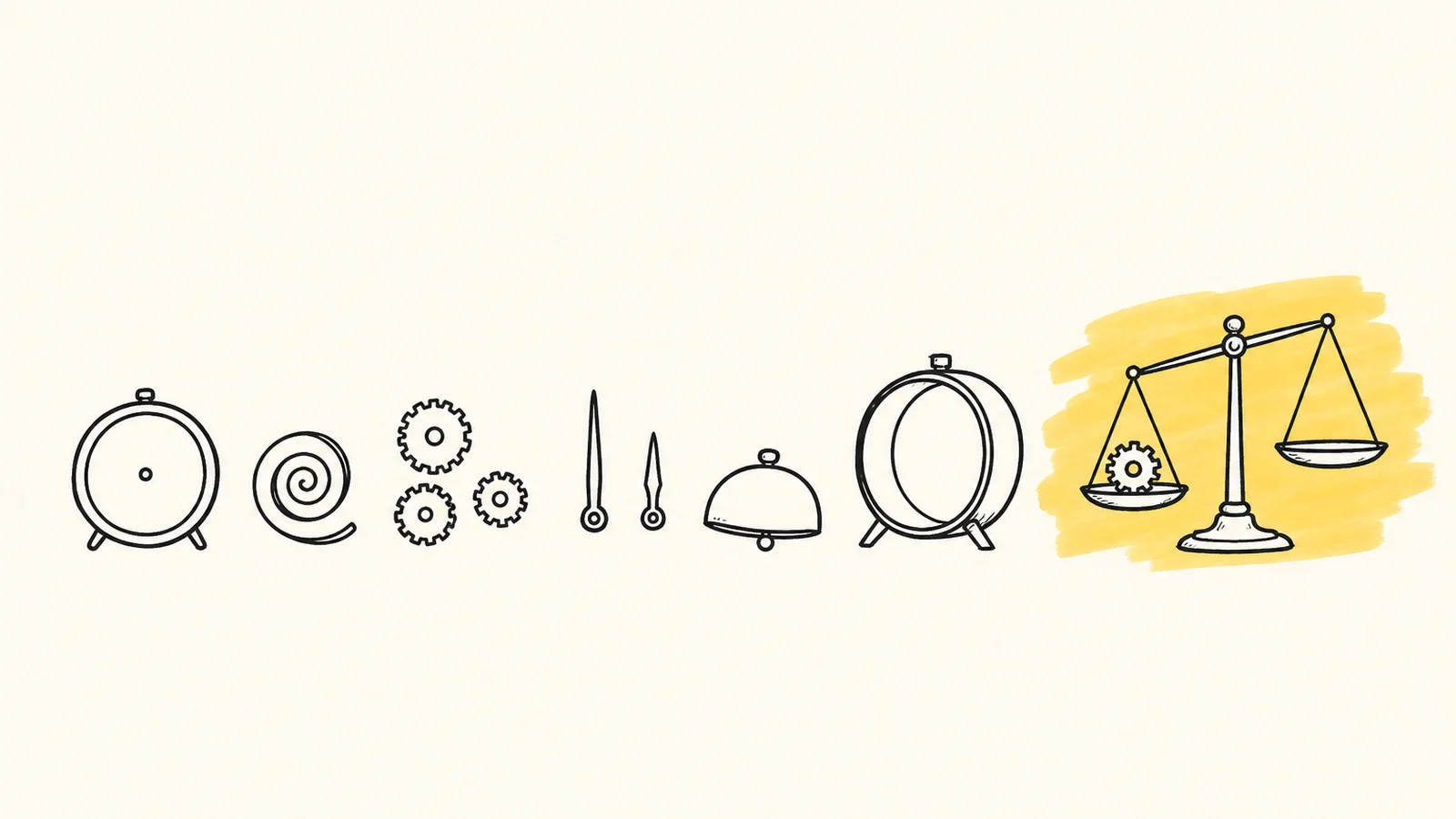
Analysis and critical thinking are two stages of one job. Analysis takes a claim or decision apart and maps how the pieces connect; critical thinking judges the pieces and ends in a verdict. The 1990 expert consensus summarized by Peter Facione lists analysis as one of six critical thinking skills, with evaluation and inference as the separate skills that do the judging. Analysis has no built-in stopping point, which is why a thorough pros and cons list can sit for weeks without producing a decision. To turn an analysis into a judgment, mark each part as fact, guess or hope, cross out the parts that would not change the answer, write a one-line verdict, and name what would reverse it. That last step matters: in two 1984 experiments, Lord, Lepper and Preston found that asking people to consider the opposite reduced biased judgment more than asking them to be fair and unbiased.
On this page+
Analysis and critical thinking are two stages of one job. Analysis takes a claim, a problem or a decision apart and maps how the pieces connect. Critical thinking judges those pieces: which hold, which do not, and what you should therefore believe or do. Analysis can go on for as long as you let it. Critical thinking has to end in a verdict.
You probably met the two words fused together, in a job description or a course outline: "strong analytical and critical thinking skills." It reads like one skill with two names. It is not, and the gap between them explains a familiar experience: a decision you have studied from every angle, with a spreadsheet to prove it, that still is not decided.
This piece draws the line between the two, shows what each one produces, and gives you a way to get from a finished analysis to a judgment you can defend.
What is the difference between analysis and critical thinking?
Analysis answers "what is this made of, and how do the parts connect?" Critical thinking answers "which of these parts deserve my trust, and what follows?" The first produces a map. The second produces a decision about the map. You can do excellent analysis and never reach a conclusion, and you can reach a conclusion with no analysis at all. Good thinking needs both, in that order, and it needs the second one to actually happen.
The clearest way to see it is to put them on the same axes.
Analysis
Critical thinking
Question it asks
What are the parts, and how do they relate?
Which parts hold up, and what follows from them?
What it produces
A breakdown: claims, reasons, assumptions, links
A verdict, with the reasons that earned it
Stops when
You decide it is complete (it never says so itself)
The verdict has survived a real attempt to reverse it
Typical failure
Endless mapping, no conclusion
A conclusion that was never tested
On a job decision
Salary, commute, team, growth, risks, listed
"The growth claim is a guess; the rest holds; I take it unless the team call goes badly"
Read down the "stops when" row. That is where most of the trouble between analysis and critical thinking lives.
Is analytical thinking the same as critical thinking?
No. Analytical thinking is one ingredient of critical thinking, not a synonym for it, which is why most "analytical thinking vs critical thinking" comparisons end up describing a sequence rather than a rivalry. The most cited definition comes from a 1990 panel of experts convened by the American Philosophical Association, summarized by Peter Facione, who led it. The panel named six core critical thinking skills: interpretation, analysis, evaluation, inference, explanation and self-regulation.1 Analysis is one of the six. Evaluation and inference, the two that do the judging, are separate entries.
The panel's wording makes the division plain. Analysis is identifying "the intended and actual inferential relationships" among statements, reasons and claims. Evaluation is assessing "the credibility of statements" and "the logical strength" of those relationships.1 One finds the links; the other tests them.
Employers blur the two because they want both and analysis is easier to spot. In the World Economic Forum's Future of Jobs Report 2025, analytical thinking remained the top core skill, with nearly 70% of employers calling it essential.2 What they usually mean in practice is someone who can take a mess apart and then say what to do about it. The second half is the scarce one. If you want the full set the panel described, our piece on the components of critical thinking lays them out.
What does analysis do well, and where does it stop?
Analysis is good at making the invisible visible. Facione's sub-skills for it are concrete: examine ideas, identify arguments, identify reasons and claims.1 In practice that means pulling the main claim out of a paragraph, writing down the reasons offered for it, spotting the assumption nobody stated, and sketching how one piece depends on another. Without that work, critical thinking has nothing to judge. You cannot test a reason you never noticed you were relying on.
The limit is that analysis has no built-in finish line. There is always another factor to list, another scenario to model, another article to read. Each one makes the map more detailed, and a more detailed map feels like progress. It is progress, up to a point. After that point it becomes a way of not deciding while looking busy.
We see this pattern often in sessions. Someone arrives with a carefully built list of pros and cons, sometimes several pages of it, and the first question is not about anything on the list. It is "which of these would you be willing to be wrong about?" The list was finished weeks ago. The judgment was never started, and the handoff between analysis and critical thinking simply never happened. That is the shape we described in overanalyzing as analysis without a stopping rule: the problem is not the hours, it is that nobody agreed what would settle the question.
What does critical thinking add to an analysis?
Critical thinking adds three things analysis cannot supply on its own: a test of each part, a conclusion drawn from the parts that survived, and a stated condition under which that conclusion would change.
The first is evaluation. Each claim in the breakdown gets sorted: is this something I know, something I am guessing, or something I am hoping? Is this source in a position to know? Does this reason actually support the conclusion, or does it just sit near it? The second is inference, which in the expert panel's terms includes "query evidence," "conjecture alternatives" and "draw logically valid or justified conclusions."1 That is the verdict: given what held up, here is what I believe or will do.
The third is the step analysis skips and most advice skips too: naming what would reverse the verdict. The social psychologists Lord, Lepper and Preston tested this in 1984. Across two experiments on biased judgment, telling people to "consider the opposite" corrected their bias more than telling them to be "as fair and unbiased as possible."3 Good intentions did less than a specific question. A verdict with no reversal condition is a preference that has been dressed up as a conclusion.
An analysis tells you what is on the table. Only a judgment tells you what you are going to do with it.
Ask four questions of the analysis you already have, in order, and write each answer down. That puts analysis and critical thinking on the same page: the breakdown is the input, and the four answers are the judgment.
What does each part rest on? Mark every item fact, guess or hope. Most lists are a mixture, and the hopes tend to carry the most weight.
Which parts actually move the decision? Cross out anything that would not change your answer if it flipped. A long list usually shrinks to two or three items that matter.
Given what is left, what is my verdict? One line. Not "it depends." If it truly depends, write what it depends on.
What would make me reverse it? A specific event, number or answer, not "if things change."
Here is the shape of it on a common decision: whether to go back to school for a master's degree. The analysis is usually thorough. Tuition, time out of work, which roles ask for the degree, what the program covers, how a partner feels about it, the worry of being older than the other students.
Run the first question and the list changes character. "Roles I want ask for it" turns out to be a guess from three job ads. "It will make me more confident at work" is a hope. The cost is a fact. Run the second and the worry about age drops off; it would not change the answer either way.
The verdict might read: "Not this year. The degree is only worth it if the roles I want require it, and I have not checked." The reversal condition: "If five people doing the job I want tell me the degree mattered in their hiring, I apply next cycle." That is a judgment. It may be the wrong one, but it is now the kind of wrong you can find out about.
Doing this on paper matters more than it sounds. A list in your head reshuffles itself every time you look at it; on a page, the "hope" label stays where you wrote it. That is the idea behind the thinking board in Inwitt AI, an AI thinking partner app that asks one question at a time and draws only what you confirm. It does not hand you the verdict. Critical mode walks the four questions above, so the judging step happens instead of being postponed.
What only feels like critical thinking
Some habits blur analysis and critical thinking so well that they pass for the second while doing only the first.
More analysis as a substitute for a decision. Adding a sixth scenario to the spreadsheet feels rigorous. If the first five did not produce a verdict, the sixth will not either, because the missing piece was never information. It was the act of weighing.
Verdict first, analysis after. This is the reverse failure and it is just as common. The decision is made by feel, then a careful-looking analysis is assembled to support it. The test is to check when each reason arrived. If every item on the list appeared after the conclusion, the critical analysis was a defense brief.
"Try to be objective" instead of naming the opposite. Telling yourself to be fair is the instruction Lord and colleagues found weaker than a concrete one.3 "What would have to be true for the other option to be right?" gives your mind something to do. "Be objective" does not.
Letting an assistant do both halves. An AI assistant that answers can produce a tidy analysis and a confident conclusion in one reply. That is a judgment, but it is not yours, and you have nothing to test it against because you never did the sorting. An answer you did not build is an answer you will not follow, or will follow without knowing why.
Questions people ask about analysis and critical thinking
What are analytical critical thinking skills?
The phrase usually means the skills that sit at the meeting point of the two: breaking an argument into claims and reasons, spotting unstated assumptions, judging how credible each source is, and drawing a conclusion that follows from what held up. In the expert consensus these are analysis, evaluation and inference.1 Listing them on a CV is easy; showing one moment where you used them to change a decision is what convinces.
Which comes first, analysis or critical thinking?
Analysis comes first, because you cannot judge parts you have not identified. But the order is a loop, not a line: evaluating one part often sends you back to analyze it more closely. Our guide to the 7 steps of critical thinking shows where the analysis steps end and the judging steps begin.
Can you be analytical but not a critical thinker?
Yes, and it is common among people who are very good at their jobs. They can take any problem apart, and they stall at the moment of commitment, or they commit by instinct and use their analytical skills to justify it afterward. The fix is not more analysis. It is practicing the verdict and the reversal condition on small decisions until they stop feeling exposed.
How do you get better at both?
Practice them on real decisions rather than puzzles, and separate the stages on paper so you can see which one you skip. Our piece on how to improve critical thinking covers what the research says works.
The four questions above are close to what a session does: your analysis goes on the board, one question at a time sorts it, and the session ends with your verdict and the condition that would change it, in your own words. If you would like those questions asked rather than remembered, join the Inwitt waitlist.
Footnotes
Facione, P. A. (2023 update). Critical Thinking: What It Is and Why It Counts. Insight Assessment. Summarizes the American Philosophical Association Delphi expert consensus (1990), including its definitions of analysis, evaluation and inference. Insight Assessment PDF↩↩2↩3↩4↩5
World Economic Forum, Future of Jobs Report 2025 (January 2025), as reported by Steph Brown, "Analytical thinking remains top core skill for employers", FM Magazine, 18 February 2025. FM Magazine article↩
Lord, C. G., Lepper, M. R., & Preston, E. (1984). Considering the opposite: A corrective strategy for social judgment. Journal of Personality and Social Psychology, 47(6), 1231-1243. DOI 10.1037/0022-3514.47.6.1231↩↩2