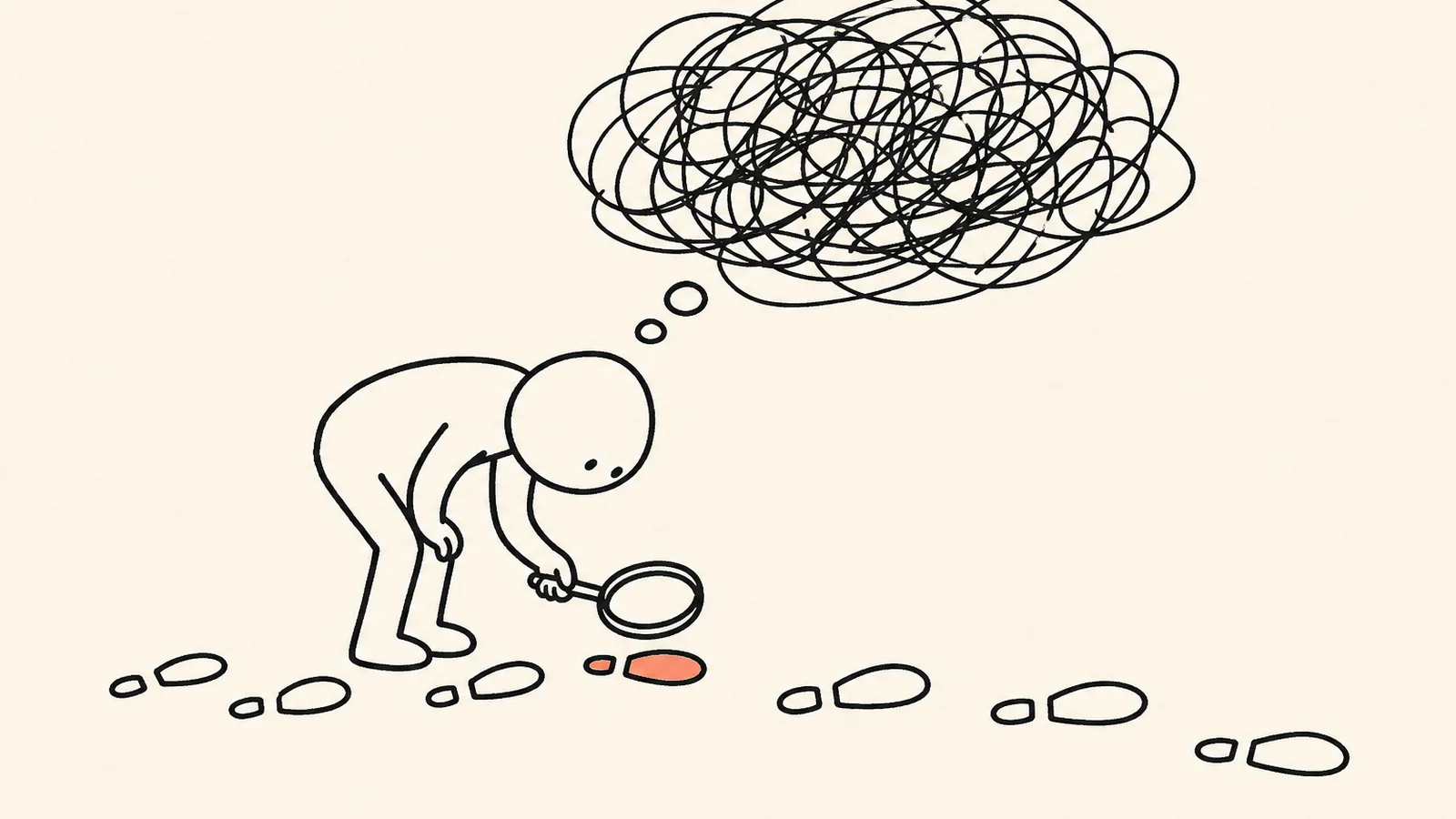
When people search how to analyze myself, the reliable answer is to study what you did rather than why you think you did it. Pick one pattern, collect three real instances, write what happened before, during and after each, find what they share, and rewrite your explanation as a prediction you can test next week. The why question is weak because the mind answers it without access to the cause. A 1977 review by Nisbett and Wilson found that people report a plausible theory rather than the real process, and a 2005 choice blindness study had people confidently explain choices they had never made. Reflection alone is not insight either: a 2002 scale study separated the two and tied self-reflection to more anxiety and insight to less. Other people help with traits that show in behavior. In a 2010 study, friends judged intelligence and creativity better than people judged themselves, while people knew their own anxiety best.
On this page+
If the question in your head is how do I analyze myself, the short answer is to study what you did, not why you think you did it. Collect three real moments of the same pattern, write down what happened in each, find what they share, and turn your explanation into a prediction you can check next week.
Search for ways to analyze myself and most guides say something else: sit down with a journal, ask why you reacted the way you did, and treat whatever comes back as the truth about you. The trouble is that an answer always comes back, fluent and confident, whether it is right or not. Psychologists have been testing that answer for almost fifty years, and the results are humbling. Below is what they found, and a method built around it.
Why does asking yourself why go wrong?
Asking yourself why goes wrong because the mind answers the question without access to the cause. In 1977 the psychologists Richard Nisbett and Timothy Wilson reviewed a long run of experiments and concluded that people may have little or no direct introspective access to the processes behind their choices and reactions.1 Asked why they had done something, people did not look inward and read off the cause. They reached for a theory of what usually causes that kind of behavior, and reported it as fact. Their reports were accurate mainly when the real cause happened to be obvious and plausible as well. The unsettling part is that a wrong answer feels exactly like a right one from the inside. Introspection hands you a reason every time, and nothing in the experience of producing it tells you whether you found the cause or built a likely one.
A study from Lund University in 2005 made the point hard to forget.2 Petter Johansson, Lars Hall and colleagues showed people pairs of faces and asked them to pick the more attractive one. On some trials, a card trick swapped the chosen photo for the rejected one before people explained their choice. Fewer than one in ten swaps were noticed straight away, and no more than a fifth were caught at all. People then explained why they had picked a face they had in fact turned down, with the same confidence and detail they gave for faces they really had chosen. The researchers called the effect choice blindness.
None of this means you know nothing about yourself. It means the why question is the weakest tool in the kit, and it is the one nearly every guide reaches for first. Reasoning is far better at defending a conclusion than testing it, and an explanation of your own behavior is a conclusion like any other.
Is self-reflection the same as self-awareness?
No. Self-reflection is the habit of turning your attention inward; self-awareness, or insight, is actually understanding what you find there, and the two can come apart. In 2002 Anthony Grant, John Franklin and Peter Langford built a questionnaire that measured them separately and found two distinct factors.3 Self-reflection went with higher anxiety and stress. Insight went with lower depression, anxiety and stress, and with more flexible thinking. People who kept diaries scored higher on self-reflection and lower on insight.
That diary result is a correlation, not proof that journaling harms anyone. Anxious people may simply be more drawn to diaries in the first place. It is still a fair warning: time spent looking inward is not the same thing as time spent learning something about yourself.
In sessions we see the difference within a few minutes. Reflection that loops keeps returning to the same question with a slightly reworded answer. Reflection that lands produces something you did not know when you started, and usually something you can do. A useful habit is to judge your thinking by what it produces rather than how long it ran.
Reflection that loops
Reflection that lands
Asks why, about yourself in general
Asks what and when, about one situation
Works from memory and mood
Works from written instances
Ends with a verdict: I am just like this
Ends with a prediction or a next step
Feels the same on day ten as on day one
Changes what you notice next time
Has no agreed point where it stops
Stops when the prediction has been tested
The last row is the one people skip. Overanalyzing is usually analysis that never agreed on what would settle the question, so it ends in tiredness rather than an answer.
How do I analyze myself, step by step?
Analyze yourself the way an observer would: from records of what you did, with your own explanation treated as a guess to be tested. There are five steps, and the first round takes about twenty minutes.
Pick one pattern, not your whole self. "I snap at my partner on Sunday evenings" can be studied. "Why am I so difficult" cannot. Choose something that has happened at least three times.
Collect three real instances. For each one, write what happened just before, what you did, and what happened after. Write what a camera would have recorded. Leave out why.
Find what the instances share. Read the three side by side. The shared element is often not the one you would have guessed: a time of day, a particular person, a task you were putting off, an empty stomach.
Write your explanation as a prediction. Turn "I get defensive because I feel criticized" into "Next time someone comments on my work in a meeting, I will start explaining before they finish." A prediction can be wrong, and that is what makes it useful.
Test it, then revise. Watch for the next instance and write it down the same way. If the prediction held, you have learned something. If it failed, you have learned more, because the story you were carrying was not the cause.
Step four is where self-analysis stops being a mood and becomes a finding. An explanation you never test can feel true for years. A prediction meets reality inside a week.
Why gets you a story. What, when and what next get you evidence.
Each step also asks a question with an answer you can check. "What did I do?" has a right answer. "When does it happen?" has a right answer. "Why am I like this?" has a thousand believable ones, and you will tend to pick whichever fits the mood you are in while you ask.
That exercise is the shape of a session in Inwitt AI, an AI thinking partner app that asks rather than answers. It asks the what and when questions one at a time, waits for your reply, and draws your instances onto the thinking board, so the pattern sits on the page in front of you rather than in your head. It does not tell you what the pattern means. That part stays yours.
What can other people see about you that you can't?
Other people see the parts of you that show up in behavior, especially traits that carry a judgment, like how clever, creative or difficult you are. In a 2010 study, Simine Vazire had 165 people rate themselves and be rated by friends and by strangers, then checked every rating against behavioral tests: an IQ test, a group discussion and a stressful public-speaking task.4 People were the best judges of their own anxiety and other inner states. Their friends were better judges of their intelligence and creativity. On extraversion, everyone did about equally well.
That suggests a rough division of labor when you analyze yourself. Your inner states, what you felt and what you were afraid would happen, are yours to report, and nobody is a better witness. How you come across is different. If the question is whether you interrupt people or seem dismissive in meetings, the people in those meetings know more than you do.
How you ask decides what you get back. "Am I difficult?" invites reassurance or a fight. "Last Thursday, when I pushed back on the plan, what did it look like from where you sat?" invites a description. Ask for what they saw, not for a verdict on who you are.
Which questions to ask yourself actually help?
The questions to ask yourself that help are about one specific situation and have an answer you can check. Questions about your character in general mostly produce stories. A practical rule is to swap why for what, when or what next, and to swap "always" for one named instance.
Instead of asking
Ask
Why do I always do this?
When did it last happen, and what came just before?
Why am I so anxious?
What, exactly, was I afraid would happen?
Why can't I stick to anything?
What was the last thing I stuck to, and what was different?
What is wrong with me?
What did I do that I would like to do differently?
Who am I, really?
What did I choose this week when nobody was watching?
These questions take longer to answer than why questions, and that is deliberate. A why question gets an instant reply because the mind keeps a stock of plausible causes ready to hand. A what question sends you back to the record, and the record is the only part of self-analysis that cannot flatter you.
Common mistakes when you analyze yourself
Most advice on how to analyze yourself goes wrong in a few predictable ways, and each one has a simple correction.
Treating the first explanation as the cause. The first answer to why is the most available theory, not the most accurate one. Write it down, label it a guess, and keep collecting instances.
Doing it all in your head. Thinking about yourself without writing anything down lets every instance blur into one general feeling. Paper keeps three moments separate long enough to compare them. When the thinking starts to circle, sorting the loop on paper is usually the way out.
Analyzing in the low moment. Straight after a bad day, the explanation you reach for will match the mood. Record the instance while it is fresh, but read the three side by side a day later.
Taking a personality test as the answer. A test summarizes how you describe yourself. It can be a useful prompt, but it is built from the same self-report that the research above questions, so treat the result as a hypothesis to check against what you actually do.
Asking for a verdict instead of a description. When you bring someone else in, ask what they saw, not what you are.
Questions people ask about self-analysis
Can I analyze myself without a therapist?
Yes, for ordinary patterns: habits, reactions at work, the way you make decisions. The method above needs no training, only honest records and a willingness to be wrong. If what keeps coming back is distress that will not lift, thoughts of harming yourself, or the effects of trauma, talk to a professional, because self-analysis is not treatment.
Is it bad to analyze myself all the time?
It depends on what the analysis produces. If you finish with a prediction or a next step, it is working. If you finish where you started, only more tired, it has turned into rumination, and two moves help: postponing the loop to a set time, and checking afterwards whether it produced anything new.
Is self-analysis the same as overthinking?
No. Self-analysis aims at a finding you can check, while overthinking repeats the question without any way to settle it. The same twenty minutes can be either one, depending on whether you are working from instances and predictions or from memory and mood.
How often should I analyze myself?
Less often than it feels like you should, and one pattern at a time. Pick a pattern, collect its instances over a week or two, then check the prediction on the date you set. A short session with a finish beats a daily habit of open-ended looking inward.
How do I know if my self-awareness is accurate?
Test it. Every belief about yourself implies a prediction about what you will do next time. If those predictions keep coming true, the belief is probably sound; if they keep failing, or you never make any, you are holding a story rather than knowledge.
The moment you most want to analyze myself, as people tend to type it, is usually right after something you did that surprised you. That is a good moment to collect the instance and a poor one to explain it. A session works the same way the exercise does: one question at a time, your answers drawn where you can see them, and a receipt at the end with what you found in your own words. If you would like to try it on a pattern of your own, join the Inwitt waitlist.
Footnotes
Richard E. Nisbett and Timothy D. Wilson, "Telling more than we can know: verbal reports on mental processes", Psychological Review 84(3), 231-259 (1977). Journal record↩
Petter Johansson, Lars Hall, Sverker Sikström and Andreas Olsson, "Failure to detect mismatches between intention and outcome in a simple decision task", Science 310(5745), 116-119 (2005). Lund University record↩
Anthony M. Grant, John Franklin and Peter Langford, "The Self-Reflection and Insight Scale: a new measure of private self-consciousness", Social Behavior and Personality 30(8), 821-835 (2002). Journal record↩
Simine Vazire, "Who knows what about a person? The self-other knowledge asymmetry (SOKA) model", Journal of Personality and Social Psychology 98(2), 281-300 (2010). Journal record↩