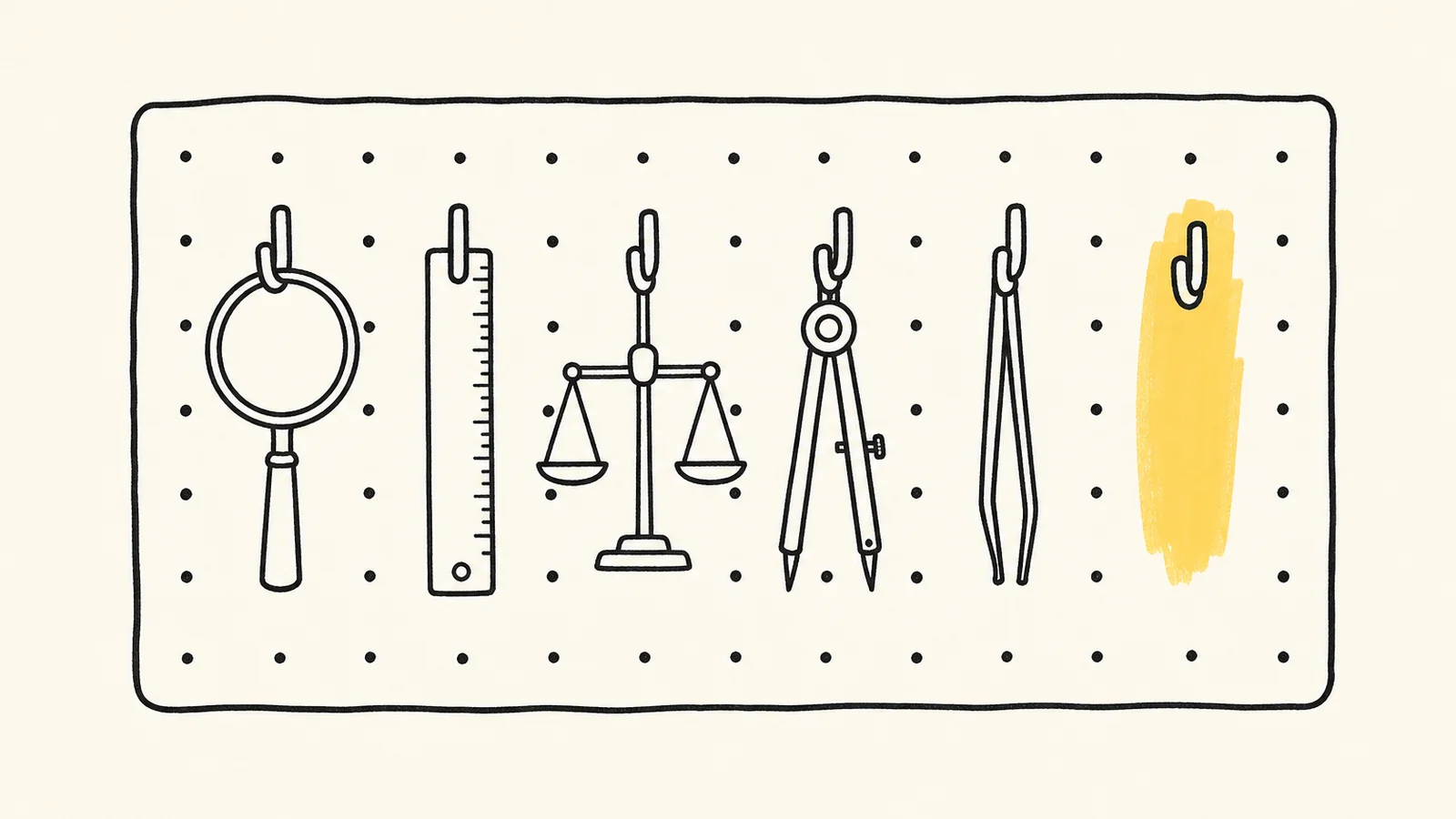
The components of critical thinking, in the 1990 expert consensus led by Peter Facione, are six skills: interpretation, analysis, evaluation, inference, explanation and self-regulation, plus dispositions such as being inquisitive, open-minded and willing to reconsider. Lists that count two, five or eight components are describing different layers of the same ability. Skills are what you do. Paul and Elder's eight elements of thought (purpose, question, information, concepts, assumptions, point of view, inferences, implications) are what any piece of reasoning contains, and their intellectual standards (clarity, precision, accuracy, relevance, depth, breadth, logic) are how you judge each element. Dispositions decide whether you bother. The part no list includes is noticing: Project Zero researchers describe good thinking as ability, inclination, and sensitivity to the moments when thinking would help. Most reasoning fails at that last step, when an assumption arrives as a fact and is never checked.
On this page+
The components of critical thinking, in the expert definition most lists trace back to, are six skills: interpretation, analysis, evaluation, inference, explanation and self-regulation, plus the dispositions that make a person use them. Other lists count two, five or eight because they describe different layers of the same thing. One component is missing from all of them.
You may be here because an assignment asks you to name the components, or because someone at work said you need to "think more critically" and you would like to know what that is made of. Search for it and you get a different list on every page. One says there are two components, another five, a third eight, and none of them says why the others are wrong.
None of them is wrong. They are answering different questions. What follows sorts the lists into four layers, shows each one on a real decision, and then names the part no list includes: noticing the moment when any of it is needed.
What are the components of critical thinking?
The core components are six skills, each of which is really a question you ask about a claim or a decision:
Interpretation: what does this actually say, and what does it mean here?
Analysis: what is the claim, and what is holding it up?
Evaluation: how far should I trust this source and this reasoning?
Inference: what follows from what I now know, and what does not?
Explanation: could I lay out how I got here so someone else could check it?
Self-regulation: where might my own reasoning be off, and what would I correct?
These six come from the most cited definition there is. In 1990 a panel of experts convened by the American Philosophical Association, with the philosopher Peter Facione as principal investigator, agreed that critical thinking is "purposeful, self-regulatory judgment which results in interpretation, analysis, evaluation, and inference, as well as explanation" of the considerations behind that judgment.1 The same consensus statement then does something most summaries skip. It describes the ideal critical thinker by character rather than skill: someone "habitually inquisitive", "open minded", "honest in facing personal biases" and "willing to reconsider". So the full answer has two halves, the core critical thinking skills and the habits that decide whether they get used. Most pages keep the first half and drop the second.
Why do lists of critical thinking components disagree?
Lists disagree because they describe four different layers of thinking and usually pick one, or mix two without saying so. One layer is what you do (skills), one is what any piece of reasoning contains (elements), one is how you judge it (standards), and one is whether you bother (dispositions). Put side by side, they stop competing:
inquisitive, open-minded, fair-minded, honest about bias, willing to reconsider
APA expert consensus, 1990
Once you see the layers, the odd lists make sense. Pages that give two main components of critical thinking, analysis and evaluation, have folded the six skills down to the two that do most of the work. Five-part lists used by universities to grade essays are usually a process (explain the issue, use evidence, examine assumptions, take a position, draw conclusions), which is a different shape again. The eight-item lists on training sites tend to put "open-mindedness" next to "analysis", a disposition next to a skill.
Mixed critical thinking components are not wrong. They just make it hard to see which layer you are weak in. Critical thinking is also only one branch of the wider family of thinking skills, and the layers above apply to the others too.
What are the elements of thought and the intellectual standards?
The elements of thought are the eight parts every piece of reasoning contains, and the intellectual standards are the tests you hold each part to. Together they are what most pages mean by the elements of critical thinking, and both come from the philosophers Richard Paul and Linda Elder at the Foundation for Critical Thinking.2 In their 1997 statement, all reasoning has a purpose, is an attempt "to settle some question", is "based on assumptions", is "done from some point of view", rests on "data, information, and evidence", is "shaped by concepts and ideas", contains inferences, and "leads somewhere, has implications and consequences".
Their standards are "clarity, precision, accuracy, relevance, depth, breadth, and logic". The two lists are meant to be used together. In Paul and Elder's words, how well someone reasons "depends on how well he/she applies these universal standards to the elements (or parts) of thinking". That is the most useful idea in this whole topic: the elements tell you where to look, and the standards tell you what to look for once you are there.
Here is how it runs on an ordinary decision, a job offer with a bigger title and a longer commute. Take three elements and hold each to one standard:
Purpose, held to clarity. "I want to grow" is not clear. "I want to lead a team within two years" is, and it can be checked against the offer.
Assumption, held to accuracy. "A bigger title means more say in decisions." Is that true at this company? You can ask someone who works there.
Point of view, held to breadth. How would the person who would manage you describe this role? Their version may be narrower than the recruiter's.
Three questions, ten minutes, and the decision already looks different. This is also most of what reasoning critically involves in practice: not cleverness, but checking the parts you were about to skip.
Why do skills alone not make a critical thinker?
Because skills only show what you can do when someone asks you to do it, and most thinking happens when nobody is asking. That is why the expert consensus describes critical thinking dispositions alongside the skills, and why it says educating critical thinkers "combines developing CT skills with nurturing those dispositions which consistently yield useful insights".1
The difference shows up most clearly in people who are good at arguing. Strong analysis can be used entirely to defend a conclusion you already hold. Every skill on the list is working, and the result is still poor thinking, because the reasoning was only ever pointed outward. Paul and Elder's advice for the point-of-view element is the antidote: "Strive to be fair-minded in evaluating all points of view", which has to include your own.2
In sessions we see the same thing from the other side. People who would never describe themselves as analytical often reason carefully once they are curious about the answer, and sharp people stop reasoning once they are sure. The dispositions are not a soft extra on top of the skills. They decide which skills run at all. If you want to see skill and habit separated in real situations, we worked through six situations, belief to result.
What is the component every list leaves out?
The missing component is noticing: spotting, in the moment, that something you just thought is a claim worth checking. Every list assumes you already know when to think critically. In practice that is where most thinking fails.
Researchers at Harvard's Project Zero made this distinction explicit. David Perkins and colleagues argued in 2000 that most accounts of intelligence are "abilities-centric", while thinking dispositions "concern not what abilities people have, but how people are disposed to use those abilities".3 Project Zero's own summary of good thinking has three parts: "having a repertoire of thinking moves to draw on", "having an inclination to use those moves", and "being sensitive to the times when thinking would be helpful".4 The first part is the skills list. The second is the dispositions. The third is the component no list of the components of critical thinking includes.
This matches the pattern we see most in sessions. People rarely lack the ability to question an assumption. Point a question at it and most people answer well, often better than they expected. What they miss is that the assumption was there at all. It arrived as a fact ("obviously I can't afford to leave") and never got the chance to become a claim.
You cannot use a skill on a moment you did not notice.
Noticing is hard to practice alone, because the assumptions you miss are exactly the ones that feel like facts. It gets easier when the thought is written down where you can look at it, and easiest when something keeps asking.
That exercise is a small version of what Inwitt AI does. It is an AI thinking partner app that asks one question at a time instead of answering, and its Critical mode keeps returning to the sentence you treated as settled. Only what you confirm goes onto the thinking board, so the assumptions you find are written in your words, not ours.
What only feels like using the components
Memorizing the list as if it were the skill. Knowing that "inference" is component four does not change how you read the next claim that reaches you. The list is a map of where to look, and it only helps if you look.
Running every component on every choice. Six skills, eight elements and seven standards make 336 checks. Use them on decisions you will live with, not on what to cook. Applying all of them to everything turns into analysis that never stops.
Pointing the standards only at other people. It is easy to find an unclear claim in someone else's argument. The test is whether you hold your own reasoning to the same clarity and accuracy, especially on a question where you already know what you want the answer to be.
Asking a chatbot to "analyze" and calling it your analysis. A tool can list assumptions for you. It cannot notice the one you were making, because you never typed it. The research on what improves critical thinking points the same way: the skill grows when you do the questioning on a real problem.
Questions people ask about the components of critical thinking
What are the two main components of critical thinking?
When a list names two, it usually means analysis and evaluation: taking a claim apart, then judging its parts. Another common pair is skills and dispositions, the ability to think critically and the habit of doing it. The second pair is the more accurate answer, because it includes the reason skilled people still think badly.
What is the difference between components and steps?
Components are the parts of the ability; steps are the order you use them in on one problem. Interpretation, analysis and evaluation each show up in several steps. If you want the process rather than the parts, see the steps of critical thinking, each written as a question with a test that it is done.
Which component of critical thinking is most important?
Self-regulation is the usual answer, because it is the skill of checking your own reasoning and correcting it. We would add noticing, since self-regulation only starts once you have spotted something to check. A strong set of skills with weak noticing looks like a good thinker who is often surprised.
Can the components of critical thinking be learned?
Yes. The expert consensus treats them as teachable, and the dispositions as something to nurture alongside the skills.1 Both grow the same way: by being used on problems that matter to you, with your reasoning written down where you can check it.
The three questions in the exercise take two minutes. Doing them every time a sentence starts with "obviously" is the hard part, and that gets easier when something else is asking. That is what a session does: it asks, you answer, and the assumptions you found end up on a receipt in your own words. If you have a decision with a sentence like that in it, join the Inwitt waitlist and bring it to your first session.
Footnotes
Peter A. Facione (principal investigator), Critical Thinking: A Statement of Expert Consensus for Purposes of Educational Assessment and Instruction (the Delphi Report), American Philosophical Association, California Academic Press, 1990. Consensus statement as reproduced by Penn State, GEOG 882↩↩2↩3
Richard Paul and Linda Elder, "The Elements of Reasoning and the Intellectual Standards", Foundation for Critical Thinking, 1997. Foundation for Critical Thinking↩↩2
Perkins, Tishman, Ritchhart, Donis and Andrade, "Intelligence in the Wild: A Dispositional View of Intellectual Traits", Educational Psychology Review 12(3), 269-293 (2000). Project Zero record↩
Bari Walsh and Iman Rastegari, "Think Better", Harvard Graduate School of Education, Usable Knowledge, 5 February 2018. Harvard GSE↩