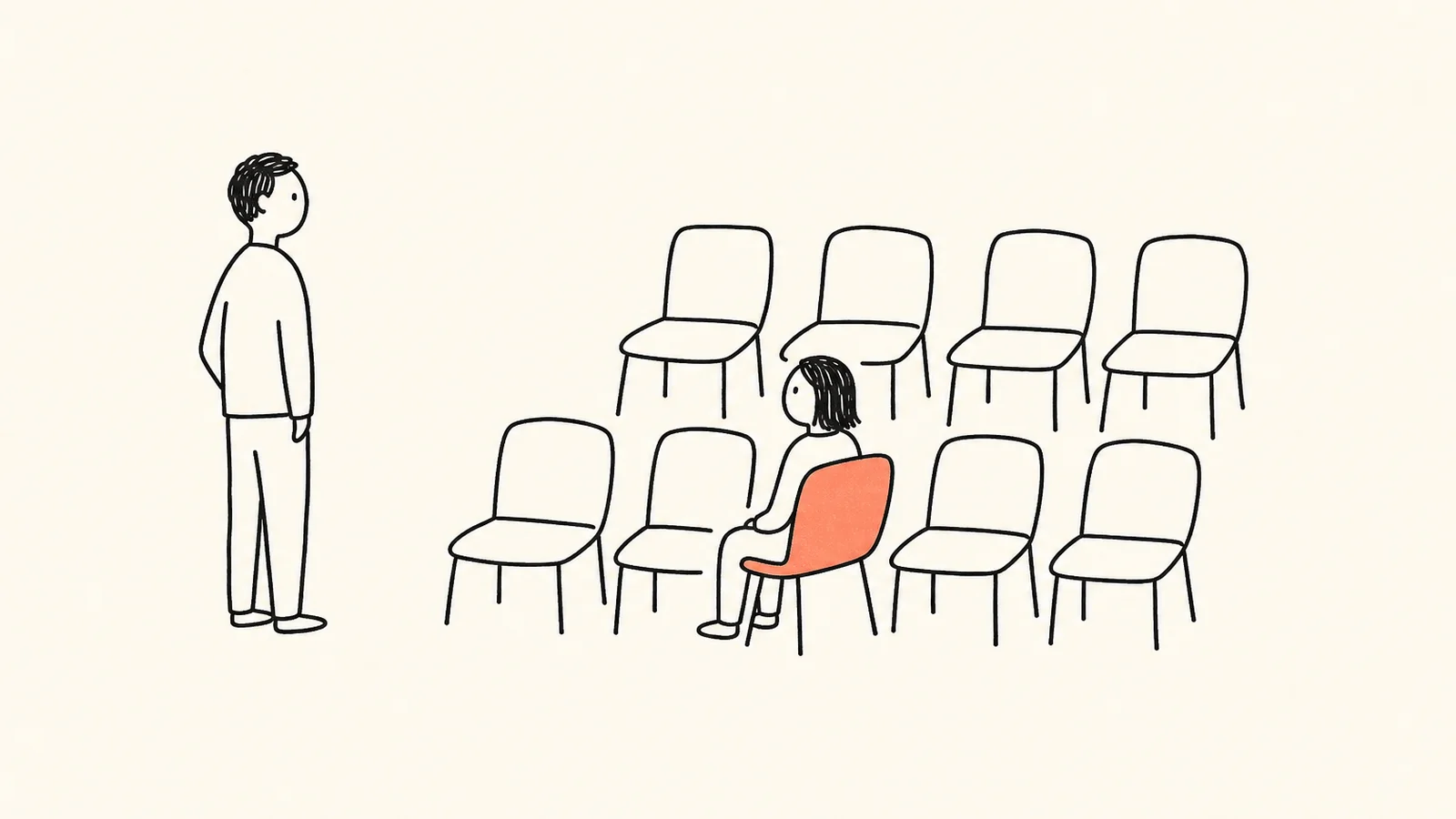
The exercises to stop caring what others think that work do not try to switch the caring off. Experiments by Mark Leary and colleagues in 2003 found that approval and disapproval moved people's self-esteem even when they insisted other people's opinions did not affect them. What can be corrected is the estimate. Studies from 2001 show that people expect harsher judgment for a blunder than observers actually give, and studies from 2020 show that people overestimate how far observers generalize from one performance. So the useful exercises audit the imagined verdict in writing, in order: name the specific person, write their verdict as one sentence, list what else the judged trait consists of, ask what you would do differently if the verdict were true, and run one small test with a prediction written first. Opinions from people who know the situation and live with its results are worth asking for directly. The rest can be noticed and given no vote.
On this page+
The exercises to stop caring what others think that hold up are written ones: name the person whose opinion you fear, write their verdict as a single sentence, check how much one moment could really tell them, and ask what the verdict would change. You will still care. You will care about fewer people, more accurately.
Most advice on how to stop overthinking what others think comes down to one instruction, which is to care less. It works for about an afternoon. Then you draft a message four times, or skip the thing you wanted to post, or replay a comment from a meeting, and the imagined audience is back in its seats.
"Care less" gives you nothing to do. What follows is five exercises, each one a question with something to write down, and the research on why the judgment you are bracing for is usually harsher and wider than the one anybody is making.
Can you actually stop caring what others think?
No, and the evidence on this is unusually direct. In 2003 the psychologist Mark Leary and colleagues ran two experiments with college students, some of whom had said that their self-esteem did not depend on other people's evaluations.1 Everyone then received approval or disapproval, in the form of feedback on whether others in their group wanted to get to know them. The feedback moved how people felt about themselves in both groups, including the ones who had insisted it would not. "People underestimate the degree to which they are influenced by others," Leary said when the study came out.
So the part of you that registers approval is not a flaw you can train away. It is standard equipment, and it runs whether or not you endorse it. That changes what a useful exercise looks like. Most exercises to stop caring what others think aim at zero caring, which means aiming at something the research says nobody reaches, and each failure then feels like proof that you are weak.
The better target is accuracy. You cannot turn the gauge off, but you can check what it is reading. Much of the misery in caring what other people think comes from a reading that is wrong in two specific ways, and both have been measured.
Why does the judgment in your head feel so harsh?
Because you are estimating it from the inside, and the inside view runs harsh and wide. In 2001 Kenneth Savitsky, Nicholas Epley and Thomas Gilovich published four studies in which people imagined committing a social blunder, failed at an intellectual task in public, or were described in an embarrassing way.2 In every case they expected observers to judge them more harshly than the observers did. The authors' explanation is that you are fixed on the mishap, while an observer also takes in the situation around it, and the situation softens the impression.
The second error is about width. Across eight studies published in 2020, Alice Moon, Muping Gan and Clayton Critcher found that people overestimate how much observers read into a single performance.3 Bake a bad batch of cookies, and you and your guests agree that the cookies were bad. You go further and assume they now doubt your cooking in general, omelets included. They mostly do not. The researchers call this the overblown implications effect, and Moon has said it showed up whether the observers were strangers, acquaintances or friends.
Put the two together and the fear of judgment has a shape. The verdict you expect is more severe than the real one, and it covers more of you than the real one does. The same inside view also distorts what you think people noticed in the first place, which we covered in why your replay of a conversation is unreliable.
None of this means that nobody ever judges you. It means your estimate has a known lean, and a known lean can be corrected, the way you would correct a clock you know runs ten minutes fast.
Which exercises to stop caring what others think are worth doing?
The ones that turn a vague audience into a specific claim you can check. The fear survives by staying blurry: "people" will think "something bad". Each exercise below removes one piece of blur and leaves a line on paper. Do them in order the first time, because each one uses the line before it.
Exercise
The question
What ends up on paper
1. Name the judge
Who, exactly?
One to three names
2. Write the verdict
What would they say, in one sentence?
A sentence in their voice
3. Widen the trait
What else is that judgment made of?
Five other things the trait includes
4. Ask what it changes
If they did think it, what would I do differently?
One action, or "nothing"
5. Run one test
What do I predict, and what happened?
A prediction and a result
1. Name the judge
Write the names of the people whose opinion you are worried about. "Everyone" and "people at work" do not count. The pattern we see most in sessions is that the crowd shrinks to one or two people the moment it has to be named. Often one of them is not present in the situation at all: a parent, a former manager, an old classmate. A named person can be asked, observed or weighed, and a crowd can only be feared.
2. Write the verdict in their words
Next to each name, write the sentence you imagine them thinking, as a quotation. "She thinks I am out of my depth." "He thinks I only got the role because nobody else wanted it." This is uncomfortable for about a minute, and then it is a claim like any other.
Check it the way you would check a claim in the news, by asking what this person did or said that supports it. If the only evidence is a look, a pause or a short reply, write that down too. Making a vague worry specific is most of the work with any worry, and this is the same move.
3. Widen the trait
Your verdict will usually name a broad trait (competent, likable, serious) on the strength of one narrow moment. This exercise borrows from the 2020 studies. When participants were led to define the trait more broadly, to include relevant behaviors the observer would never get to see, the overblown implications effect disappeared.
So list five other things that "good at this job" or "a good friend" consists of. Mark the ones this person has watched you do. One fumbled answer is now one entry in six.
4. Ask what it would change
Suppose the verdict is exactly right, and write what you would do differently. Sometimes there is a real answer: prepare the numbers before the next meeting, apologize for the remark. Then the opinion was useful, and you have a task where you had a dread.
Often the answer is "nothing", because you would still take the course, post the work or leave the job. An opinion that changes none of your actions has only one place left to act, which is your mood.
5. Run one small test
Pick the smallest version of the thing you have been avoiding and write a prediction first: what you will do, who will see it, and what you expect them to say or do. Disagree mildly in a meeting. Wear the jacket. Share the draft with two people.
Afterward, write what happened next to what you predicted. Therapists who treat social anxiety use the same structure and call it a behavioral experiment. The written prediction is the point, because without it your memory will quietly edit the forecast to match the result.
You will not stop caring what people think. You can stop caring about verdicts that no one has delivered.
The hard part on paper is that nobody asks the next question when you write "everyone" or "I don't know". That is the job of Inwitt AI, an AI thinking partner app: it asks one question at a time, waits, and writes only what you have confirmed onto the thinking board, so the judge, the verdict and the evidence sit side by side where you can look at them. It does not tell you whose opinion to keep. That part stays with you.
Whose opinion should you keep caring about?
The people who can see the thing being judged and who live with its results. Caring is information when it comes from the right source, and a short test sorts most of the names from exercise one. Does this person know the situation well enough to judge it? Will they be affected by what you do? Would you ask for their view if they had not offered it?
Someone who passes all three is not a judge to escape. They are closer to an adviser, and the honest move is to ask them directly: "I am thinking of doing this. What do you see that I don't?" In our experience the answer is more specific than the imagined one, and easier to use. It also belongs among the questions worth asking before a decision.
Someone who fails all three, such as a stranger online or a relative with strong views on a field they have never worked in, may still have an opinion. You are allowed to notice it and give it no vote. This is how to stop caring what people think in practice: by subtraction, one name at a time, with a reason for each.
What only feels like it helps?
Several moves that get passed around as exercises to stop caring what others think give relief for a day and leave the estimate untouched.
Announcing that you don't care. Leary's participants who said this were affected anyway. The announcement adds a second problem, because now you are hiding the reaction as well as having it.
Collecting reassurance. Asking three friends "that wasn't weird, was it?" answers a question about one evening. It does not test the belief underneath, and the relief fades in time for the next evening. Done often, it is thinking that circles without producing anything, out loud.
The slogan "nobody is thinking about you". It is roughly true of strangers and plainly false of your manager, your partner and your mother. A slogan you can falsify in ten seconds will not hold when you need it. Exercise one does the same job with names.
Values lists that never meet a situation. Knowing that you value honesty does not tell you whether to send the email. Values earn their place at exercise four, when you ask what the verdict would change and find that you would do the same thing anyway.
Shock exposure without a prediction. Doing something embarrassing on purpose can work. If you never wrote down what you expected, though, a mind that defends its conclusions will file a neutral result under "they were being polite".
Questions people ask about caring what others think
Why do I care so much about what others think of me?
Because the system that tracks approval is built in. Leary's 2003 experiments found it at work even in people who believed they were immune. How loud it gets varies from person to person and from week to week. Many people find it louder when they are tired, new somewhere, or waiting on a decision that someone else controls.
Is it bad to care what people think of you?
No. It is how you learn that a joke landed badly or that a plan has a hole in it. Caring becomes costly when the opinions are imagined, when they come from people who cannot see the situation, or when they stop you from doing things you had already decided to do.
What is the fear of being judged called?
Psychologists call it fear of negative evaluation, and they treat it as a matter of degree: everyone has some. When it is intense, lasts for months and makes you avoid work, study or people, it overlaps with social anxiety. At that point a qualified professional is the right support, and written exercises are a supplement at most.
How long do exercises to stop caring what others think take to work?
One round on one situation takes ten to twenty minutes, and you can judge the result yourself by whether you do the thing you were avoiding. The general habit is slower. We know of no study that gives an honest number of weeks, so be wary of any page that does. What you can count is tests: every written prediction that turns out too harsh makes the next forecast harder to believe.
What a session adds to the three lines
The three lines in the exercise above are a small version of what a session does: one question, your answer in your words, then the next question that your answer makes necessary. At the end you keep a receipt of what you worked out, including the names that lost their vote. If you would like something that keeps asking after you write "everyone", join the Inwitt waitlist.
K. Savitsky, N. Epley and T. Gilovich, "Do others judge us as harshly as we think? Overestimating the impact of our failures, shortcomings, and mishaps", Journal of Personality and Social Psychology, 2001, 81(1), 44-56. https://doi.org/10.1037/0022-3514.81.1.44↩