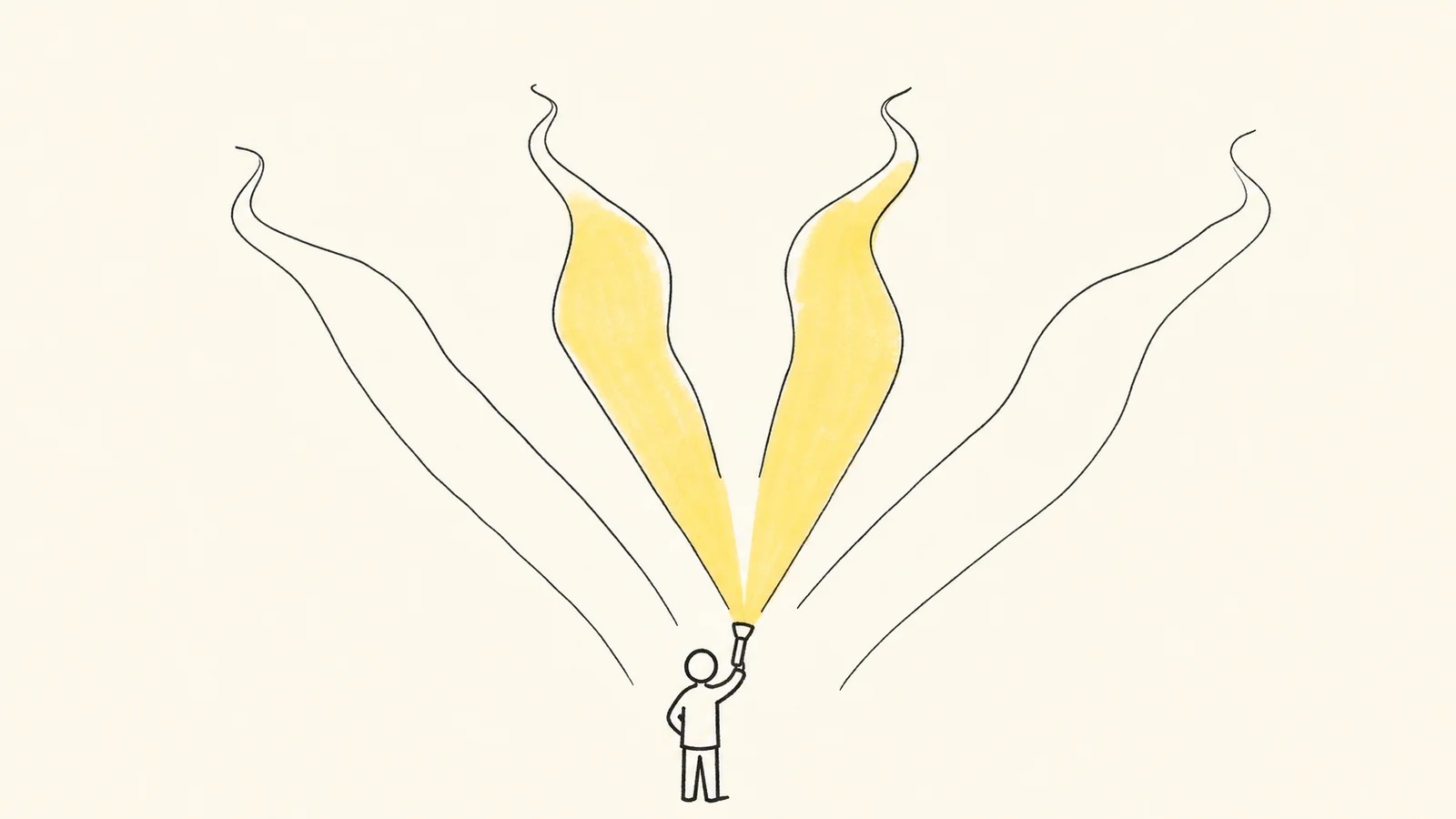
How do stress and mental wellness struggles affect decision making? They rarely switch your judgment off; they tilt it in four ways that research has measured. Under stress, people end the search early: in a 1987 study by Giora Keinan, stressed students offered solutions before considering all the alternatives, even with no time limit. Stress also pulls toward reward and habit: a 2016 meta-analysis by Katrin Starcke and Matthias Brand found more disadvantageous choices under stress, a small effect concentrated where risk taking was the losing strategy. Time pressure compounds it: in a 2025 University of Melbourne study, the largest drops in decision quality came when stress and time pressure arrived together. Mood picks a direction: in 1999 experiments by Rajagopal Raghunathan and Michel Tuan Pham, anxious people chose the safe option and sad people the high-risk, high-reward one, and the effect weakened when they chose for someone else. Each tilt has a check you can write down.
On this page+
How do stress and mental wellness struggles affect decision making? Less by making you choose badly than by changing how you choose. You stop looking at options sooner, lean toward the reward and the familiar, feel more rushed than you are, and let your mood pick a direction. Each of those changes has a check you can run on paper.
You are probably reading this in a hard stretch, with a choice that will not wait for a better month: a job offer during weeks of bad sleep, a move or a breakup decided while something else is going wrong. The question underneath is whether you can trust yourself right now. The research says mostly yes, with four blind spots, and what follows takes each one in turn with the check that catches it.
How do stress and mental wellness struggles affect decision making?
They tilt the process in four predictable ways rather than switching your judgment off. First, the search ends early: under stress, people settle on an answer before they have looked at all the options, even with no deadline. Second, the weighing shifts toward the immediate reward and the habitual move, and away from the downside. Third, time pressure multiplies the damage, and stress makes you feel more pressed for time than you are. Fourth, mood picks a direction: anxiety pulls toward the safe option, sadness toward the big swing.
The effects measured in labs are real but modest. Stress does not turn a sensible person reckless; it makes them skip steps they would normally take, without noticing the skip. That is good news, because a skipped step can be put back. You do not need to feel settled to decide well. You need to run the steps the stress would have dropped.
What changes
What it sounds like
The check
The search ends early
"There are only two options here."
Write every option, including the ones you dropped.
Reward and habit win
"Obviously I'll do what I did last time."
Write the worst realistic downside of the obvious choice.
Time feels shorter
"I have to know by Friday."
Write who set the deadline and what happens if it moves.
Mood picks a direction
"The safe one is clearly better." Or: "I need a big change."
Name the mood, then ask which way it leans.
Why do you stop looking at options when you are stressed?
Because stress makes you commit to an answer before the search is finished, and it does so even when nothing is rushing you. In a 1987 study, the psychologist Giora Keinan gave 101 students decision problems on a computer, some under a stress condition and some under none1. There was no time limit. The stressed students were significantly more likely to offer a solution before they had considered all the available alternatives, and they scanned the options less systematically. How they scanned predicted whether they got the problem right.
The missing clock is the detail that matters: stress made an unfinished search feel finished.
Outside a lab, decision making under stress looks like this. In sessions, the decisions people bring during a hard month usually arrive as a pair: stay or leave, buy it or walk away. Once a question asks what else was considered and set aside, a third and fourth option often appear: a later date, a smaller version, a conversation that would change the facts. Those options were never rejected. They were never looked at.
That is why the first check is a list, written before any weighing starts. Weighing two options carefully is still weighing only two.
Does stress make you take bigger risks?
Sometimes, and mainly in the situations where chasing the reward is the wrong move. In 2016, Katrin Starcke and Matthias Brand pooled 32 datasets with 1,829 participants on stress and decisions under uncertainty2. Overall, stressed people made more disadvantageous choices, but the effect was small. It was concentrated in tasks where reward seeking and risk taking were the losing strategy; elsewhere there was essentially no effect. Psychological stressors, such as being judged by others, moved choices more than purely physical ones, and none of the personal characteristics they tested changed the result: this is not a weakness of certain people.
A second line of research explains the pull toward the familiar. In 2009, Lars Schwabe and Oliver Wolf stressed some participants (a hand in ice water while being watched and evaluated) before they learned which actions earned which food rewards3. Afterwards, one of the foods was made less appealing. The stressed group kept working for it anyway, and they could say less about which action led to which outcome. Their behavior ran on habit instead of on the goal.
So how does stress affect decision making in practice? The obvious option looks more obviously right, because obvious and habitual feel the same from the inside. The fast version of this is covered in why stress makes rash choices feel certain. The check is one line: the worst realistic outcome of the option that feels obvious, written down before you take it.
Why does time pressure make stress worse?
Because the two compound: stress makes you feel short of time, and a short clock is where stressed decisions fall apart. In a 2025 study, Karlo Doroc, Nitin Yadav and Carsten Murawski at the University of Melbourne put 42 students through a standard stress procedure, a mock job interview in front of evaluators, and had them solve decision problems of varying difficulty, once stressed and once not4. Higher cortisol went with lower decision quality and with more experienced time pressure. In a follow-up analysis, the largest drops came when stress and time pressure arrived together. In a January 2026 write-up, Doroc reported that on solvable problems, accuracy in that combination fell from about 83% to 57%, close to guessing. The authors flag this part as needing replication.
In personal decisions, much of the time pressure is self-made. "I need to decide this weekend" is often a wish to stop feeling the decision rather than a date anyone set. So write who set the deadline and what changes if it moves by a week. If the answer is "nothing, except I would have to sit with it longer", the pressure is the stress talking. If the date is real (an offer expires, a lease ends), ask a smaller question: which part has to be decided by then, and which part can wait?
How do anxiety and low mood change what you choose?
They push in opposite directions, which is why mental health and decision making cannot be summed up as "worse decisions". In three experiments published in 1999, Rajagopal Raghunathan and Michel Tuan Pham put participants into an anxious, sad or neutral mood and then had them choose between gambles and between jobs, choices with nothing to do with what had caused the mood5. Anxious participants favored the low-risk, low-reward option. Sad participants favored the high-risk, high-reward one. Neutral participants landed in between. The authors' reading is that anxiety sets up a goal of reducing uncertainty and sadness a goal of replacing something lost, and that people consult the feeling by asking which option they would feel better about.
In plain terms, anxiety and decision making lean toward the safe choice that keeps things as they are, while low mood leans toward the dramatic change that promises to fix how you feel. Either can be right. Neither is a conclusion.
A 2026 study by Weinberg and Weinberg found a related pattern in surveys of 85 UK members of parliament and 128 from other parliaments6. Poorer mental health went with harsher judgments of their own decisions, more risk aversion and more sensitivity to how options were framed. It is correlational, and the authors stress that it does not question anyone's competence. If your anxiety is about the decision itself rather than spilling over from elsewhere, that is a different problem, covered in our post on decision anxiety.
The most useful detail in the 1999 paper is a boundary. The mood effect weakened when participants made the same choices on behalf of someone else. Distance worked where a better mood was not available.
Stress rarely picks the wrong answer for you. It decides which answers you get to see.
The fourth line borrows the distance the 1999 study found. The whole exercise is what a session in Inwitt AI, an AI thinking partner app, is built around: it asks one question at a time and draws your options on a thinking board, including the ones you set aside, so the full list is visible before anything gets weighed. It never tells you which option to take. Decision mode, one of the six thinking modes, is made for this.
Should you wait to decide until you feel better?
Wait if the decision is hard to reverse and the deadline is your own; decide now if it is reversible or the date is real. Stress tilts choices rather than wrecking them, so waiting is not automatically the safer move, and it has costs. An open decision gets reopened all day, a strain covered in how to manage decision fatigue. And a decision left alone rarely stays that way: a default or another person tends to make it, as what happens when you do not make a decision lays out.
Chronic stress adds a catch. If the hard stretch has lasted months, "when I feel better" may not have a date. Then split the decision: settle the reversible part now (a trial, a conversation, a smaller version of the change), and put the irreversible part on a specific date, after running the four checks twice, a few days apart. An option that survives both times, in different moods, has passed a better test than one good afternoon.
What only feels like it helps?
A pros and cons list of the two options you already had. It feels thorough, but it weighs carefully inside a search that stopped early. Write the options first, then the pros and cons.
Trusting the answer because it feels obvious. Under stress, obvious often means familiar. Familiar may be right, but nobody has checked it yet.
Asking everyone you know. Reassurance soothes the feeling for an hour and leaves the options where they were. Other people help when they bring a new option or a missing fact; if you are collecting votes, the worry is running the process (see how to stop worrying for making a worry specific).
Making a big change to end the stress. Deciding anything at all feels like relief. That relief is real, but it is not evidence the choice is good, and a low mood in particular argues for the dramatic option.
Waiting to feel better with nothing scheduled. A wait with no date tends to turn into a decision you can't make.
Questions people ask about stress and decision making
Can stress improve decision making?
Sometimes. Starcke and Brand's 2012 review of human studies from 1985 to 2011 concluded that stress can help or hurt decisions depending on the task and the situation7. Mild pressure can pull your attention onto a problem you had been avoiding and get you to act. The trouble starts with high stress, a short clock, and choices where the tempting reward is the trap.
Does chronic stress affect decisions the same way as acute stress?
Less is known, because most human studies use short lab stressors such as a mock interview or a cold-water test. A fair working assumption is that the same tilts apply and last longer, which makes written checks more useful, not less.
Is it bad to make big decisions when you are anxious or depressed?
Not automatically, but it helps to know the direction of the pull: anxiety leans toward keeping things as they are, low mood toward a dramatic change. If a doctor or therapist is supporting you, bring the decision to them; they can help you see which part is the mood talking. The four checks work either way.
When should you get help?
If low mood, anxiety or stress has lasted for weeks, if even small decisions feel impossible, or if it is affecting your sleep, work or relationships, talk to a doctor or a mental health professional. If you are thinking about harming yourself, contact local emergency services or a crisis line now. This piece covers the ordinary strain of a hard stretch; it is not a substitute for care.
The four lines work because each one is a question you answer in your own words before the stress answers it for you. A session does the same thing at length: one question at a time, your options drawn where you can see them, and a receipt at the end that records what you decided and why, in your words. If you want to try it, join the Inwitt waitlist.
Footnotes
Keinan, G. (1987). Decision making under stress: scanning of alternatives under controllable and uncontrollable threats. Journal of Personality and Social Psychology, 52(3), 639-644. https://pubmed.ncbi.nlm.nih.gov/3572731/↩
Starcke, K. and Brand, M. (2016). Effects of stress on decisions under uncertainty: a meta-analysis. Psychological Bulletin, 142(9), 909-933. https://pubmed.ncbi.nlm.nih.gov/27213236/↩
Doroc, K., Yadav, N. and Murawski, C. (2025). Acute stress impairs decision-making at varying levels of decision complexity. Communications Psychology, 3, 179. https://doi.org/10.1038/s44271-025-00355-x↩
Raghunathan, R. and Pham, M. T. (1999). All negative moods are not equal: motivational influences of anxiety and sadness on decision making. Organizational Behavior and Human Decision Processes, 79(1), 56-77. https://doi.org/10.1006/obhd.1999.2838↩
Starcke, K. and Brand, M. (2012). Decision making under stress: a selective review. Neuroscience and Biobehavioral Reviews, 36(4), 1228-1248. https://pubmed.ncbi.nlm.nih.gov/22342781/↩