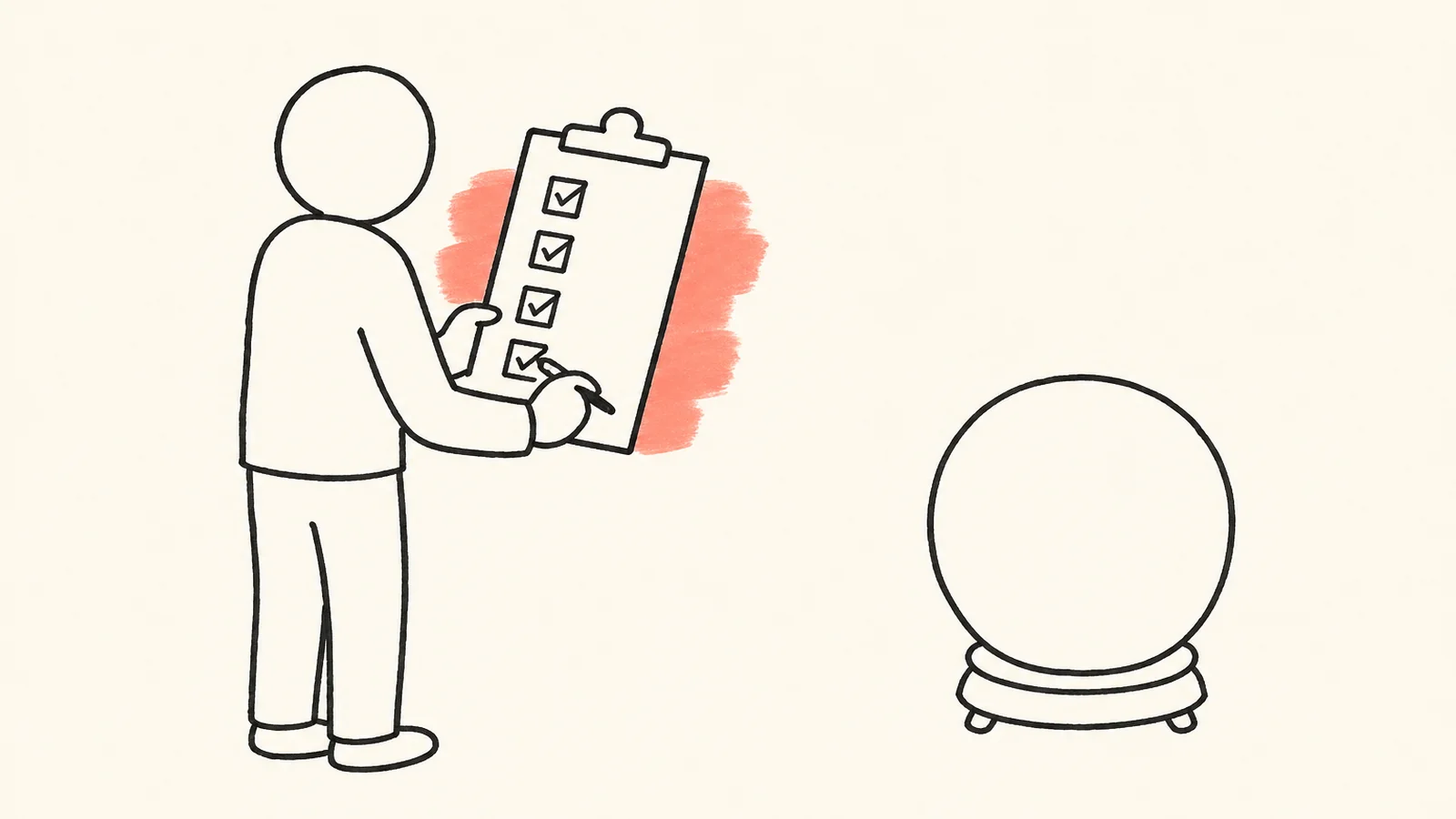
You cannot know in advance how a choice will turn out, so the answer to how to know if you are making the right decision is to check how it was made. The word right hides three questions: will it turn out well, is it well made, and will I feel settled about it. Only the second can be answered before you act. The settled feeling mostly follows commitment: in Jack Brehm's 1956 experiment, people rated an item higher after choosing it and the rejected one lower, and in 2002 Gilbert and Ebert found that people liked a final choice more than one they could reverse. A gut feeling shows what you want, yet Kahneman and Klein argued in 2009 that intuition forecasts well only where feedback has been frequent. Four written checks do the work: what the decision is for, why the other real option loses, what you are giving up, and what you would see, by a set date, that would mean it was wrong.
On this page+
The honest answer to how to know if you are making the right decision is that you cannot know how it will turn out, and the feeling of rightness mostly arrives after you commit. What you can know today is whether the decision was well made. Four written checks cover that, and they take ten minutes.
You have more or less decided. The offer is on the table, or the flat, or the conversation you plan to have on Sunday. What you want now is a sign: a quiet certainty, a friend saying "obviously", a morning when the doubt is gone. It has not come, so you keep the decision open a little longer.
Most advice on how to know if you are making the right decision hands you signs to look for, and nearly all of them are feelings. This piece sorts what "right" can mean, shows what research says about when the feeling turns up, and gives you something to check instead.
Can you know a decision is right in advance?
Partly. "Right" hides three different questions, and only one of them has an answer before you act. Asking them as one question is why no answer ever feels like enough.
The first question is whether it will turn out well. That depends on things you do not control and cannot see yet: the market, other people, luck. The second is whether the decision is well made: whether you know what you want from it, looked at a real alternative, counted the cost and know what would change your mind. That one you can check now, on paper. The third is whether you will feel settled about it. Most people wait for this one, and it is the one that tends to come last.
In sessions, the pattern we see most is someone asking the first question, wanting the third, and skipping the second because it looks like homework. The second is the only one that moves.
Why is a good decision not the same as a good outcome?
Because the outcome includes luck and the decision does not. A good decision can end badly and a careless one can pay off, and from the inside the two results look like verdicts on your judgment.
Jonathan Baron and John Hershey showed how strong this pull is in 19881. Across five studies, people read about decisions made under uncertainty, such as a medical choice or a gamble, and rated the thinking behind them. When the same decision happened to end well, they rated the thinking as better and the decision maker as more competent. Asked directly, they agreed that the outcome should not count. They counted it anyway.
So "it worked out" is weak proof of a good decision, and "it went badly" is weak proof of a wrong decision. If you are already looking back at one, we have written about telling a bad choice from a bad outcome and about the checkable facts of a poorly made decision. Before the choice, the useful point is narrower: the outcome is not available to check, so check what is.
Should the right decision feel right?
Not before you make it. The settled feeling people call "knowing" is largely produced by choosing, so waiting for it first puts the steps in the wrong order.
In 1956 Jack Brehm asked 225 students at the University of Minnesota to rate eight household items, including a toaster, a coffee-maker and a portable radio2. Each was then offered a choice between two of them to keep, and rated everything again. After choosing, they rated the item they had picked as more desirable and the one they had passed over as less desirable. The shift tended to be larger when the two items had started out close. Students who were simply handed an item, with no choice to make, showed no such shift.
Daniel Gilbert and Jane Ebert added a twist in 20023. Photography students chose one of two prints to keep. Some were told the choice was final; others could swap for several days. Those with the final choice ended up liking their print more. People asked to predict this did not see it coming, and most preferred to keep the option to change.
Put together: the closer the call, the more doubt you should expect beforehand, and the more your mind will do to settle it afterwards, provided you let the decision close. Doubt before a close call is information about how close it is. It is not evidence that you are choosing wrong. The same goes for anxiety around a decision, which tracks the stakes more than the quality of the choice.
The feeling that a decision is right is mostly something you get from having made it.
This also explains second-guessing in the first days after a big choice. The re-rating Brehm measured takes a little time, and it stalls if you keep reopening the question.
Can you trust your gut on a big decision?
Trust your gut for what you want, and be careful with it for what will happen. A gut feeling is real evidence about your own preferences. It is a poor forecaster in situations you have not been through many times.
Daniel Kahneman and Gary Klein spent years on opposite sides of the argument about intuition, and in 2009 they wrote down where they agreed4. Intuitive judgment can be trusted when two conditions hold: the environment is regular enough to be predictable, and the person has had real opportunity to learn those regularities. A firefighter reading a building or a nurse reading a patient meets both. Their warning for everyone else is blunt: "Subjective experience is not a reliable indicator of judgment accuracy." Feeling sure and being right are separate things.
Most life decisions fail the second condition. You change careers, move cities or end a long relationship a handful of times, with slow and noisy feedback. So when your gut says "this job will suit me", treat the wanting as data and the prediction as a guess. Write down which part is which. The wanting belongs in the first check below, and the prediction belongs in the fourth.
How to know if you are making the right decision before you commit
You can check four things, each as a question with a written answer. A decision that passes all four is well made, whatever happens next. One that fails any of them is not finished, however good it feels.
What is this decision for? One sentence on what you want it to get you. If you write two aims that pull apart, you have found the real question.
What is the other real option, and why does it lose? "Not doing it" counts. If you cannot say why the alternative loses, you have not compared, you have only preferred.
What are you giving up? Every choice costs the best thing about the option you drop. Name it in plain words.
What would tell you this was wrong, and by when? A specific thing you could observe, and a date to look.
Here is how it might go. Say you have been offered a move into management and you are leaning yes. The first sentence comes out as "more say over what the team builds". The second: staying a specialist loses because the projects you want are decided a level above you. The third takes longer: you are giving up most of the hands-on work, which is the part of the week you enjoy. The fourth: "wrong if, by June, I spend no time at all on the work itself and have stopped minding".
Nothing on that page says the move will go well. It does say the decision was made on purpose. That is as close to making the right choice as anyone gets in advance. If one of the lines refuses to come, that is usually the missing piece a stuck decision is waiting on.
This is the move Inwitt AI is built around. In Decision, one of the six thinking modes, the AI thinking partner app asks one question at a time and draws your answers onto a thinking board, so a line you skipped stays visibly empty. It does not tell you whether the choice is right. It keeps asking until you can see how the choice was made.
How do you know if you made the right decision afterwards?
Before the choice, how to know if you are making the right decision comes down to the four checks. Afterwards, you compare what happened with what you wrote, on the date you set. How do you know if you made the right decision without that page? Mostly you do not: you ask your current mood, and your mood answers with whatever happened this week.
The fourth check is what makes a later review possible. On the date, read the sentence again and ask two things. Did the thing you said would mean "wrong" show up? And did you know something on the day you chose that you ignored? If the answer to both is no, the decision stands, even if parts of it are hard. If the first is yes, you have a new decision to make with better information, which is different from having failed.
This is also the answer to the worry that committing means being trapped. A decision with a review date is closed for now and open on a schedule. That is enough closure for the settling Gilbert and Ebert measured, and enough of an exit to be honest.
What only feels like knowing?
Several habits feel like an answer to how to know if you are making the right decision while checking nothing. We see these most often:
Asking people until one agrees. Their "obviously" tells you about them. It becomes useful only when you ask what they think you are giving up.
Reading relief or excitement as proof. Relief often means the deciding is over, and excitement means the option is new. Neither forecasts the outcome.
Rewriting the pros and cons list. Timothy Wilson and Jonathan Schooler found in 1991 that students who analyzed their reasons for liking different jams ended up agreeing less with expert ratings than students who did not5. Listing reasons can pull you toward whatever is easy to put into words.
Keeping the door open to feel safe. The photography students who could swap their print liked it less.
Questions people ask about making the right decision
Is there such a thing as the right decision?
For most real choices, no single right one exists in advance. There are well made and poorly made decisions, and outcomes that luck then sorts. Two people can make opposite choices in the same spot and both be choosing well, because they want different things from it.
Why do I doubt a decision right after making it?
Because the option you gave up still has its good points, and they are most vivid in the first days. Brehm's study suggests the mind then adjusts, raising the chosen option and lowering the other. Reopening the choice each evening interrupts that. A review date gives the doubt somewhere to go.
Does feeling anxious mean it is the wrong decision?
No. Anxiety rises with the stakes and with uncertainty, and a good decision can have plenty of both. It becomes a signal only when you can attach it to something specific, such as a regret you can already picture. Then it belongs in the third or fourth check.
What if both options look equally right?
Then the cost of choosing either is small compared with the cost of not choosing, and no further analysis will separate them. Run the four checks on each. If both pass, pick, set the review date and let the decision close.
The four sentences take ten minutes with a pen, and they go further when something keeps asking after the first easy answer. That is what a session does: one question at a time, your answers on the board, and at the end a session receipt with the decision and your tripwire in your own words. If you came here asking how to know if you are making the right decision about something specific, join the Inwitt waitlist and bring it with you.
Footnotes
Jonathan Baron and John C. Hershey, "Outcome bias in decision evaluation", Journal of Personality and Social Psychology 54(4), 569-579 (1988). Journal record↩
Jack W. Brehm, "Postdecision changes in the desirability of alternatives", Journal of Abnormal and Social Psychology 52(3), 384-389 (1956). Journal record↩
Daniel T. Gilbert and Jane E. J. Ebert, "Decisions and revisions: the affective forecasting of changeable outcomes", Journal of Personality and Social Psychology 82(4), 503-514 (2002). Journal record↩
Daniel Kahneman and Gary Klein, "Conditions for intuitive expertise: a failure to disagree", American Psychologist 64(6), 515-526 (2009). Journal record↩
Timothy D. Wilson and Jonathan W. Schooler, "Thinking too much: introspection can reduce the quality of preferences and decisions", Journal of Personality and Social Psychology 60(2), 181-192 (1991). Journal record↩