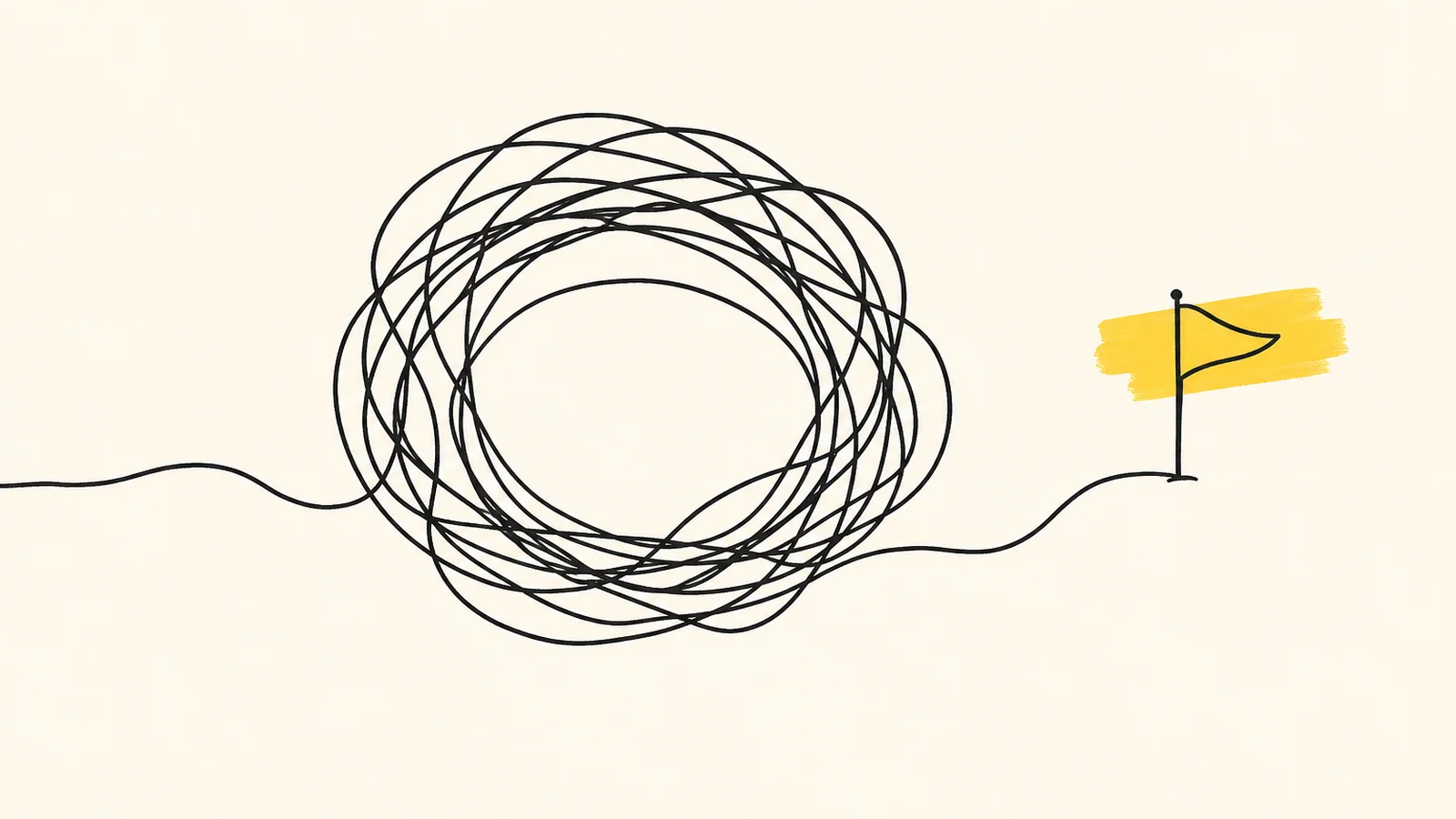
Overthinkers are people who keep returning to the same worry, decision or conversation after the thinking has stopped producing anything new. The mark is repetition, not the amount of thought, and it is a habit rather than a diagnosis. A 2015 study of 126 students by Alexander Penney and colleagues found small links between verbal ability and both worry and rumination, which suggests verbally able people build more detailed and more persuasive loops, not more accurate ones. The label also carries two beliefs about thinking itself, both measured in Adrian Wells's metacognitive research: that looping helps, and that it cannot be stopped. In a 2014 diary study, people with stronger positive beliefs about rumination ruminated more. The cost is a missing finish line: in 2003 experiments, people with a ruminative style felt less confident in their own plans and were less likely to commit to them. The way out is to write the repeated question down, then write what answer would end it.
On this page+
Overthinkers are people who keep thinking about the same worry, decision or conversation after the thinking has stopped producing anything new. The amount of thinking is not what marks them. Repetition is: the same question asked again in the same words, with no answer in view that would let it close.
You have probably used the word about yourself, maybe as an apology, maybe with a little pride. "I'm an overthinker" explains the late nights and the three drafts of a text you never sent, and it also sounds faintly like a compliment: careful, and a bit too clever for your own good. What follows tests what that sentence claims, part by part, and names the one thing overthinkers tend to run short of.
What is an overthinker?
An overthinker is someone whose thinking about a problem keeps going after it has stopped moving. The overthinker meaning most people reach for is "someone who thinks too much", but volume is the wrong measure. A researcher can spend a year on one question without overthinking it, because the question changes shape every week. The overthinker's question does not. It comes back in the same words, often at the same hour of the night, and leaves where it started.
Psychologists split the loop by direction. Worry runs forward ("what if the interview goes badly?"), and rumination runs back ("why did I say that in the meeting?"). Most people who call themselves overthinkers do both.
It is not a diagnosis. Overthinking can travel with anxiety or low mood, and when it does it deserves a professional's attention, but on its own it is a habit of thought rather than a disorder. The same goes for the overthinker personality. There is no fixed type, only a habit plus a set of beliefs about the habit, and the beliefs turn out to matter more than most lists admit.
What are the signs of an overthinker?
The useful signs of an overthinker are facts about the loop, not adjectives about the person. "Sensitive" and "perfectionist" describe plenty of people who sleep fine. These six can be checked against any current worry:
The question has not changed in days. You could write it down today in the words you would have used last Sunday.
You cannot say what answer would end it. Asked what would let you stop, you have nothing, or a list of things that would each lead to another question.
You replay conversations that are over. Or rehearse ones that have not happened yet, in several versions.
You collect opinions and keep your plan. Three friends have weighed in, and the plan you had before asking is the plan you have now, only less certain.
You finish thinking less sure than you started. An hour on the problem leaves you with more doubts, not fewer.
Stopping feels careless. The thinking feels like work you owe the problem, so setting it down feels like a lapse.
The last two signs matter most, because they point at what keeps the loop running. One is a cost and the other is a belief, and both have research behind them.
Are overthinkers smarter?
A little, in one narrow way, and the narrow way explains more than the headline. In a 2015 study, Alexander Penney, Victoria Miedema and Dwight Mazmanian gave 126 university students verbal and non-verbal intelligence tests, along with standard questionnaires on worry and rumination1. After accounting for current mood and test anxiety, verbal ability went with more worry (a partial correlation of .21) and more rumination (.24). Non-verbal reasoning, measured with a pattern-completion test, went slightly the other way for one kind of looping: replaying past social encounters (-.20).
Those are small correlations from a single sample, mostly young women, with few participants over 30, and the authors call their results preliminary. They do not show that overthinkers are smarter in general, or that overthinking makes anyone sharper. The authors' own explanation is more useful than the "are overthinkers smart" headlines it produced: verbally able people can consider past and future events in great detail, and the detail feeds the worry.
If you are good with words, you are good at building a convincing case, including the case for why this worry deserves one more pass. The ability does not make the loop more accurate. It makes it more persuasive. So when the evidence partly confirms the flattering half of the label, what it confirms is the quality of the arguments you can make to yourself, not the quality of the conclusions they reach.
Why does the overthinker label stick?
Because it carries two beliefs about thinking itself, and each one keeps the loop going. The psychologist Adrian Wells built a model of worry around beliefs like these, which he calls metacognitive: not thoughts about the problem, but thoughts about your own thinking. His short questionnaire, the MCQ-30, published with Sam Cartwright-Hatton in 2004, measures five kinds, and people who hold more of them tend to worry more2. Two of the five read like a description of the label.
The first is a positive belief about worry: this is how I prepare, how I catch problems, how I stay careful. The second is a negative belief about control: I cannot switch it off, and it might do me harm. Together they make a strange pair. One says the loop is useful, the other says it is not yours to stop, and between them nothing is left for you to decide.
The positive belief is the one people defend. In a study published in 2014, Thomas Kubiak and colleagues gave 93 adults electronic diaries that prompted them four times a day for four weeks3. Those who held stronger positive beliefs about rumination ruminated more in daily life, and that rumination, set off by bad moments, went with less positive mood. The belief that looping helps came packaged with more looping.
In sessions we often hear both beliefs from the same person, a few minutes apart: "I just need to think it through properly", and then, "but I can't turn it off." Each one can be tested, which is more than the label allows.
Belief
What it sounds like
What it gets right
What it leaves out
The question that tests it
Thinking it over helps
"This is how I stay careful"
Some reflection does catch problems
Repeating a question is not reflecting on it
What did the last hour add that I did not have before?
I can't stop it
"My brain won't switch off"
Thoughts do arrive on their own
What you do with a thought is still yours
What would I do right now if this question were settled?
What do overthinkers run short of?
Not ideas: a finish line. In a pair of studies published in 2003, Andrew Ward, Sonja Lyubomirsky, Lorie Sousa and Susan Nolen-Hoeksema asked people to draw up a plan of their own: in one study, a plan to revise a university housing system, and in the other, a plan to redesign an undergraduate curriculum4. Everyone produced a plan. The differences the researchers reported came afterward. People with a ruminative style were less satisfied with their plans, less confident in them, and less likely to commit to them.
The authors' explanation was uncertainty. Turning a problem over and over raises doubt about whatever answer you reach, the doubt calls for more turning, and the plan stays on the desk. That matches the fifth sign above, and it explains why so many overthinkers have a plan that never quite begins.
So the shortage is rarely intelligence or effort. It is knowing, before you start, what would count as done. Without that, every pass ends in "not yet", because nothing was ever going to count as enough. Decision researchers call this a stopping rule, and the point of a stopping rule agreed before the analysis starts is that you set it before the loop starts, not halfway round it.
Overthinkers are rarely short of ideas. They are short of a finish line.
How do you stop being an overthinker?
One loop at a time, by giving each loop the finish line it is missing rather than trying to think less. Three moves do most of the work, and they take a pen and a few minutes.
Write the question exactly. Not the topic ("work") but the sentence your mind keeps repeating ("Did my manager mean that as a warning?"). A loop written down in its own words is easier to see than one that circles as a feeling.
Write what answer would end it. If you can write one, you now know what to find out, or whom to ask. If you cannot, the loop is not missing information. It is missing a criterion, and no amount of thinking will supply one you have not chosen.
Test the belief that it is helping. Ask whether the last hour changed your plan. If it did not, the thinking has stopped working, however busy it feels, and you can set the question down until something new arrives.
For worries that come back every night, postponing the loop to a set time has trials behind it, and it pairs well with these moves: postpone first, then use the time to write the question and its ending.
The second line is the hard one to answer alone, because the loop is good at producing reasons to keep going. This is the move Inwitt AI is built around. The AI thinking partner app asks one question at a time, starting with the one you keep asking yourself, and draws your answers on a thinking board, so the question stays the same size on the page instead of growing in your head. It does not hand you an answer. It keeps asking until you can say what would end the loop.
What only feels like it helps
Most advice on how to stop being an overthinker is aimed at the noise, not the loop. Four common moves bring relief for an evening and leave the question where it was.
Taking the label as a personality. "I'm just an overthinker" turns a habit into a fact about you, and facts about you do not need fixing. It also keeps the flattering belief in place. The habit is easier to change once it is a set of loops you can name rather than who you are.
Trying not to think about it. Telling yourself to stop is natural and one of the weakest moves, because pushing a thought away tends to bring it back, especially under stress. Give the thought a finish line instead of a door to leave by.
Asking for reassurance. A friend saying it is fine lands for an hour. Then the question returns, now with a new detail to examine: how they said it. Reassurance answers the feeling, and the question underneath stays open.
One more round of research. Reading another article feels like progress, but if you cannot say what result would change your plan, the article cannot either. It is the same trap as waiting on facts that would not change the choice.
Questions people ask about overthinkers
Is being an overthinker a mental illness?
No. Overthinking is not a diagnosis, though it often shows up alongside anxiety and depression. If the loops are eating into your sleep, work or mood for weeks at a time, talk to a doctor or therapist. For everyday worry, making the worry specific, then splitting it is a good place to start.
What causes someone to be an overthinker?
Research has not found a single cause. Stress, high stakes and an anxious temperament all make loops more likely, and verbal ability may add detail to them. The part most within your reach is the belief that looping helps: in the diary study above, people who held it more strongly looped more.
What do overthinkers need in a relationship?
Usually less reassurance than they ask for, and more help naming the actual question. A partner who asks "what would settle this for you?" often does more than one who keeps saying it is fine. If the loop is about the relationship itself, sorting each doubt by who could answer it tends to end it faster.
What is the opposite of an overthinker?
Not someone who thinks less, but someone who knows when a question is closed. Closing it too early has its own cost, and deciding on a passing mood is the usual version of it. The aim is a finish line in the right place, not an end to thinking.
The two lines in the exercise take a few minutes on paper, and they work better when something keeps asking after the first easy answer. That is what a session does: it asks, you answer, and the question you kept circling ends up written down next to what would close it, in your own words. If one question has been going round for weeks, join the Inwitt waitlist and start with that one.
Footnotes
Alexander M. Penney, Victoria C. Miedema and Dwight Mazmanian, "Intelligence and emotional disorders: Is the worrying and ruminating mind a more intelligent mind?", Personality and Individual Differences 74, 90-93 (2015). Journal record↩
Adrian Wells and Sam Cartwright-Hatton, "A short form of the metacognitions questionnaire: properties of the MCQ-30", Behaviour Research and Therapy 42(4), 385-396 (2004). PubMed record↩
Thomas Kubiak, Daniela Zahn, Kerstin Siewert, Cornelia Jonas and Hannelore Weber, "Positive beliefs about rumination are associated with ruminative thinking and affect in daily life: evidence for a metacognitive view on depression", Behavioural and Cognitive Psychotherapy 42(5), 568-576 (2014). Journal record↩
Andrew Ward, Sonja Lyubomirsky, Lorie Sousa and Susan Nolen-Hoeksema, "Can't quite commit: Rumination and uncertainty", Personality and Social Psychology Bulletin 29(1), 96-107 (2003). Journal record↩