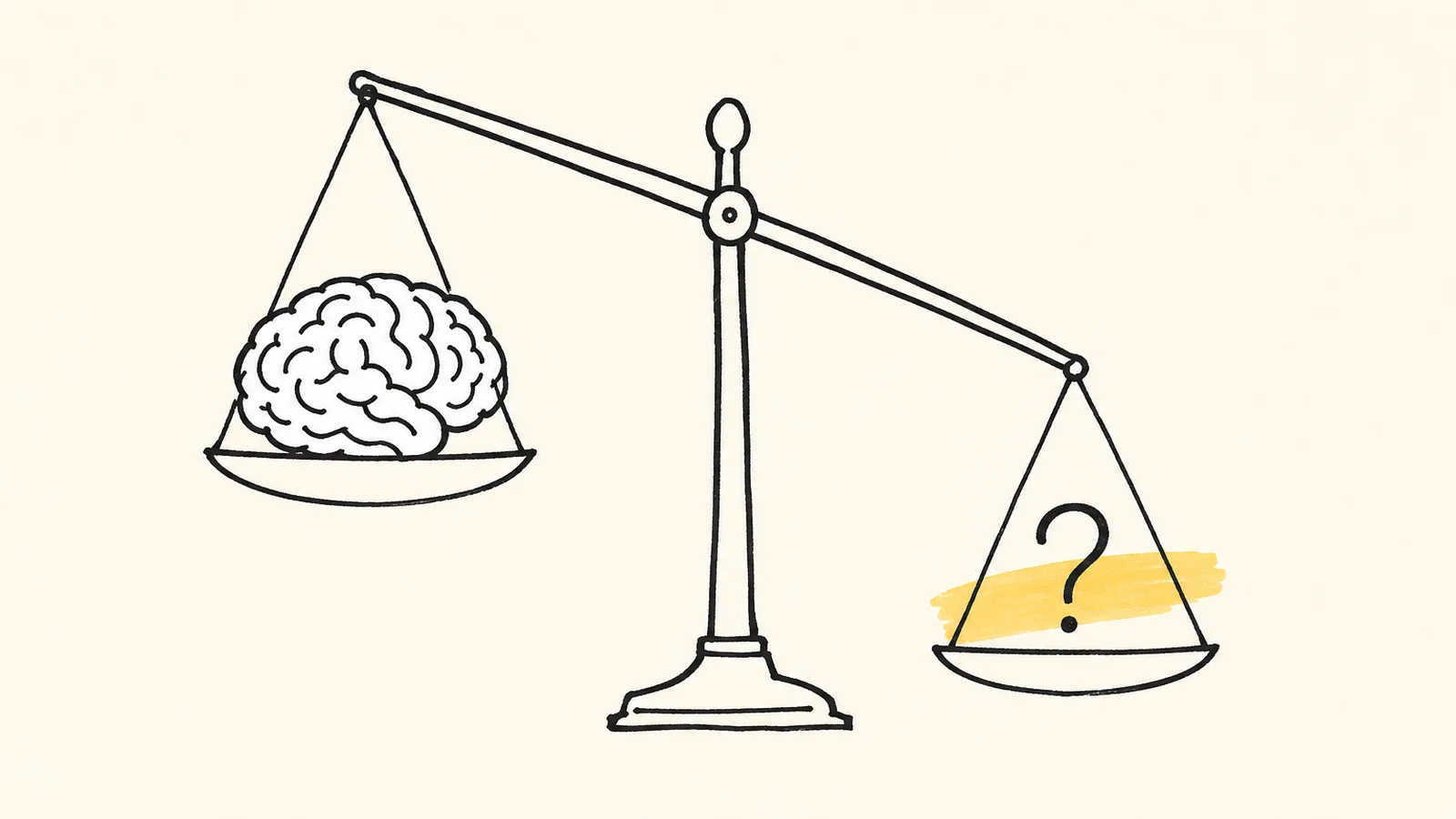
Why is critical thinking important? Because most decisions that shape a life have nobody checking the answer. Critical thinking is the habit of testing a claim or a choice before acting on it, and it is not the same as intelligence. In a 2007 study of 360 adults, Bruine de Bruin, Parker and Fischhoff found decision-making skill explained about 16% of the variation in bad real-life outcomes, such as foreclosure, divorce or a night in jail, while cognitive ability explained about 4%. Being clever can even cut the other way: in Kahan's 2017 experiment, the most numerate people read data best on a neutral topic and became more polarized when the same data touched politics, and West and colleagues found smarter people no less blind to their own biases. Critical thinking matters most where you want a particular answer, so the useful practice is to test the option you are hoping for, not only the one you fear.
On this page+
Why is critical thinking important? Because most decisions that shape your life have nobody checking your answer. Critical thinking is the habit of testing a claim or a choice before you act on it. Research suggests it predicts real-life mistakes better than intelligence does, because intelligence on its own mostly makes you better at defending what you already think.
You may be here for an essay, a job application, or because someone at work keeps using the phrase and you want to know whether it means anything. Most pages answer with the same list: careers, problem solving, democracy. The list is fine. It skips the version of "why is critical thinking important" that a sensible reader actually brings: why would a reasonably smart person need it at all? That question has a better answer than the list, and three studies behind it.
Why is critical thinking important?
Critical thinking is important because it is the only check on your reasoning in the places where nobody else checks it. The reasons most guides give are real, and they are worth having in one place:
Decisions: choosing between options on what is true, not on what feels comfortable.
Information: telling a supported claim from a confident one, in news, ads and group chats.
Problem solving: finding the cause of a problem instead of treating the first symptom you notice.
Work: nearly every job pays for judgment that cannot be scripted in advance.
Civic life: voting, juries and public arguments all assume people can weigh evidence.
Read the list again and one feature runs through every item. In each case, the check is up to you. At school there is a marker, and we have written about what the classroom version is for. At work there is sometimes a reviewer. Your choice of partner, your reaction to a frightening headline, the job you take or quit: none of these comes back with a grade. The importance of critical thinking lives mostly in those unmarked places, where a wrong answer still costs you and nobody points it out until much later, if at all.
Being clever does not settle "why is critical thinking important?" either, and that is the part the benefit lists leave out.
Why are critical thinking skills important if you are already smart?
Critical thinking skills are important even for smart people because intelligence and good judgment turn out to be different things, and the gap shows up in ordinary life. In 2007, Wändi Bruine de Bruin, Andrew Parker and Baruch Fischhoff tested 360 adults in the Pittsburgh area, aged 18 to 88, on seven decision tasks, such as resisting how a choice is framed and applying a decision rule consistently.1 They also asked about 41 bad outcomes: food thrown out because it went bad, a loan foreclosed, a divorce, a night in a jail cell, money lent and never returned. People who scored better on the decision tasks reported fewer of those outcomes.
The decision score explained about 16% of the differences in bad outcomes; cognitive ability explained about 4%. After intelligence was accounted for, decision skill still explained 12%. The study is correlational and the outcomes are self-reported, so it does not prove cause. It does show that being bright and choosing well are not the same measurement.
Intelligence can even point the wrong way. Dan Kahan and colleagues gave people a table of results and asked what it showed, a problem that takes real numeracy.2 When the table was about a skin-rash cream, the most numerate people did "substantially better" than everyone else. When the same numbers were about a gun-control ban, answers split along political lines, and the split "did not abate among subjects highest in numeracy; instead, it increased." Skill with numbers became skill at reaching the preferred answer.
Smart people also do not see this in themselves. Richard West, Russell Meserve and Keith Stanovich found in 2012 that people rate others as more biased than themselves, and that higher cognitive ability did not shrink this bias blind spot. If anything, it went with a slightly larger one.3
What intelligence supplies
What critical thinking adds
Speed
Reaches a conclusion fast
Asks whether it was the right question
Arguments
Builds a strong case
Builds the case against, too
Numbers
Reads data accurately
Reads it the same way when the answer is unwelcome
Where does critical thinking matter most in everyday life?
The importance of critical thinking in everyday life is greatest where you have a stake in the answer. Three places come up again and again.
The first is your own decisions. A choice you will live with is the one you most want to feel settled about, so the pull is to stop thinking the moment it feels settled. The second is a claim you would like to be true: the study that backs your diet, the review that confirms the purchase you already made, the rumor about a rival. These pass inspection because nobody inspects them. The third is advice from people you trust. Trust is a good reason to listen and a poor reason to stop checking.
We have watched the same pattern in sessions many times. When someone is torn between two options, they interrogate the one they fear in great detail: what could go wrong, what it costs, who will judge them. The option they are hoping for gets waved through with a sentence. The thinking is real; it is just pointed at one side. Many of the signs of poor decision making are traces of this, a check run hard on the side you feared and skipped on the side you wanted.
Intelligence argues for whatever you already want. Critical thinking is the part that checks.
None of this needs a special talent. It needs one question, asked at the moment you would rather not ask it.
What are the advantages of critical thinking, by the evidence?
The advantages of critical thinking that research supports are narrower and more interesting than the usual lists. Here is how the common claims hold up against the sources in this piece:
Claimed benefit
What the evidence here shows
Verdict
Better life decisions
Decision skill tracked fewer bad real-world outcomes, beyond intelligence (Bruine de Bruin, 2007)
Supported, correlational
Smart people are protected
More numerate people polarized more on a charged topic (Kahan, 2017); higher ability did not shrink the bias blind spot (West, 2012)
Not supported
Resisting misinformation
Plausible, and the Kahan result shows the risk is sharpest on topics you care about
Partly supported
Career success, happiness
Widely claimed; the top-ranking pages on this question cite no study for either
Unproven here
So the benefits of critical thinking are real but specific. It helps most with the errors intelligence does not catch, and only when it is used, not when it has merely been heard of. Nobody can honestly promise you better grades, a better job or a happier life from it. What the evidence does support is fewer avoidable mistakes in the decisions that are actually yours.
Why does critical thinking matter more when answers are instant?
Critical thinking matters more when answers are instant because an answer that arrives first leaves you nothing to check it against. A question used to sit with you for a while: you guessed, looked something up, argued with a friend. By the time you found an answer, you had a view of your own to compare it with. An AI assistant that answers in two seconds skips that stage. The answer can be good. The trouble is that you now hold a conclusion you did not build, with no earlier view to set beside it.
This is the newest answer to "why is critical thinking important?", and the plainest. We looked at what the research says in AI and critical thinking, and the variable that kept coming up was simple: who does the reasoning.
That makes the order of use matter more than the amount. Write your own answer first, even a rough one, and the AI's version becomes something to test. Ask first and it becomes something to accept. The second habit is what over reliance on AI looks like day to day: not using it often, but agreeing with it by default.
How do you practice critical thinking on a decision you care about?
You practice it by turning the check on the option you are hoping for, on paper, before you commit. Reading about thinking changes little; using it on a real decision is the version that sticks, which is also what the research behind how to improve critical thinking keeps finding.
Most people find the hoped-for option rests on one claim they have never tested. That is not a failure. It is the useful part, and it is the step that disappears when someone else hands you the answer.
This is the job we built Inwitt AI to do. It is an AI thinking partner app that asks instead of answering: one question at a time, aimed at the claim you skipped, while the answers you confirm go up on a thinking board where you can see them. Its Critical mode keeps coming back to the sentence you treated as settled. It never tells you which option to pick. The decision stays yours, and so does the reasoning behind it.
Common mistakes: what passes for critical thinking
Several habits look like critical thinking and do none of its work. They are worth naming, because each one lets you feel you have the skill without ever using it.
Doubting everything. Cynicism is cheap. Rejecting every claim takes no more thought than accepting every claim, and both skip the weighing.
Criticizing only the arguments you dislike. This is the Kahan result in daily form. Sharp scrutiny aimed at one side is advocacy with extra steps. The test is whether you run the same check on the conclusion you want.
Learning the names of biases. Knowing what confirmation bias is does not stop it. West and colleagues found that people without the blind spot were not, as a result, any freer of the biases themselves.
Gathering more information instead of testing one assumption. Another article or another opinion feels like progress. Usually the decision turns on one claim, and more reading is a way of not looking at it.
Treating it as a trait. People talk about critical thinkers as if they were a type. The attributes of a critical thinker that matter most, like open-mindedness, are the ones that fail on beliefs you care about. Critical thinking is something you do in a given moment, or skip.
Questions people ask about why critical thinking matters
What is the significance of critical thinking?
Its significance is that it lets you correct your own reasoning before the world does it for you. A mistake caught on paper costs a few minutes. The same mistake caught after a lease is signed or a job is quit costs far more.
Why is critical thinking important at work?
Most work that pays well involves judgment that cannot be fully scripted: which problem to fix first, which number to trust, which complaint is real. Critical thinking is the habit of checking those calls instead of defending them, and it matters most when you are the one who made the call.
Is critical thinking the same as intelligence?
No. Intelligence is how well you can reason; critical thinking is whether you check your reasoning, especially when you like the conclusion. In the 2007 Pittsburgh study, decision skill explained about four times as much of people's real-life mistakes as cognitive ability did.
Can you be too critical?
Yes, if critical means rejecting things. Endless doubt is a way of never deciding. Critical thinking ends in a judgment you are willing to act on and revisit, not in permanent suspicion.
If you came here asking "why is critical thinking important?", the exercise above is the short answer in practice: name the option you want, find the claim under it, and ask how you know. A session does the same at the length a real decision needs, one question at a time, until your reasoning is on the board in your own words and you can decide what you think of it. If you want to try it on something you are deciding now, join the Inwitt waitlist.
Footnotes
Wändi Bruine de Bruin, Andrew M. Parker and Baruch Fischhoff, "Individual differences in adult decision-making competence", Journal of Personality and Social Psychology 92(5), 938-956 (2007). Journal record↩
Dan M. Kahan, Ellen Peters, Erica Cantrell Dawson and Paul Slovic, "Motivated numeracy and enlightened self-government", Behavioural Public Policy 1(1), 54-86 (2017). Journal record↩
Richard F. West, Russell J. Meserve and Keith E. Stanovich, "Cognitive sophistication does not attenuate the bias blind spot", Journal of Personality and Social Psychology 103(3), 506-519 (2012). PubMed record↩