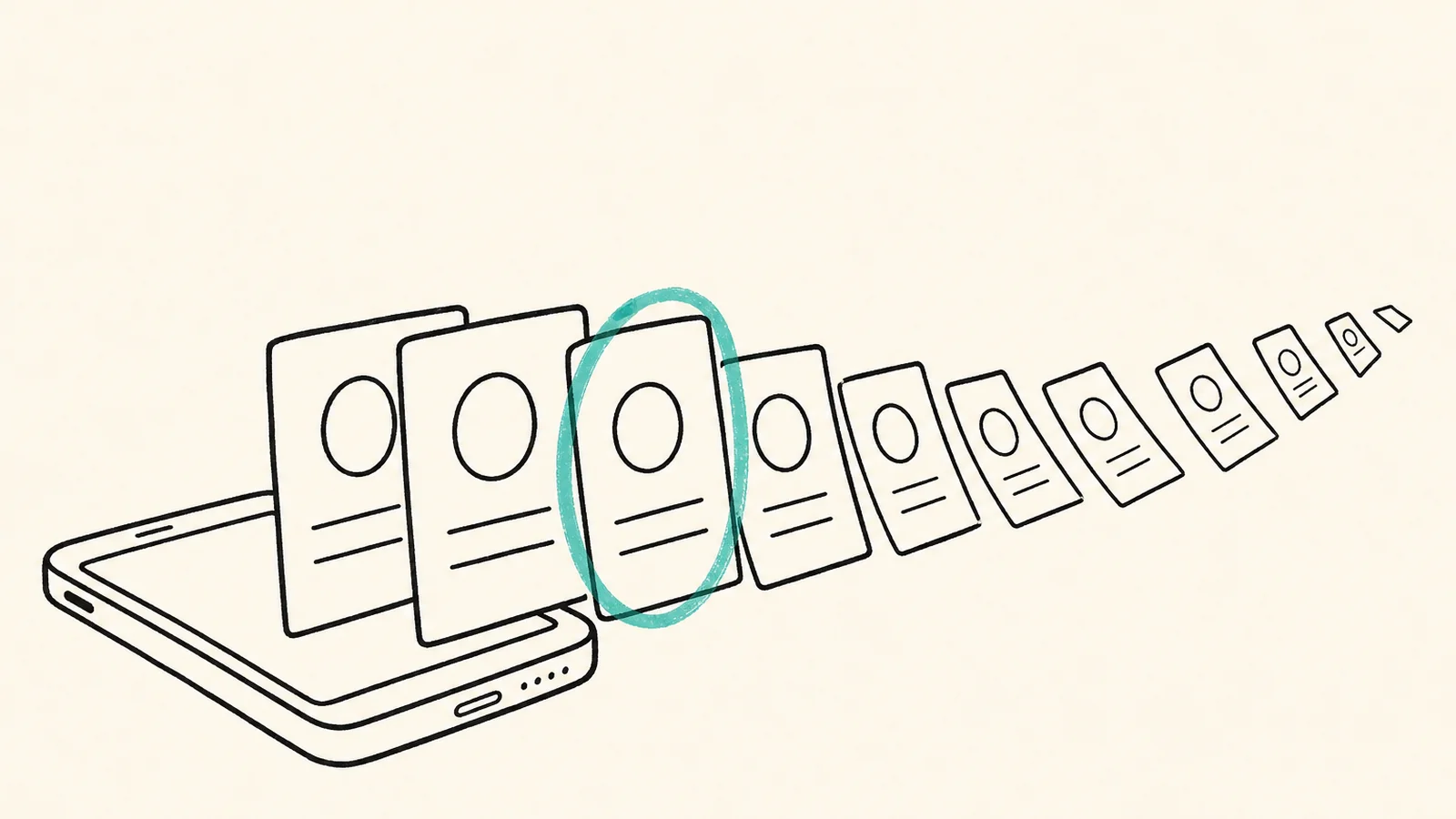
Dating app decision fatigue is the drained, picky feeling that builds during a stretch of swiping, when every profile seems slightly wrong and replies feel like work. It comes less from total time than from how a session runs. In three studies published in 2020, people became steadily more rejecting as they went through profiles: the chance of accepting someone fell by 27% on average from the first option to the last, driven by falling satisfaction with the pictures and rising pessimism about their own chances. Open chats add to it, because a choice you can still reverse tends to be liked less, and an endless pool trains you to compare every match with an imagined better one. What helps: cap the number of profiles per sitting rather than the minutes, write three things you are looking for in a form a profile can be checked against, and close conversations you are not pursuing.
On this page+
Dating app decision fatigue is the flat, drained, oddly picky feeling that sets in after a stretch of swiping, when every profile seems slightly wrong and replying to a match feels like admin. It comes less from the hours you spend than from the order you see people in: each profile gets judged a little harder than the last.
You open the app meaning to give it ten minutes. Forty minutes later you have swiped left on almost everyone, you have three conversations you are not answering, and the one person you liked last week now seems less interesting than they did. You close the app feeling worse about the pool and slightly worse about yourself. This piece looks at what is happening inside a session like that, and what changes it more than a time limit does.
What is dating app decision fatigue?
Dating app decision fatigue is the tiredness and pickiness that build up when you choose between people over and over, quickly, with no end to the supply. It shows up as swiping on autopilot, rejecting by default, leaving matches unanswered, and a sense of dread before opening the app. Many people call the same thing dating app fatigue or dating app burnout, and the signs overlap: the app starts to feel like a second job you are bad at.
It helps to be honest about the label. The popular idea of decision fatigue says every choice drains a fixed tank of willpower, so later choices are worse. That idea has struggled in large replication tests, and we went through in another piece. The tiredness is real. The tank is the doubtful part.
For dating apps there is a better explanation, and it comes from a study that watched what people did across a single session of swiping. It points less at willpower and more at three things you can change: how many profiles you see in one sitting, how many conversations you keep open, and what you are comparing each person against.
Why do you reject more profiles the longer you swipe?
You reject more as you go because each profile is judged by a slightly gloomier, harder-to-please version of you than the one before. Psychologists Tila Pronk and Jaap Denissen named this a rejection mindset. In three studies published in 2020, people saw a series of potential partners in a swiping format and accepted or rejected each one. The chance of saying yes dropped by 27% on average from the first profile to the last1.
The drop had two causes they could measure. People grew less satisfied with the pictures as the session went on, and they grew more pessimistic about their own chances of being accepted. Both fed the habit of rejecting. For women, the researchers also found the rejection mindset led to fewer matches. Their summary was that people gradually "close off" from options while dating online.
The study has limits worth knowing. The participants were single heterosexual adults aged 18 to 30, and much of the work used photos in a lab task rather than a full app with messages and bios. It shows that judgment shifts within a session; it does not show how long that shift lasts after you put the phone down.
The fortieth profile is not worse than the first. You are harder on it.
That turns the usual advice around. A 30-minute cap does little if those 30 minutes still hold 200 profiles. The unit that matters is how many people you judge in one sitting.
Does having more matches make it harder to choose?
Yes, and not only because comparing is tiring. Choice overload is the name for the pattern where more options leave people less satisfied with the one they pick, and a dating app is close to the extreme version: the pool never ends, and the next option is always one swipe away. We wrote about why knowing what you want before you look matters more than shrinking the list in general. On an app, the open-endedness does a second kind of damage.
In 2002, Daniel Gilbert and Jane Ebert ran a study with photography students. Each student printed two photos and kept one. Some were told they could swap it later; others were told the choice was final. The students who could still swap liked their photo less than the students who could not, and yet most people said they would rather have the option to swap2.
Online dating is that experiment running on your phone all day. A match you are chatting with is a choice you can reverse at any moment, and the app reminds you of it with every new notification. Keeping six conversations alive "to see where they go" feels like keeping options open. In practice it keeps every one of them on trial, which makes each person easier to find fault with. We looked at why some choices lock and others do not elsewhere; dating apps are built to make every choice feel temporary.
How do you stop dating app decision fatigue?
To stop dating app decision fatigue, cap the number of profiles per sitting rather than the minutes, write down what you are looking for before you open the app, and close conversations you are not pursuing instead of letting them drift. Each move targets one of the causes above: the order effect, the missing yardstick, and the open choices.
The second move does the most work, and most advice skips it. "Swipe with intention" only helps if the intention is written in a form a profile can actually be checked against. "Ambitious" cannot be checked in a photo. "Makes plans and keeps them" can be checked by the third message. Three items like that give you a reason to say yes, so you are not choosing purely by what is wrong.
What the app makes easy
What helps you decide
Judging dozens of people in one sitting
Ten profiles, then stop
Comparing each person to the next one
Comparing each person to your three written things
Keeping every match open
Closing chats you would not meet in person
Swiping when bored or low
Opening the app at a set time, in a decent mood
Deciding on a photo
Deciding on a first plan to meet
Two habits make the rest stick. Open the app earlier in the day, not last thing in bed, when tiredness and pessimism are already doing the judging. And give each conversation a simple stopping rule: if a plan to meet has not come up by a certain point, you close it kindly and move on.
That last line is the important one. It separates what you know about a person from what you filled in. It is also the kind of question a thinking session asks: one question at a time, your answers drawn onto the thinking board so you can see where the evidence ends and the hoping begins. Inwitt does not tell you who to date. It asks what you are looking for until your own answer is specific enough to use.
Is anyone ever good enough on a dating app?
Someone can be good enough, but only against a standard you set. Against the endless supply on the app, nobody is. Psychologists split decision makers into maximizers, who try to find the best possible option, and satisficers, who stop at the first option that clears their bar. In 2002, Barry Schwartz and colleagues found that people who lean toward maximizing report more regret, less satisfaction with what they choose, and more comparison with other people3.
A dating app trains maximizing by design. There is always another profile, and the pool feels bottomless, so a good match is quietly compared with an imagined better one. The person in front of you is real, with a slightly awkward first message. The imagined one has no flaws because they do not exist yet.
Satisficing in dating does not mean lowering your standards. It means writing them down, so "good enough" has a definition that does not move each time you open the app. If you notice you are afraid of picking someone and later finding a better match, that fear has its own structure, and anticipated regret has a part you can control. The part you can control is how you chose, not what the next profile would have been.
What only feels like it helps?
Some fixes feel productive and leave the causes in place.
Deleting and reinstalling. A break helps. Coming back to the same habits after a break brings the same fatigue, usually within a week.
Widening the filters. More distance and a wider age range add profiles. If the problem is how you judge them, more of them makes it worse.
Swiping in bed to save time. It saves time and hands the judging to your most tired, least generous self.
Keeping every chat open just in case. Open chats feel like options. They work like unfinished decisions, and each one makes the others harder to commit to.
Rewriting your own profile every week. Sometimes it needs work. Often it is a way to keep busy without deciding anything about the people already in your matches.
The pattern behind all of them is activity that never closes anything. A good session ends with fewer open questions than it started with.
Questions people ask about dating app fatigue
Is dating app burnout real?
Yes, in the sense that the drained, cynical feeling is common and has measurable causes. The research on swiping shows people become more rejecting and more pessimistic within a single session. Whether that counts as "burnout" in the clinical sense is a different question; most people use the word loosely, and that is fine.
How long should a break from dating apps be?
There is no tested number. A useful break is long enough that opening the app no longer feels like a chore, often a few weeks. What matters more is what you change before coming back: a profile limit, a set time, and your three written things.
Why do I lose interest right after matching?
Often because the match is now a choice you could reverse, and the app keeps showing alternatives. A match also carries more uncertainty than a profile: you are now waiting on someone else. Moving to a concrete plan, or closing the chat, settles both. If the doubts keep looping after a date, how to stop overthinking in a relationship covers that stage.
Should I delete dating apps altogether?
Only you can weigh that, and it helps to ask what the apps are for in your life right now. Some people find most of their dates there; others mostly scroll. A few questions to ask yourself before deciding usually make the answer clearer than one more week of mixed feelings.
Dating app decision fatigue eases when each session has an end and each profile has something to be checked against. That is the habit Inwitt AI is built around: an AI thinking partner app that asks you one question at a time and keeps your answers on a board, so what you want stays in your words and stays put from one session to the next. If you want somewhere to work out what you are looking for before the next swipe, join the Inwitt waitlist.
Footnotes
Tila M. Pronk and Jaap J. A. Denissen, "A rejection mind-set: choice overload in online dating", Social Psychological and Personality Science 11(3), 388-396 (2020). Abstract↩
Daniel T. Gilbert and Jane E. J. Ebert, "Decisions and revisions: the affective forecasting of changeable outcomes", Journal of Personality and Social Psychology 82(4), 503-514 (2002). Journal record↩
Barry Schwartz, Andrew Ward and colleagues, "Maximizing versus satisficing: happiness is a matter of choice", Journal of Personality and Social Psychology 83(5), 1178-1197 (2002). Abstract↩