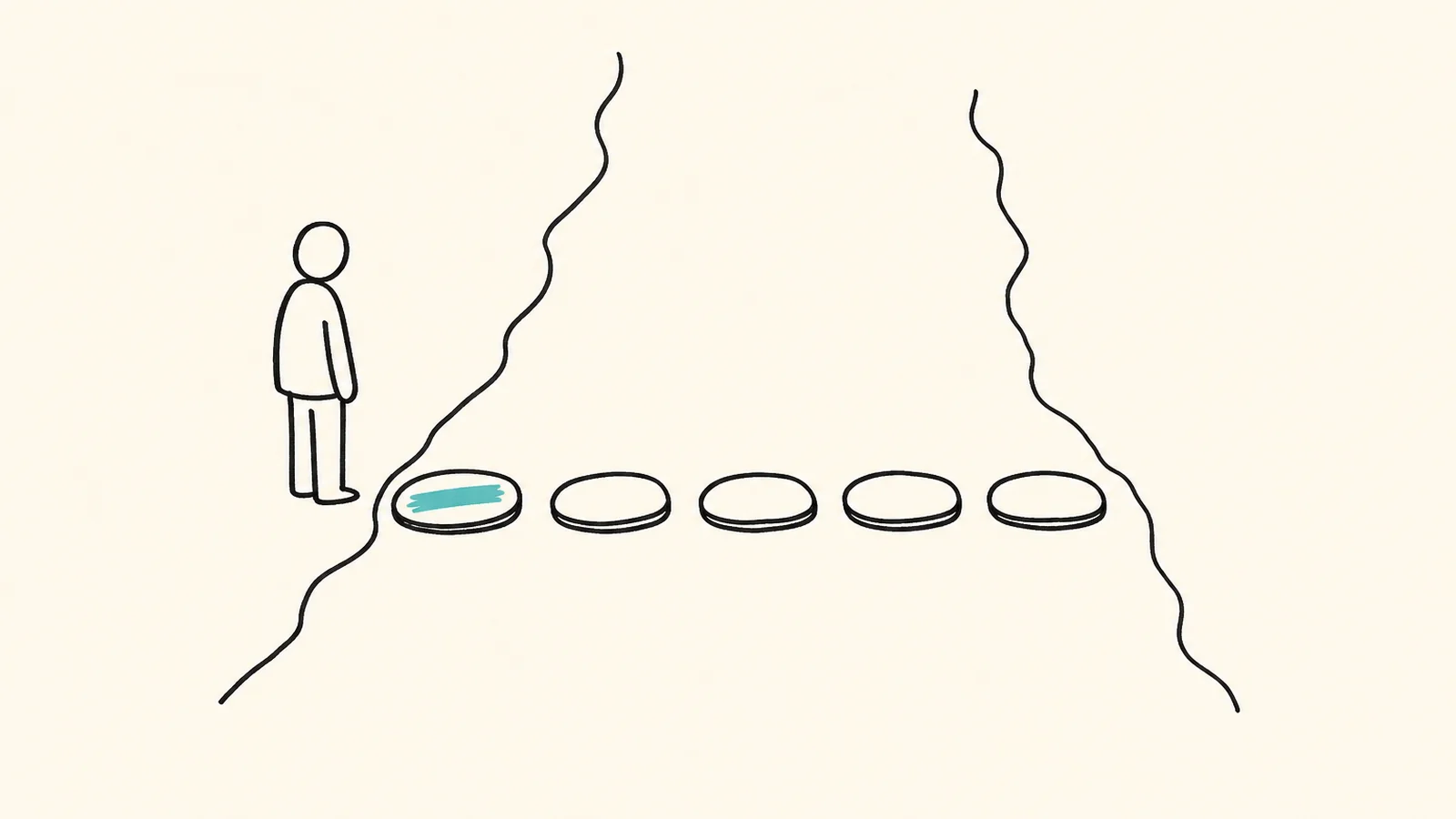
Fear is paralyzing because freezing is a defensive brake: the body holds still, heart slowing, while it takes in information and gets ready to act. In a 2017 review, Karin Roelofs describes freezing as a brake on movement that serves perception and action preparation, not a passive state. In everyday fear the brake stays on because the threat is too vague to act on or to disprove. The way out has three parts. Turn the fear into a specific prediction, who does what and when, with a likelihood in percent. Say the feeling in plain words rather than arguing with it: in a 2012 study of people afraid of spiders, those who labeled their fear showed a lower body response a week later than those who reappraised or distracted. Then take the smallest step that could prove the prediction wrong, and do it before you feel ready: exposure research ends a step when the prediction is checked, not when the fear fades.
On this page+
Fear is paralyzing because freezing is a brake: the body holds still while it works out whether to act. In everyday fear the brake stays on, because the threat is too vague to act on. Name the exact outcome you fear, say the feeling in plain words, and take the smallest step that tests that prediction.
You probably know what you need to do. Send the message, make the call, hand in the application, say the thing you have been rehearsing for a week. The draft is written. The number is saved. And every time you get close, something in you goes still, and you find yourself tidying the desk instead. This piece is about that stillness: why it happens, why settling your nerves alone rarely ends it, and one method that does.
When fear is paralyzing, what is it waiting for?
Fear is paralyzing because stopping is one of the oldest things fear does. Before an animal fights or runs, it often freezes, and people do the same. In a 2017 review, the neuroscientist Karin Roelofs describes freezing as a distinct defensive mode, with the heart slowing rather than racing, unlike fight or flight, where it speeds up1.
The key line in that review is that freezing "is not a passive state but rather a parasympathetic brake on the motor system, relevant to perception and action preparation." In other words, the freeze response is a pause for taking in information. The body stops so it can see better and get ready to move. Roelofs also notes that healthy coping depends on being able to shift out of freezing into action, and that the shift runs through connections between the front of the brain and the amygdala.
Here is our reading of what that means away from the lab. A freeze built for a few seconds in front of a predator is waiting for something: a sign of where the threat is and what to do about it. When the threat is an email to your manager, that sign never comes. The fear says "this could go badly" and nothing more, so the brake has nothing to release on. The pause that was meant to last seconds lasts a fortnight.
What does being paralyzed by fear look like?
Being paralyzed by fear rarely looks like standing rigid. Day to day, it looks like activity that goes everywhere except toward the one thing. You reopen the form, read it, close it. You research a decision long after you have enough to make it. You clean, answer other messages, reorganize a list, and feel exhausted at the end of a day in which the important thing did not move.
Some people describe the wider version as feeling emotionally paralyzed: flat, stuck, and unable to start anything, not just the frightening task. Others say "I feel paralyzed to do anything" about a whole area of their life, like job hunting or a conversation with family. In both cases the common thread is a known action and an unnamed fear sitting in front of it. That is the specific way fear is paralyzing: not by hiding the path, but by never saying what waits at the end of it.
It helps to tell fear paralysis apart from two states that feel similar, because each one moves for a different reason.
Stuck because...
It sounds like
What usually moves it
Fear of an outcome
"I know what to do, I just can't make myself do it"
If you are still choosing between options, the fear is probably doing something else: guessing the risks of the choice itself, which the risk guesses a hard choice makes covers in detail. This post is for when the choice is made and your body has not signed off on it.
What exactly are you afraid will happen?
The fastest way to loosen paralyzing fear is to make it say exactly what it predicts, because a vague fear cannot be acted on or proven wrong. Fear speaks in totals: "it will be a disaster", "they will think I'm a fraud", "everything will fall apart". Those sentences feel like information, but they contain no event you could watch for. Ask instead: who does what, when, and how bad would it be? "She reads my message and doesn't reply for three days." "The interviewer asks about the gap in my CV and I go blank." Then put a number on it: how likely, in percent, do you think that is?
Writing the prediction down does two things. It shrinks the fear from a fog to an event, and it gives you something to check. Most people find their first number is higher than they would defend out loud. Even when it is not, a named outcome lets you plan for it, which "disaster" never does.
This is close to how exposure therapy works for anxiety. In a 2014 paper, Michelle Craske and colleagues describe building each exposure around the specific outcome a person expects, with a rating of how likely they think it is, and continuing until that expectation is violated2. They put it plainly: "the end of an exposure trial is determined by conditions that violate expectancies and not by fear reduction." The goal is to learn that the prediction was wrong, not to stop feeling afraid first. We are not describing therapy here, and if fear is running your life a clinician is the right person. But the principle travels well.
Should you talk yourself out of the fear or name it?
Name it. When fear is paralyzing, the instinct is to argue with it ("it'll be fine, they won't care"), but one experiment suggests that plainly putting the fear into words does more. In 2012, Katharina Kircanski, Matthew Lieberman and Michelle Craske worked with people afraid of spiders, who were repeatedly brought close to a live spider3. Each group handled the exposure differently.
Strategy during exposure
What they did
A week later, with a new spider
Affect labeling
Put their feelings into words
Lower skin conductance than every other group
Reappraisal
Reinterpreted the situation as less threatening
Higher skin conductance than the labeling group
Distraction
Turned their attention away from the spider
Approached slightly less than the labeling group
Exposure alone
Stayed with the spider, no strategy
Higher skin conductance than the labeling group
Two details matter. People who used more fear and anxiety words during exposure showed larger drops in their fear response. And the labeling group did not report feeling less afraid than anyone else: the change showed up in the body and in approach, not in how scared they said they were. The study covered one fear and one short course in a lab, so treat it as a direction rather than a rule.
In practice, the difference is between "it will be fine" and "I am afraid she will say no and I will feel stupid." The second sentence sounds worse. It is also the one that, in this study at least, left the body less reactive a week later.
How to overcome paralyzing fear, one step at a time
To overcome paralyzing fear, settle your body enough to think, name the feeling, write the prediction, and take the smallest step that tests it. Each part takes a few minutes, and the order matters.
Settle the body first, if you need to. A few slow breaths or a short walk will not end the freeze, but they can get you to where you can hold a pen. The breathing and grounding the health sites recommend are useful here, as a first step rather than the whole plan.
Say the feeling in plain words. "I am afraid that..." and finish the sentence. Do not soften it.
Write the prediction. Who does what, when, and how bad. Then a percent for how likely it is.
Find the smallest step that tests it. Not the smallest step that feels safe. If the fear is "they will ignore me", rereading the draft tests nothing; sending a two-line version does.
Do it before the fear drops. Waiting to feel ready is waiting for the brake to release itself, and it was waiting for you.
Write what happened next to the prediction. Same page, same line. This is the part people skip, and it is the part that teaches.
Fear holds you still until it learns something. Give it a prediction it can check.
The hard part alone is the third step, because when fear is paralyzing it resists being pinned down, and you will drift back to "it'll be bad" without noticing. That is the kind of work Inwitt AI is built around. The AI thinking partner app asks one question at a time ("what exactly happens next?", "how likely is that?") and puts your answers on the thinking board, so the prediction sits in front of you in your own words. It does not tell you whether to send the message. It asks until you can see what you are actually afraid of.
What only feels like it helps
When fear is paralyzing, some habits feel like progress and keep the brake on.
Waiting until you feel ready. Readiness tends to arrive after the first step, not before it. The exposure research is explicit that a step should end when the prediction is checked, not when the fear fades.
Asking for reassurance. "It'll be fine" from a friend works for an hour. Craske and colleagues note that safety signals ease distress in the short term, and that when they are gone, the fear returns (they add that newer data are mixed). Reassurance borrows relief without testing anything.
Over-preparing. A fourth draft, one more practice run, another article on the subject. Preparation is real until it becomes a way to stay near the task without touching it.
Picking a step so small it tests nothing. Opening the email does not test whether they will reply. The step has to be able to prove the prediction wrong.
Distracting yourself all day. It lifts the mood and leaves the prediction untouched, so the fear is waiting exactly where you left it.
Calling it laziness. Lazy people do not lie awake rehearsing a phone call. Treating the freeze as a character flaw adds shame to fear, and shame freezes harder.
Questions people ask about paralyzing fear
Is fear paralysis the same as the freeze response?
They are closely related. The freeze response is the body's short defensive pause, with the heart slowing and movement stopping while you take in the situation. What people call fear paralysis in daily life is usually a long, low version of it: a freeze that never got the information it was waiting for.
Why do I freeze before something I actually want?
Because wanting it raises the stakes. Fear of failure attaches most strongly to things that matter, like the job you want or the person you like, and often what freezes you is the picture of having tried and lost. Fear of regret has two parts, and only one of them is out of your hands.
Is feeling emotionally paralyzed a sign of something more serious?
Sometimes. Feeling stuck in front of one hard task is ordinary. Feeling emotionally paralyzed across most of your life for weeks, with changes in sleep, appetite or mood, or with panic attacks, can be part of depression, an anxiety disorder or the after-effects of trauma, and is worth raising with a doctor or therapist.
Can paralyzing fear go away on its own?
Sometimes the situation passes and the fear goes with it. When it is attached to something you still need to do, avoidance tends to keep it in place, because each day you do not act is another day the prediction goes untested.
When fear is paralyzing, the way out is usually smaller and more specific than it feels: one sentence about what you are afraid of, one number, one step that could prove it wrong. A session works the same way: one question at a time, your answers on the board, and a receipt at the end with what you decided and when you will do it, in your own words. If there is a message you have been not sending for a week, join the Inwitt waitlist and bring it with you.
Footnotes
Karin Roelofs, "Freeze for action: neurobiological mechanisms in animal and human freezing", Philosophical Transactions of the Royal Society B 372(1718), 20160206 (2017). Journal record↩
Michelle G. Craske, Michael Treanor, Christopher C. Conway, Tomislav Zbozinek and Bram Vervliet, "Maximizing exposure therapy: an inhibitory learning approach", Behaviour Research and Therapy 58, 10-23 (2014). Journal record↩
Katharina Kircanski, Matthew D. Lieberman and Michelle G. Craske, "Feelings into words: contributions of language to exposure therapy", Psychological Science 23(10), 1086-1091 (2012). Journal record↩