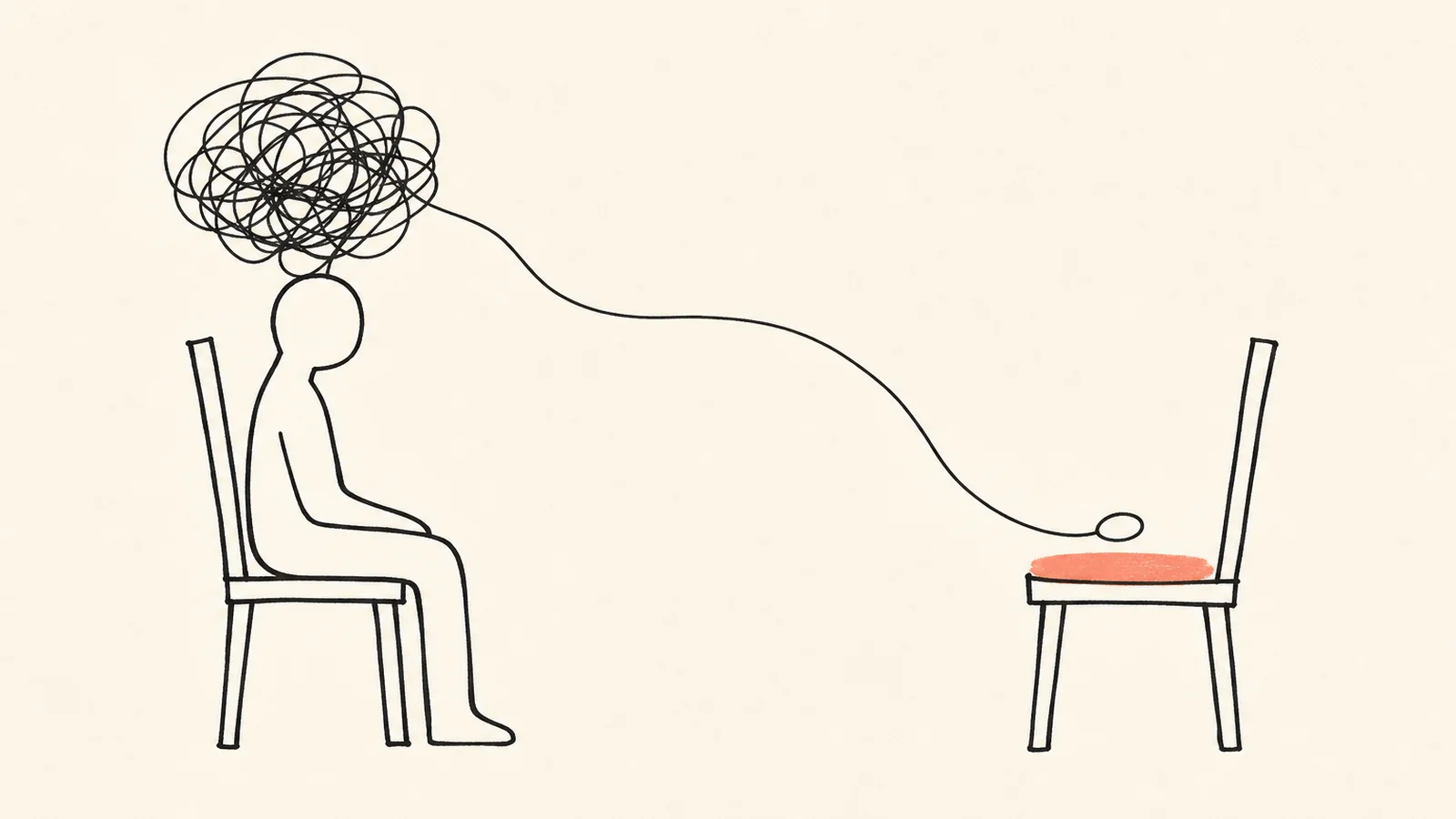
Learning how to quiet your mind means sorting the noise rather than chasing silence, which minds do not do: in Wilson and colleagues' 2014 studies, most people found 6 to 15 minutes alone with their thoughts hard, and some chose an electric shock over sitting still. A busy mind is usually three things. A revved-up body comes down through a long exhale; in a 2023 Stanford trial, five minutes a day of cyclic sighing lifted mood and slowed breathing more than mindfulness meditation. Tomorrow's rehearsed tasks go quiet once written down; in a 2018 sleep-lab study, a specific bedtime to-do list cut the time to fall asleep from about 25 minutes to 16. The inner voice, the loudest part, quiets with distance: Kross's 2014 studies found that talking to yourself by name or as "you" rather than "I" lowered distress and rumination. The last step is to turn its statements into questions you can answer, the way you would answer a friend.
On this page+
Learning how to quiet your mind starts with working out what the noise is made of, then turning down that part. A revved-up body needs a long exhale. Tomorrow's list needs paper. The inner voice, usually the loudest part, needs distance: talk to it as "you", by your own name, and ask it a question instead of letting it narrate.
It is 11 p.m., or the middle of a meeting, and something in your head will not stop talking. It replays what you said, rehearses what you have to do, and comments on all of it. You have tried telling it to stop, and you have tried a podcast loud enough to cover it. Most advice on how to quiet your mind hands you seventeen techniques at the same volume, with no way to tell which one fits the noise you actually have.
We sort the noise first. We have watched a lot of people arrive at a session with a loud mind, and it is rarely one thing. It is usually a body that has not come down, a list being rehearsed, and a voice talking to itself in the first person. Each has its own off switch, and the third is the one most advice leaves out.
Can you actually quiet your mind?
Not to silence, and you do not need to. A mind with nothing to do does not go still; it wanders, and most people find that unpleasant. In 2014 Timothy Wilson, Daniel Gilbert and colleagues ran eleven studies in which people sat alone for 6 to 15 minutes with nothing to do but think. Most found it hard: 57.5% said concentrating was difficult and 89% said their mind wandered. When people tried the same thing at home, about a third admitted cheating by reaching for something to do.
In the study everyone remembers, 67% of men and 25% of women gave themselves at least one electric shock during 15 minutes alone, a shock they had said earlier they would pay to avoid. The authors put it plainly: "the untutored mind does not like to be alone with itself."
So a quiet mind is not an empty one. It is a mind whose thoughts come and go without grabbing you. That is a target you can hit, and it changes the method. Instead of trying to stop thinking, you deal with the particular thoughts that hold on, and any honest answer to how to quiet your mind has to start there.
What is a busy mind actually made of?
Usually three things at once: a body that is still revved up, a list being rehearsed, and a voice commenting in the first person. From the inside they blur into a single noise, which is why one technique rarely clears a busy mind. Pull them apart and how to quiet your mind becomes three smaller questions, each with its own fix.
The noise
What it sounds like
What turns it down
What it cannot do
A revved-up body
Fast breath, tight chest, thoughts arriving in a rush
A long, slow exhale for five minutes
Settle anything you still have to do or decide
The rehearsal
"Reply to the landlord, book the car, the form is due Friday"
A specific to-do list on paper
Quiet a thought that is about you rather than a task
The inner voice
"I always do this", "I should have said", "I'm going to blow it"
Distance: your name, "you", and a question
Settle a body that is still running fast
The first two have good, simple fixes, so we keep them short. The third is the one that keeps people awake, and it is where most advice for a loud mind stops at "observe your thoughts" without saying what comes next. If what is looping is none of these but an unmade decision or a question only someone else can answer, the four kinds of loop and the paper door are the better tool.
How do you settle your mind in five minutes?
Breathe out for longer than you breathe in, for five minutes. In a 2023 trial at Stanford, Melis Yilmaz Balban and colleagues randomly assigned 108 people to five minutes a day, for a month, of one of three breathing patterns or of mindfulness meditation.2 The pattern called cyclic sighing did best:
Breathe in slowly through your nose.
When your lungs feel full, take one more short sip of air on top.
Let it all out slowly through your mouth, taking longer than the inhale took.
Repeat for five minutes.
Compared with meditation, cyclic sighing produced a bigger daily lift in positive mood and a bigger drop in breathing rate. Anxiety fell in every group by similar amounts, so this is not evidence that breathing beats meditation for worry. It is evidence that a revved-up body comes down quickly through the exhale. The trial was small and remote, with people reporting their own practice, so treat it as promising rather than settled.
Mindfulness does a different job with overthinking: it changes how hard a thought grips. The exhale only changes the body the thought is running in. That is often enough to make the next step possible.
How to quiet your mind at night
Write tomorrow's to-do list before bed, and make it specific. In a 2018 sleep-lab study, Michael Scullin and colleagues asked 57 young adults to spend five minutes before lights out writing either everything they had to do in the next few days or everything they had already done.3 Measured by brain activity, the to-do group fell asleep in about 16 minutes; the completed-list group took about 25. The more specific the list, the faster its writer fell asleep, while writing about finished tasks did not help.
That fits what keeps a mind busy at night. The day's rehearsal arrives when nothing else is competing for attention, and a written list tells the mind it no longer has to hold the items. Vague entries ("sort out work") do not count. "Reply to the landlord about the lease by noon" does.
If what keeps you up is a worry rather than a task, a list will not hold it. That kind of thought needs an appointment, which worry postponement gives it. To quiet your mind at night, then: list the tasks, and give the worries a time tomorrow.
How do you quiet the inner voice?
Change who it is talking to. The inner voice is loud because it narrates in the first person, to no one: "I always ruin this", "I should have said something". Speak to yourself the way you would speak to a friend, by name or as "you", and the same thought loses much of its charge. That is not a mantra. It has been tested.
In 2014 Ethan Kross and colleagues ran seven studies with 585 people.4 Before stressful tasks such as giving a speech or making a first impression, some reflected on their feelings using "I" and others using their own name or "you". The second group showed less distress, performed better according to independent raters, ruminated less afterwards, and saw the coming task as a challenge rather than a threat. The effect held for people high in social anxiety too. Kross calls this distanced self-talk, and it is the best-tested answer to mental chatter we know of.
A second study shows why it works. Igor Grossmann and Kross found, across three experiments with 693 people, that we reason more wisely about a friend's problem than about our own: we see the limits of what we know, consider other people's views and allow for things to change.5 When people took a distanced view of their own problem, the gap disappeared. It is the same reason thinking skills tend to stay where they were learned: you are sharp about other people's lives and blunt about yours, until something carries the question across.
The step we add, from watching sessions, is the question. The loudest sentences in a busy mind are statements about the self, and a statement cannot be answered, so it repeats. Turned into a question addressed to you by name, the same sentence becomes something you can answer, the way you would answer a friend. This is the part of how to quiet your mind that the lists skip.
The monologue
The same thought, asked from across the table
I always mess up interviews.
Sam, which part of the last interview actually went wrong?
I should have said something.
What would you have said, and can you still say it?
I'm going to fail at this.
What would you tell a friend who said that about this project?
Why am I like this?
When did you last not do this, and what was different?
The voice in your head is loud because it is talking to no one. Give it someone to answer.
That exercise is a session in miniature. Inwitt AI is an AI thinking partner app built on the same move: it asks one question at a time, from outside your head, and writes your answers onto a thinking board where you can look at them. It does not answer for you or tell you what to think. The voice finally has someone to talk to, and you do the answering.
What only feels like a quiet mind?
Five things pass for quiet and leave the noise where it was.
Trying to empty your mind. A blank mind is not on offer, as Wilson's studies showed, and pushing a thought away mostly rehearses it. Aim for thoughts that pass, not for no thoughts.
Drowning it out. A podcast, a feed, a show at double speed. It works while it plays, which is the problem. Wilson's participants reached for almost anything rather than sit with their own thoughts, and the thought is still waiting when the noise stops. Distraction is fine for an evening; as a habit, it means the voice never gets answered.
A brain dump that stays vague. Writing helps when it is specific. "Work stuff" on a page is the same fog in ink, and in Scullin's study it was specificity that went with falling asleep faster.
Asking for reassurance. Someone telling you it will be fine quiets the voice for an hour. It comes back because their confidence is not your answer. Ask yourself the question a friend would ask and the answer you get is one you can keep.
Calming a decision. Some noise is not noise. If the same choice has been running for weeks, no breath or list will settle it, because the mind is waiting for a decision. Give it a stopping rule instead of more analysis.
Questions people ask about a quiet mind
Why can't I quiet my mind?
Usually because you are using one tool on three kinds of noise, or aiming for silence, which minds do not do. Check which part is loud: the body, the list or the voice. If one decision is behind most of it, the noise will last until it is made, because not deciding is a choice that keeps reopening.
Is a racing mind a sign of ADHD or anxiety?
It can be part of either, and it is also common in people with neither. Racing thoughts that come with a constant sense of threat, months of poor sleep, or thoughts that frighten you are worth taking to a doctor or psychologist; the methods here are not treatment. A mind that is loud mostly at night, about tasks and things you said, is the ordinary kind.
How do you quiet your mind for meditation?
You do not have to before you start, because noticing the noise is the practice. If it is too loud to sit with, do two minutes of cyclic sighing first, then begin. Bringing the body down first makes the thoughts easier to watch.
What is the fastest way to clear your mind?
For the next few minutes, a long exhale: in, top up, out slowly, repeated. For the next few hours, a specific written list of what is pending. Neither settles a thought that keeps coming back; that one needs a question.
How to quiet your mind, in the end, is less about silence than about giving each kind of noise somewhere to go: the breath for the body, paper for the list, a question for the voice. The last one is easiest with someone across the table asking it. A session with a thinking partner does that, one question at a time, and leaves you a board of your own answers; your first session shows what that looks like. If you would rather start with a pen tonight, the exercise above is enough. If you want the questions asked for you, join the Inwitt waitlist.
Footnotes
Wilson, T. D., Reinhard, D. A., Westgate, E. C., Gilbert, D. T., Ellerbeck, N., Hahn, C., Brown, C. L. and Shaked, A. (2014). Just think: The challenges of the disengaged mind. Science, 345(6192), 75-77. https://pmc.ncbi.nlm.nih.gov/articles/PMC4330241/↩
Balban, M. Y., Neri, E., Kogon, M. M., Weed, L., Nouriani, B., Jo, B., Holl, G., Zeitzer, J. M., Spiegel, D. and Huberman, A. D. (2023). Brief structured respiration practices enhance mood and reduce physiological arousal. Cell Reports Medicine, 4(1), 100895. https://pmc.ncbi.nlm.nih.gov/articles/PMC9873947/↩
Scullin, M. K., Krueger, M. L., Ballard, H. K., Pruett, N. and Bliwise, D. L. (2018). The effects of bedtime writing on difficulty falling asleep: A polysomnographic study comparing to-do lists and completed activity lists. Journal of Experimental Psychology: General, 147(1), 139-146. https://pmc.ncbi.nlm.nih.gov/articles/PMC5758411/↩
Kross, E., Bruehlman-Senecal, E., Park, J., Burson, A., Dougherty, A., Shablack, H., Bremner, R., Moser, J. and Ayduk, O. (2014). Self-talk as a regulatory mechanism: How you do it matters. Journal of Personality and Social Psychology, 106(2), 304-324. https://pubmed.ncbi.nlm.nih.gov/24467424/↩
Grossmann, I. and Kross, E. (2014). Exploring Solomon's paradox: Self-distancing eliminates the self-other asymmetry in wise reasoning about close relationships in younger and older adults. Psychological Science, 25(8), 1571-1580. https://pubmed.ncbi.nlm.nih.gov/24916084/↩